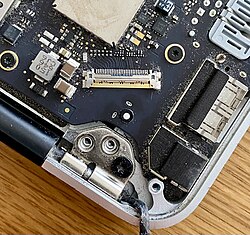
A liquid contact indicator (LCI) is a small device that turns from white into another color, typically red, after contact with water.
These indicators have small adhesives that can be placed on several points, usually near points of egress for liquid1, within electronic devices such as laptops and smartphones. This allows service technicians to determine if water damage could have caused damage to the device, allowing them to repair it easier, and/or determine if the device is covered under warranty, as some device's warranties do not cover water damage.
Liquid contact indicators are also known by other names such as water damage tape or sticker, water contact indicator tape, or liquid submersion indicator.

Purpose
The main purpose of the liquid contact indicator is to have a lead to the cause of a defect in electronic devices. The manufacturer may not conduct a repair under warranty for a device with an activated LCI.2 Still there can be reasons for doubt.
- Longer, but not extreme exposure of a device in a humid environment, can trigger a LCI.1
- Water can reach the LCI(s), but the electronics around it are unaffected
So, a liquid contact indicator can be triggered, without pointing to liquids causing a defect, with other signs like rust, burn marks or liquid residue being used to confirm the liquid damage1
Forgery
In the simplest form, liquid contact indicators are good for a first lead to the cause of defects. LCIs can be replaced and are readily available in online electronic stores. But the other interest, use in warranty claims, make them prone to potential misuse. Therefore, manufacturers introduced LCIs that are harder to reproduce, even with small holographic details.
Some LCIs are only visible under Ultraviolet frequencies, making it harder for a would-be forger to detect and replace triggered LCIs.1
Placement
Liquid contact indicators are placed on several places in electronic devices, usually near possible points of entry for liquids, like near Computer ports, SD card or SIM card slots. Sometimes the liquid contact indicators are placed in such a way that they can be inspected from the outside. For instance there is an LCI in the SIM-card slot of Apple iPhones and in the dock connectors and headphone jacks of iPods made since 2006.2 In a Samsung Galaxy smartphone there is a LCI underneath the battery cover near the battery contacts.
References
References
- "How to Read Liquid Contact Indicators". iFixit. Retrieved 24 June 2026.
- "Water and other liquid damage to your iPhone or iPod isn't covered by warranty – Apple Support (UK)". Apple Support. Retrieved 15 July 2024.