Liloan | |
|---|---|
| Municipality of Liloan | |
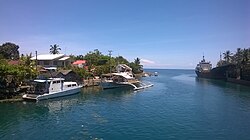 From Suba bridge | |
 Seal | |
| Etymology: Cebuano term lilo, meaning whirlpool | |
 Map of Cebu with Liloan highlighted | |
 Interactive map of Liloan | |
Liloan Location within the Philippines | |
| Coordinates: 10°24′40″N 123°58′56″E / 10.41111°N 123.98222°E / 10.41111; 123.98222 | |
| Country | Philippines |
| Region | Central Visayas |
| Province | Cebu |
| District | 5th district |
| Founded | 1845 |
| Barangays | 14 (see Barangays) |
| Government | |
| • Type | Sangguniang Bayan |
| • Mayor | Aljew Fernando J. Frasco |
| • Vice Mayor | Margarita D. Frasco |
| • Representative | Vincent Franco D. Frasco |
| • Municipal Council | Members
|
| • Electorate | 87,305 voters (2025) |
| Area | |
• Total | 45.92 km2 (17.73 sq mi) |
| Elevation | 20 m (66 ft) |
| Highest elevation | 231 m (758 ft) |
| Lowest elevation | 0 m (0 ft) |
| Population (2024 census)3 | |
• Total | 158,387 |
| • Density | 3,449/km2 (8,933/sq mi) |
| • Households | 37,390 |
| Economy | |
| • Income class | 1st municipal income class |
| • Poverty incidence | 18.81 |
| • Revenue | ₱ 635 million (2024) |
| • Assets | ₱ 1,404 million (2024) |
| • Expenditure | ₱ 417.4 million (2024) |
| • Liabilities | ₱ 423.3 million (2024) |
| Service provider | |
| • Electricity | Visayan Electric Company (VECO) |
| • Water | Metropolitan Cebu Water District (MCWD) |
| Time zone | UTC+8 (PST) |
| ZIP code | 6002 |
| PSGC | |
| IDD : area code | +63 (0)32 |
| Native languages | Cebuano Tagalog |
Liloan, officially the Municipality of Liloan (Cebuano: Lungsod sa Liloan; Tagalog: Bayan ng Liloan), is a municipality in the province of Cebu, Philippines. According to the 2024 census, it has a population of 158,387 people,5 making it the most populated municipality in Cebu and the whole Visayas. Liloan is known as the Light of North and the home of Titay's rosquillos. It serves as a gateway between Metro Cebu and the northern parts of Cebu.
History
Etymological History
Along its coastline, there is a spot called Silot, where a whirlpool is created by the ebbs and flows of the waters from the bay. This phenomenon is called lilo in Cebuano. Because of this, the town was known as Liloan, meaning "a place where there is a lilo". 6
The Creation of Liloan and Part in the History of Consolacion & Compostela
The creation of Liloan was officially on August 23,1844 from a superior decree making it officially separated from Mandaue 7, The Parish was instated in Liloan before the separation. It was officially instated as a parish on January 27, 1845 from a decree handed out by the Bishop of Cebu. The town's organized governance began around 1845, with Capitan Banlitan cited as the first "capitan municipal." Consolacion separated from Liloan and also received a supreme decree from the Bishop of Cebu for a parish to be created. Compostela merged with Liloan from Danao and later separated in 1919.8
Liloan during World War II
During the war years (World War II), Lilo‑an had three mayors at one time.9 a small Japanese Shipwreck was found and discovered in Silot Bay aswell. 10
Geography
Liloan is a rapidly developing coastal municipality bounded on the north by the town of Compostela, to the west by Cebu City, on the east by the Camotes Sea, and on the south by the town of Consolacion. It is 18 kilometres (11 mi) from Cebu City. Liloan lies within Metro Cebu. The municipality is characterized by a mixture of coastal plains, mangrove areas near Silot Bay and Mountainous Terrains as well as valleys present in Cotcot, Yati, and Tayud.
Barangays
Liloan is politically subdivided into 14 barangays. Each barangay consists of puroks and some have sitios.
| PSGC | Barangay | Population | ±% p.a. | |||
|---|---|---|---|---|---|---|
| 202411 | 201012 | |||||
| 072227001 | Cabadiangan | 1.3% | 1,982 | 1,790 | ▴ | 0.72% |
| 072227002 | Calero | 3.4% | 5,315 | 4,513 | ▴ | 1.17% |
| 072227003 | Catarman | 10.0% | 15,829 | 14,839 | ▴ | 0.46% |
| 072227004 | Cotcot | 4.3% | 6,796 | 5,185 | ▴ | 1.94% |
| 072227005 | Jubay | 7.5% | 11,931 | 8,819 | ▴ | 2.17% |
| 072227006 | Lataban | 1.4% | 2,245 | 1,863 | ▴ | 1.33% |
| 072227007 | Mulao | 0.7% | 1,067 | 952 | ▴ | 0.81% |
| 072227008 | Poblacion | 9.5% | 15,041 | 13,371 | ▴ | 0.84% |
| 072227009 | San Roque | 1.0% | 1,521 | 1,331 | ▴ | 0.95% |
| 072227010 | San Vicente | 6.5% | 10,219 | 8,665 | ▴ | 1.18% |
| 072227011 | Santa Cruz | 1.4% | 2,203 | 1,899 | ▴ | 1.06% |
| 072227012 | Tabla | 0.9% | 1,423 | 1,189 | ▴ | 1.28% |
| 072227013 | Tayud | 10.0% | 15,814 | 13,616 | ▴ | 1.07% |
| 072227014 | Yati | 17.3% | 27,367 | 22,468 | ▴ | 1.41% |
| Total | 158,387 | 100,500 | ▴ | 3.28% | ||
Climate
| Climate data for Liloan, Cebu | |||||||||||||
|---|---|---|---|---|---|---|---|---|---|---|---|---|---|
| Month | Jan | Feb | Mar | Apr | May | Jun | Jul | Aug | Sep | Oct | Nov | Dec | Year |
| Mean daily maximum °C (°F) | 28 (82) |
29 (84) |
30 (86) |
31 (88) |
31 (88) |
30 (86) |
30 (86) |
30 (86) |
30 (86) |
29 (84) |
29 (84) |
28 (82) |
30 (85) |
| Mean daily minimum °C (°F) | 23 (73) |
23 (73) |
23 (73) |
24 (75) |
25 (77) |
25 (77) |
25 (77) |
25 (77) |
25 (77) |
25 (77) |
24 (75) |
23 (73) |
24 (75) |
| Average precipitation mm (inches) | 70 (2.8) |
49 (1.9) |
62 (2.4) |
78 (3.1) |
138 (5.4) |
201 (7.9) |
192 (7.6) |
185 (7.3) |
192 (7.6) |
205 (8.1) |
156 (6.1) |
111 (4.4) |
1,639 (64.6) |
| Average rainy days | 13.4 | 10.6 | 13.1 | 14.5 | 24.2 | 27.9 | 28.4 | 27.7 | 27.1 | 27.4 | 22.5 | 15.9 | 252.7 |
| Source: Meteoblue13 | |||||||||||||
Demographics
| Year | Pop. | ±% p.a. |
|---|---|---|
| 1903 | 10,024 | — |
| 1918 | 19,842 | +4.66% |
| 1939 | 13,662 | −1.76% |
| 1948 | 12,292 | −1.17% |
| 1960 | 16,424 | +2.44% |
| 1970 | 22,495 | +3.19% |
| 1975 | 26,492 | +3.33% |
| 1980 | 30,196 | +2.65% |
| 1990 | 42,587 | +3.50% |
| 1995 | 50,973 | +3.43% |
| 2000 | 64,970 | +5.34% |
| 2007 | 92,606 | +5.01% |
| 2010 | 100,500 | +3.02% |
| 2015 | 118,753 | +3.23% |
| 2020 | 153,197 | +5.51% |
| 2024 | 158,387 | +0.80% |
| Source: Philippine Statistics Authority1415121617 | ||
Economy
Poverty incidence of Liloan
28.37
9.91
22.00
17.95
10.54
14.66
7.20
18.81
Source: Philippine Statistics Authority1819202122232425
Landmarks

Lighthouse
The lighthouse at Bagacay Point was built in 1857 by the Spanish. The current tower was constructed in 1904 by order of William Howard Taft,26 the first Governor-General of the Philippines and later the President of the United States. The tower is 22 metres (72 ft) tall and remains in active use today, using solar energy.27 The lighthouse was declared a National Historical Landmark in 2004 by the National Historical Commission of the Philippines (formerly known as National Historical Institute).28
Pier 88

Pier 88 is a maritime terminal in Liloan that connects the islands of the Central Visayas region: Camotes, LapuLapu City and Cebu City. The Pier was officially inaugurated and opened to the public on May 27, 2023, by Bongbong Marcos.29
Titay's Rosquillos and Delicacies


Titay's Rosquillos and Delicacies is a baking company started in Liloan in 1907, baking foods like rosquillos, tablea and hojaldres. In 2012, its two-hectare plant in Liloan produced about 3,000 packs of 180 grams Rosquillos daily by 118 workers.3031
In 2013, the flagship store, which produces 360,000 rosquillos a day was transformed into a café for 45 customers serving penato (peanuts), banana chips, and binangkal, among others.32
On April 1, 2024, Christina Frasco, with members of her family, partook in the groundbreaking of its Poblacion, Liloan 1.3-hectare new factory which will employ to 250 workers.33
Tourism
Rosquillos Festival
Celebrated every last week of May in honor of the town's patron saint, St. Ferdinand III. It celebrates the Rosquillos as the delicacy of Liloan and of Cebu. The 12th Rosquillos festival was held in May 26, 2019. The 13th returned from May 20–30, 2023, coinciding with the 176th annual foundation fiesta celebration.343536

List of heads of local government
- Basilio Bantilan (1845–1846)
- Hipolito Pepito (1846–1847)
- Francisco Cabahug (1847–1848 and 1859–1860)
- Esteban Cañete (1848–1849, 1850–1851 and 1852–1853)
- Juan Delgado (1849–1850)
- Juan Cabatingan (1851–1852 and 1861–1862)
- Cruz Medoza (1853–1855 and 1860–1861)
- Alberto Yungco (1855–1857)
- Victor Pepito (1857–1858, 1863–1865 and 1875–1879)
- Pedro Pepito (1858–1859 and 1862–1863)
- Felix Cabatingan (1865–1867)
- Jacinto Cañete (1867–1869)
- Apolonio Pilapil (1869–1871)
- Custodio Mendoza (1871–1873, 1883–1885 and 1899–1900)
- Guillermo Pepito (1873–1875)
- Ambrosio Pepito (1879–1881)
- Eugenio Pilapil (1881–1883 and 1889–1891)
- Mamerto Cabatingan (1883–1887 and 1891–1893)
- Sotero Cabatingan (1887–1889, 1900–1902 and 1905–1909)
- Antonio Villamor (1893–1896)
- Simeon Pilapil (1896–1898)
- Mariano Pilapil (1898–1899)
- Blas Cabatingan (1902–1904)
- Marcelo Pilapil (1909–1911)
- Francisco Ramas (1911–1912)
- Jose Cabatingan (1912–1916)
- Cirilo Ramas (1916–1919)
- Cipiriano Jumapao (1919–1922)
- Florintino Pilapil (1922–1925)
- Santiago Noval (1925–1928)
- Lazaro Ramas (1928–1937, 1937–1938, 1959–1963 and 1963–1965)
- Catalino Noval (1941–1945, 1945–1946 and 1965–1967)
- Jorge Pitogo (1946–1947 and 1947–1951)
- Fabian Cañete (1951–1955)
- Teofilo Ponce (1967–1971)
- Cesar Bugtai (1971–1986)
- Achilles Cañete (1986–1988 and 1988–1992)
- Panphil Frasco (1992–1995, 1995–1998 and 1998–2001)
- Maria Sevilla (2001–2004 and 2004–2007)
- Duke Frasco (2007–2016)
- Christina Garcia-Frasco (2016–2022)
- Aljew Frasco (2022–present)
Gallery
-
 Miniature Lighthouse Sculpture at the Main Crossroad
 -
 San Fernando Rey Church
 -
 From Suba Bridge
 -
 Looking towards Compostela
 -
 Bagacay Lighthouse – Plaque
 -
 Bagacay Lighthouse
Notable people
- Pilar Pilapil - Actress
- Christina Frasco - Former mayor, and former DOT Secretary 2022 - 2026
See also
See also
- Liloan, Southern Leyte - a municipality in Southern Leyte
- Liloan - a barangay in Santander, Cebu
Notes
Notes
References
References
- Municipality of Liloan | (DILG)
- "2015 Census of Population, Report No. 3 – Population, Land Area, and Population Density" (PDF). Philippine Statistics Authority. Quezon City, Philippines. August 2016. ISSN 0117-1453. Archived (PDF) from the original on May 25, 2021. Retrieved July 16, 2021.
- "2024 Census of Population (POPCEN) Population Counts Declared Official by the President". Philippine Statistics Authority. July 17, 2025. Retrieved July 18, 2025.
- "PSA Releases the 2021 City and Municipal Level Poverty Estimates". Philippine Statistics Authority. April 2, 2024. Retrieved April 28, 2024.
- "2024 Census of Population (POPCEN) Population Counts Declared Official by the President". Philippine Statistics Authority. July 17, 2025. Retrieved July 18, 2025.
- Liloan Documentation about the History of Liloan Liloan Government explanation of the Etymology
- Scribe Presentation of the History of Liloan, Cebu Presentation and Document explaining the History of Liloan
- Presentation for the History of Compostela / Document explaining the History of Compostela & Involvement with Liloan
- Oaminal, Clarence Paul. "Liloan, Cebu 1967 elections". Philstar.com. Retrieved November 10, 2025. Document explaining the History of Liloan
- Facebook - The Japanese Armored boat lies in capsized in the swamp of Silot Lagoon,Liloan Cebu P.I. April 4, 1945. Source: US Signal Corps and National Archives and Record Administration. Retrieved May 2026
- Census of Population (2020). "Region VII (Central Visayas)". Total Population by Province, City, Municipality and Barangay. Philippine Statistics Authority. Retrieved July 8, 2021.
- Census of Population and Housing (2010). "Region VII (Central Visayas)" (PDF). Total Population by Province, City, Municipality and Barangay. National Statistics Office. Retrieved June 29, 2016.
- "Liloan: Average Temperatures and Rainfall". Meteoblue. Retrieved May 10, 2020.
- "2024 Census of Population (POPCEN) Population Counts Declared Official by the President". Philippine Statistics Authority. July 17, 2025. Retrieved July 18, 2025.
- Census of Population (2015). "Region VII (Central Visayas)". Total Population by Province, City, Municipality and Barangay. Philippine Statistics Authority. Retrieved June 20, 2016.
- Censuses of Population (1903–2007). "Region VII (Central Visayas)". Table 1. Population Enumerated in Various Censuses by Province/Highly Urbanized City: 1903 to 2007. National Statistics Office.
- "Province of Cebu". Municipality Population Data. Local Water Utilities Administration Research Division. Retrieved December 17, 2016.
- "Poverty incidence (PI):". Philippine Statistics Authority. Retrieved December 28, 2020.
- "Estimation of Local Poverty in the Philippines" (PDF). Philippine Statistics Authority. November 29, 2005.
- "2003 City and Municipal Level Poverty Estimates" (PDF). Philippine Statistics Authority. March 23, 2009.
- "City and Municipal Level Poverty Estimates; 2006 and 2009" (PDF). Philippine Statistics Authority. August 3, 2012.
- "2012 Municipal and City Level Poverty Estimates" (PDF). Philippine Statistics Authority. May 31, 2016.
- "Municipal and City Level Small Area Poverty Estimates; 2009, 2012 and 2015". Philippine Statistics Authority. July 10, 2019.
- "PSA Releases the 2018 Municipal and City Level Poverty Estimates". Philippine Statistics Authority. December 15, 2021. Retrieved January 22, 2022.
- "PSA Releases the 2021 City and Municipal Level Poverty Estimates". Philippine Statistics Authority. April 2, 2024. Retrieved April 28, 2024.
- Philippines' Light to Get Makeover
- Bagacay Point Light
- Declaring of Bagacay Point Lighthouse in Liloan, Cebu a National Historical Landmark
- Cebu's Pier 88 boosts PH's global connectivity efforts --- PBBM
- Dagooc, Ehda (December 14, 2012). "Titay's to boost foothold in Phl delicacy market". The Philippine Star. Retrieved May 13, 2024.
- Garcia-Yap, Aileen (December 17, 2012). "How Titay's cookies became a pasalubong favorite". Philippine Daily Inquirer. Retrieved May 13, 2024.
- Cacho, Katlene (April 10, 2018). "Modern Titay's reopens in Liloan". SunStar. Retrieved May 13, 2024.
- Orellano, Christian (May 11, 2024). "Titay's Rosquillos Upgrades Facilities". Philippine Daily Inquirer. Retrieved May 13, 2024.
- Fuentes, Jan (January 26, 2024). "Liloan welcomes Suroy Suroy Sugbo". SunStar. Retrieved May 13, 2024.
- Cotejo, Honey (May 22, 2023). "Rosquillos Festival of Liloan returns on May 27". Retrieved May 13, 2024.
- "All set for Liloan's 'Rosquillos Festival'". SunStar. May 26, 2023. Retrieved May 13, 2024.
Sources
Sources
- Gonzales, Glenda R. (December 2004). "Metro Cebu: A Metropolitan Area in Need of Coordinative Body" (PDF). Discussion Paper. 2004-49. PIDS. Archived (PDF) from the original on March 10, 2016. Retrieved February 16, 2016.
- Sendino y Redondo, Felipe (1886). Breve reseña de lo que fue y de lo que es la Diócesis de Cebú en las Islas Filipinas (in Spanish). Manila: Colegio de Santo Tomas.