| Ligustrum vulgare | |
|---|---|
| |
Scientific classification 
| |
| Kingdom: | Plantae |
| Clade: | Embryophytes |
| Clade: | Tracheophytes |
| Clade: | Spermatophytes |
| Clade: | Angiosperms |
| Clade: | Eudicots |
| Clade: | Asterids |
| Order: | Lamiales |
| Family: | Oleaceae |
| Genus: | Ligustrum |
| Species: | L. vulgare
|
| Binomial name | |
| Ligustrum vulgare | |
| Synonyms1 | |
|
List
| |
Ligustrum vulgare (wild privet, also sometimes known as common privet or European privet) is a species of Ligustrum native to central and southern Europe, north Africa and southwestern Asia, from Ireland and southwestern Sweden south to Morocco, and east to Poland and northwestern Iran.23456
Description

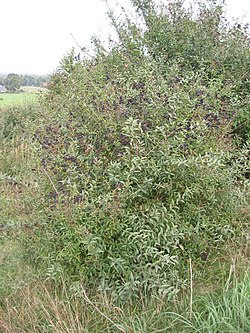
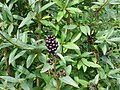
It is a semi-evergreen or deciduous shrub, growing to 3 m (rarely up to 5 m) tall. The stems are stiff, erect, with grey-brown bark spotted with small brown lenticels. The leaves are borne in decussate opposite pairs, sub-shiny green, narrow oval to lanceolate, 2–6 cm long and 0.5–1.5 cm broad. The flowers are produced in mid-summer in panicles 3–6 cm long, each flower creamy-white, with a tubular base and a four-lobed corolla ('petals') 4–6 mm diameter. The flowers produce a strong, pungent fragrance that many people find unpleasant.7 The fruit is a small glossy black berry 6–8 mm diameter, containing one to four seeds. The berries are poisonous to humans but readily eaten by thrushes, which disperse the seeds in their droppings.568
Plants from the warmer parts of the range show a stronger tendency to be fully evergreen; these have sometimes been treated as a separate variety Ligustrum vulgare var. italicum (Mill.) Vahl,6 but others do not regard it as distinct.2
Cultivation and uses
In the British Isles it is the only native privet, common in hedgerows and woodlands in southern England and Wales, especially in chalk areas; it is less common in northern England, Scotland, and Northern Ireland, where it only occurs as an escapee from cultivation.6910
The species was used for hedging in Elizabethan gardens in England, but was superseded by the more reliably evergreen introduction L. ovalifolium from Japan.9
A number of cultivars have been selected, including:6
- 'Aureum' – yellow leaves.
- 'Buxifolium' – small, oval leaves not over 2.5 cm long.
- 'Cheyenne' – cold-tolerant clone selected in North America.
- 'Chlorocarpum' - berries green.
- 'Insulense' – long, narrow leaves 5–11 cm long and 1–2.5 cm broad.
- 'Leucocarpum' – berries greenish-white.
- 'Lodense' – dense, dwarf shrub (the name is a portmanteau of 'low' and 'dense').
- 'Pyramidale' – fastigiate.
- 'Xanthocarpum' – berries yellow.
Invasiveness
The species is listed as invasive as an introduced plant in Australia,11 Canada,12 New Zealand,13 and the United States.1415 It is also fully naturalised in Mexico's highlands16 and Argentina.17
Etymology
Ligustrum means 'binder'. It was named by Pliny and Virgil.18
Gallery



References
References
- "Ligustrum vulgare L." Plants of the World Online. Royal Botanic Gardens, Kew. Retrieved 30 April 2025.
- Flora Europaea: Ligustrum vulgare
- "Ligustrum vulgare". Plants for a Future.
- "Ligustrum vulgare". Germplasm Resources Information Network. Agricultural Research Service, United States Department of Agriculture. Retrieved 17 December 2017.
- Blamey, M. & Grey-Wilson, C. (1989). Flora of Britain and Northern Europe. ISBN 0-340-40170-2
- Bean, W. J. (1978). Trees and Shrubs Hardy in the British Isles vol. 2: 576–577. ISBN 0-7195-2256-0.
- "Ligustrum vulgare (Common Privet)". Gardenia. Retrieved 2025-05-15.
- Flora of Northwest Europe: Ligustrum vulgare
- The Reader's Digest Field Guide to the Trees and Shrubs of Britain p. 52.
- Flora of Northern Ireland: Ligustrum vulgare
- Potential Environmental Weeds in Australia
- Canadian Botanical Conservation Network: Information on Invasive Shrub and Vine Species Archived 2007-08-27 at the Wayback Machine
- Protecting and Restoring our Natural Heritage: Appendix one: Invasive weeds Archived 2015-01-28 at the Wayback Machine
- Swearingen, Jil; Reshetiloff, K.; Slattery, B; Zwicker, S. (2010). Plant Invaders of Mid-Atlantic Natural Areas, 4th Edition (PDF). National Park Service and U.S. Fish & Wildlife Service. p. 71. Archived from the original (PDF) on October 7, 2006.
- Invasive species: European privet
- Plantas medicinales. Virtudes insospechadas de plantas conocidas. 1987. Reader's Digest México S.A. de C.V. Printed by Gráficas Monte Albán S.A. de C.V. Querétaro, Mexico. ISBN 968-28-0099-4
- "Gavier-Pizarro, Gregorio I.; Kuemmerle, Tobias; Hoyos, Laura E.; Stewart, Susan I.; Huebner, Cynthia D.; Keuler, Nicholas S.; Radeloff, Volker C. 2012. Monitoring the invasion of an exotic tree (Ligustrum lucidum) from 1983 to 2006 with Landsat TM/ETM+ satellite data and support vector machines in Cordoba, Argentina. Remote Sensing of Environment. 122: 134-145". Archived from the original on 2020-10-31. Retrieved 2014-04-27.
- Gledhill, David (2008). "The Names of Plants". Cambridge University Press. ISBN 9780521866453 (hardback), ISBN 9780521685535 (paperback). p 237