 | |
 | |
| Clinical data | |
|---|---|
| Other names | ACEA-1021 |
| ATC code |
|
| Identifiers | |
| |
| CAS Number | |
| PubChem CID | |
| ChemSpider | |
| UNII | |
| CompTox Dashboard (EPA) | |
| Chemical and physical data | |
| Formula | C8H3Cl2N3O4 |
| Molar mass | 276.03 g·mol−1 |
| 3D model (JSmol) | |
| |
| |
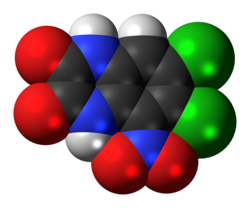
Licostinel (INN; development code ACEA-1021) is a competitive, silent antagonist of the glycine site of the NMDA receptor (Kb = 5 nM).123 It was under investigation by Acea Pharmaceuticals as a neuroprotective agent for the treatment of cerebral ischemia associated with stroke and head injuries but was ultimately never marketed.124 In clinical trials, licostinel did not produce phencyclidine-like psychotomimetic effects at the doses tested, though transient sedation, dizziness, and nausea were observed.45 In addition to its actions at the NMDA receptor, licostinel also acts as an antagonist of the AMPA and kainate receptors at high concentrations (Kb = 0.9 μM and 2.5 μM, respectively).3
References
References
- Small DL, Tauskela JS (31 January 2007). "Glutamate Receptor Pharmacology: Lessons Learned from the Last Decade of Stroke Trials". In Gill S, Pulido O (eds.). Glutamate Receptors in Peripheral Tissue: Excitatory Transmission Outside the CNS. Springer Science & Business Media. pp. 36–. ISBN 978-0-306-48644-9.
- Gusev EI, Skvortsova VI (30 April 2003). "Primary Neuroprotection". Brain Ischemia. Springer Science & Business Media. pp. 249–. ISBN 978-0-306-47694-5.
- Wilding TJ, Huettner JE (March 1996). "Antagonist pharmacology of kainate- and alpha-amino-3-hydroxy-5-methyl-4-isoxazolepropionic acid-preferring receptors". Molecular Pharmacology. 49 (3): 540–546. PMID 8643094.
- Boyce SG, Rupniak N (1 January 2002). "Behavioural studies on the potential of NMDA receptor antagonists as analgesics". In Sirinathsinghji DJ, Hill RG (eds.). NMDA Antagonists As Potential Analgesic Drugs. Springer Science & Business Media. pp. 151–. ISBN 978-3-7643-6011-5.
- Chizh BA, Headly PM (28 May 2013). "N-Methyl-D-Aspartate (NMDA) Receptors as Target for Pain Therapy". In Bountra C, Munglani R, Schmidt WK (eds.). Pain: Current Understanding, Emerging Therapies, and Novel Approaches to Drug Discovery. CRC Press. pp. 567–. ISBN 978-0-203-91125-9.