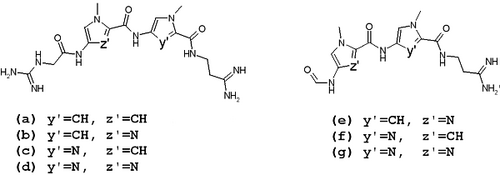
Lexitropsins are members of a family of semi-synthetic DNA-binding ligands.1 They are structural analogs of the natural antibiotics netropsin and distamycin. Antibiotics of this group can bind in the minor groove of DNA with different sequence-selectivity.23 Lexitropsins form a complexes with DNA with stoichiometry 1:1 and 2:1. Based on the 2:1 complexes were obtained ligands with high sequence-selectivity.4 This property is due to their selectivity towards AT-rich regions.5
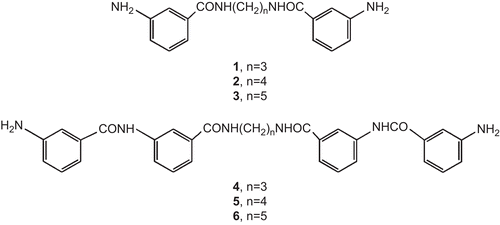
Recently, carbocyclic derivatives based on pentamidine were shown to exhibit in vivo antiproliferative effects on human breast cancer cells, possibly because of their ability to inhibit topoisomerase activity.758
See also
See also
References
References
- Sondhi S.M.; Praveen Reddy B.S.; Lown J.W. (1997). "Lexitropsin conjugates: Action on DNA targets". Current Medicinal Chemistry. 4 (5): 313–358. doi:10.2174/0929867304666220313122616. S2CID 247445486.
- Goodsell, D.S.; Ng, H.L.; Kopka, M.L.; Lown, J.W.; Dickerson, R.E. (1995). "Structure of a dicationic monoimidazole lexitropsin bound to DNA". Biochemistry. 34 (51): 16654–61. doi:10.1021/bi00051a013. PMID 8527438.
- Goodsell, D.S. (2001). "Sequence recognition of DNA by lexitropsins". Curr Med Chem. 8 (5): 509–16. doi:10.2174/0929867003373319. PMID 11281838.
- Kopka, M.L.; Goodsell, D.S.; Han, G. Won; Chiu, Th.K.; Lown, J.W.; Dickerson, R.E. (1997). "Defining GC-specificity in the minor groove: side-by-side binding of the di-imidazole lexitropsin to C-A-T-G-G-C-C-A-T-G". Structure. 5 (8): 1033–1046. doi:10.1016/s0969-2126(97)00255-4. PMID 9309219.
- Drozdowska, Danuta; Bruzgo, Irena; Midura-Nowaczek, Krystyna (2010-10-01). "Carbocyclic potential DNA minor groove binders and their biological evaluation". Journal of Enzyme Inhibition and Medicinal Chemistry. 25 (5): 629–634. doi:10.3109/14756360903389872. ISSN 1475-6366. PMID 20429779.
- Drozdowska, Danuta; Bruzgo, Irena; Midura-Nowaczek, Krystyna (2010-10-01). "Carbocyclic potential DNA minor groove binders and their biological evaluation". Journal of Enzyme Inhibition and Medicinal Chemistry. 25 (5): 629–634. doi:10.3109/14756360903389872. ISSN 1475-6366. PMID 20429779.
- Arciszewska, Karolina; Pućkowska, Anna; Wróbel, Agnieszka; Drozdowska, Danuta (2018-12-06). "Carbocyclic Analogues of Distamycin and Netropsin". Mini-Reviews in Medicinal Chemistry. 19 (2): 98–113. doi:10.2174/1389557518666181009143203. PMID 30626311.
- Drozdowska, Danuta; Rusak, Malgorzata; Miltyk, Wojciech; Midura-Nowaczek, Krystyna (2009). "Synthesis and Biological Evaluation of Distamycin Analogues – New Potential Anticancer Agents". Archiv der Pharmazie. 342 (2): 87–93. doi:10.1002/ardp.200800122. ISSN 1521-4184. PMID 19173336.