| Let the Bullets Fly | |
|---|---|
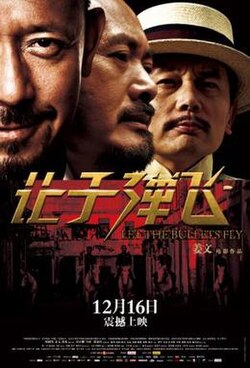 Theatrical release poster | |
| Traditional Chinese | 讓子彈飛 |
| Simplified Chinese | 让子弹飞 |
| Hanyu Pinyin | Ràng zǐ dàn fēi |
| Directed by | Jiang Wen |
| Screenplay by | Jiang Wen |
| Story by | Ma Shitu |
| Produced by |
|
| Starring |
|
| Cinematography | Zhao Fei |
| Music by |
|
Production company | |
| Distributed by | Emperor Motion Pictures |
Release date |
|
Running time | 132 minutes |
| Countries | |
| Languages | Mandarin Sichuanese |
| Box office | US$117.5 million (China)2 US$140 million (worldwide)2 |
Let the Bullets Fly3 is a 2010 action comedy film written and directed by Jiang Wen, based on a story by Ma Shitu.4 The film is a Chinese-Hong Kong co-production,1 set in Sichuan during the 1920s when the bandit Zhang (Jiang Wen) descends upon a town posing as its new governor. The film also stars Chow Yun-fat, Ge You, Carina Lau, and Chen Kun.
The film's script went through over thirty drafts before Jiang Wen was happy with it. Let the Bullets Fly was originally to be released in September 2010 but was pushed back to December. Made in Mandarin and Sichuanese, the film broke several box office records in China, and has received critical acclaim, when it was released. Let the Bullets Fly grossed 674 million yuan (US$110 million) in Chinese box office5 (becoming the highest grossing domestic film in China until it was beaten by Painted Skin: The Resurrection in 201267) and $140 million worldwide.2
This film would become the first part of Jiang Wen's gangster Beiyang trilogy with Gone with the Bullets and Hidden Man.8910
Background
Following the commercial disappointment of The Sun Also Rises (2007), Jiang Wen reassessed his filmmaking strategy and sought to balance artistic expression with broader audience appeal. Let the Bullets Fly marked a turning point in his career, combining his distinctive personal style with commercial success. The film is often regarded as an important stage in Jiang Wen's creative development and commercialization strategy.11
Plot
Set in southern China during the Beiyang Period, bandit leader “Poxy” Zhang (Jiang Wen) ambushes a train carrying Ma Bangde (Ge You), who is traveling to Goose Town to assume the position of county governor. After the train derails, Ma protects himself by lying about his identity, he claims to be a counsellor and convinces Zhang to impersonate the governor to steal the town’s finances. In Goose Town, Zhang’s appointment threatens Master Huang (Chow Yun-fat), a powerful local mobster who lives in a fortified citadel and routinely splits levied taxes with previous governors.
What follows is an escalating battle of wits and deception between Zhang and Huang, with Ma caught in the middle. After a series of assassination attempts, kidnappings, and the deaths of both Zhang’s godson and Ma himself, Zhang vows revenge. He motivates the townsfolk and incites them to storm the citadel by staging a public execution of Huang’s look-alike, breaking Huang’s psychological hold over the citizens. After the defeat, Huang commits suicide with a landmine, and Zhang’s surviving gang members leave for Shanghai.
Production
Director Jiang Wen went over 30 drafts of the film's script.12 Jiang Wen and his writing team aimed to adapt the political satire of Ma Shitu’s (马识途) original short story, Ten Extraordinary Chinese Stories (夜谭十记), into an action-oriented narrative. The casting of Jiang Wen, Chow Yun-fat (周润发), and Ge You (葛优) served as the film's core promotional and structural foundation, intended to bridge the gap between niche auteur cinema and mass-market appeal.
Filming took place primarily in Guangdong province, utilizing the Kaiping Diaolou (开平碉楼) in Zili Village (自力村) and Magang (马冈).13 These UNESCO World Heritage sites, characterized by fortified towers that blend Western and Chinese architectural elements, provided the setting for the fictional Goose Town (鹅城). The use of these historical structures grounded the production in an authentic setting, avoiding reliance on studio-built sets.
Music
Joe Hisaishi composed the film's score. Jiang Wen requested the repurposing of orchestral themes from their previous collaboration, The Sun Also Rises (2007), to maintain thematic consistency across his "Beiyang Trilogy." The soundtrack employs brass-heavy arrangements to reinforce the film's masculine aesthetic and historical scale.14
Visual presentation
The film used the dark tones and the arrangement of yellow lighting to make the entire film more nostalgic and have a stronger sense of The Times.15 Its visual presentation also relies on rapid editing, frequent close-ups, compressed background space, and controlled camera movement to create a strong visual rhythm and heighten narrative tension.16
Aesthetics presentation
The film's violent aesthetic is in line with the war background of the film in the 1920s, enhancing the film's entertainment value.17 Its stylized violence also reflects the film's use of western and spaghetti western genre conventions, including firearms, bandit figures, lawless local settings, and graphic violence.18
Characterization
The film's characterization relies on archetypal figures that mirror the rigid hierarchy of the Beiyang era. Flora (花姐; Huajie) functions as a central female presence, acting as a bridge between the bandits' revolutionary ideals and the civilian population. Her role is defined by strategic ambiguity, as she navigates between the bandits and Master Huang's power structure. In contrast, characters like Six (老六; Lao-liu) serve as tragic moral anchors, whose deaths act as primary narrative devices that force the protagonist to transition from a profit-driven bandit to a symbolic anti-hero.18
The character in the film applied dialects, the Sichuan-Chongqing dialects and northern dialects to showcase the strong original local characteristics. The mixture of multiple dialects adds to the promotion of local culture to the film.19
Critical reflection
The presentation of violent forms in the film has a strong impact on the audience. Although it weakens the moral concepts of the film, the deaths of the characters in the film have a significant reflective effect on the audience. The film also employs dark humor and allegorical characters to reflect on issues of social hierarchy, extending its significance beyond conventional action and comedy.20
Marketing
The marketing budget for Let the Bullets Fly was approximately 50 million Yuan (US$6 million).21 The promotional strategy included deploying posters in major public areas across China and leveraging the high profile of the film’s three lead actors to generate media coverage. The campaign utilized a multi-platform approach, including television, print media, and press conferences.22 A significant component of the strategy relied on internet marketing to foster online word-of-mouth. The core marketing concept was described as “affinity marketing,” which prioritized engaging the audience as peers rather than traditional consumers, this involved direct online interaction between the cast, directors, and the public.23
Release
Let the Bullets Fly was originally scheduled for a release in September 2010. The release date was postponed as a spokesperson for Emperor Motion Pictures stated that "There is a lot of post-production to be done and it has to be done properly."24 The film premiered in Beijing on December 6, 2010, with wide release in Mainland China on December 16.2526 Let the Bullets Fly was released in Hong Kong on January 13, 2011.2728 The film has become the highest grossing Chinese film, beating the record set by Aftershock.29 Following Avatar, this film is now the second highest-grossing film ever released in China.30
Let the Bullets Fly had its American premiere at the Tribeca Film Festival in 2011. The festival's co-founder, Martin Scorsese, had a private screening of the film in August 2010 during post-production when he was visiting Beijing with his family.31
Box office
The film's opening day gross was $4.5 million (RMB30m), which did not break the opening day record set by Feng Xiaogang's Aftershock. By the weekend, the film's accumulated grossed reached $19.52 million (RMB130.18m) and it became the local film fastest to break the RMB100m mark.32 Let the Bullets Fly earned a total of 400 million yuan (60 million US dollars) in its first 11 days of release.33 It was scored 7.3 points on IMDb.34
Critical reception
In China, Let the Bullets Fly garnered acclaim for its sharp dialogue and complex narrative, while drawing some criticism for its overt violence. Entertainment trade publications praised the film’s commercial appeal, Variety described it as “an entertaining hot pot of wry political commentary and general mischief,” noting the contrast between its computerized mayhem and subtle visual composition.The Hollywood Reporter echoed this, classifying the film as an “unabashedly entertaining” and “rollicking Chinese western”.
In academic circles, the film has been widely analyzed for its allegorical commentary on Chinese history and contemporary politics. Sebastian Veg argues that the film functions as a political pastiche, deliberately subverting the conventions of state-sponsored propaganda films. Veg notes that Jiang Wen’s protagonist appropriates Maoist rhetoric,such as the mobilization of the masses, to deliver a post-socialist critique of modern elite corruption and social inequality.35 Similarly, Xiaoming Luo interprets the film as a reflection on the cyclical nature of revolution. Luo suggests that the film’s title metaphor, “let the bullets fly for a while,” represents the delayed impact of revolutionary action, which ultimately concludes with the heroes merely replacing the former elite, signifying historical hopelessness.36
Furthermore, the film’s approach to the Western genre functions as a continuation of the cultural critique and national allegory seen in 1980s Chinese cinema, operating through a postmodern lens. By adopting the iconography and plots of American and Spaghetti Western films, Jiang presents a deep personal vision of Chinese history and the role of revolution, although this genre adoption may limit the film’s political scope.18 Additionally, the film utilizes the style of absurd comedy to satirize and criticize social problems, blending absurdity with reality to expose the darker aspects of society. Through its unique comedic aesthetics, the narrative acts as a legendary reflection of social changes and the struggle of human nature, guiding the audience to explore themes of justice and fairness while highlighting the strength of the human spirit.37
Awards and nominations
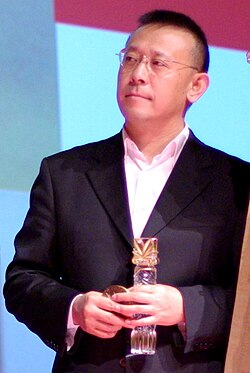
Let the Bullets Fly's awards and nominations included Best Film and Directing nominations from the Asian Film Awards and the Asia Pacific Screen Awards. Jiang also received the Best Director award from the Hong Kong Film Critics Society.
| Awards | ||||
|---|---|---|---|---|
| Ceremony | Category | Name | Outcome | |
| 5th Asian Film Awards3839 | ||||
| Best Film | Nominated | |||
| Best Director | Jiang Wen | Nominated | ||
| Best Actor | Chow Yun-fat | Nominated | ||
| Best Supporting Actress | Carina Lau Kar-ling | Nominated | ||
| Best Screenplay | Jiang Wen | Nominated | ||
| Best Costume Design | William Chang Suk-pin | Won | ||
| 5th Asia Pacific Screen Awards40 | ||||
| Best Feature Film | Nominated | |||
| Achievement in Directing | Jiang Wen | Nominated | ||
| 2011 Golden Horse Film Festival and Awards41 | ||||
| Best Film | Nominated | |||
| Best Director | Jiang Wen | Nominated | ||
| Best Leading Actor | Ge You | Nominated | ||
| Best Supporting Actress | Carina Lau | Nominated | ||
| Best Adapted Screenplay | Wei Xiao, Li Bukong, Zhu Sujin, Shu Ping, Jiang Wen, Guo Junli | Won | ||
| Best Cinematography | Zhao Fei | Won | ||
| Best Visual Effects | Eman Tse, Victor Wong | Nominated | ||
| Best Makeup & Costume Design | William Chang | Nominated | ||
| Best Sound Effects | Wen Bo, Wang Gang | Nominated | ||
| 31st Hong Kong Film Awards4243 | ||||
| Best Film | Ma Ke, Albert Lee, Yin Homber, Barbie Tung, Zhao Haicheng | Nominated | ||
| Best Director | Jiang Wen | Nominated | ||
| Best Screenplay | Zhu Sujin, Shu Ping, Jiang Wen, Guo Junli, Wei Xiao, Li Bukong | Nominated | ||
| Best Actor | Jiang Wen | Nominated | ||
| Best Actor | Ge You | Nominated | ||
| Best Supporting Actress | Carina Lau | Nominated | ||
| Best Cinematography | Zhao Fei | Nominated | ||
| Best Film Editing | Jiang Wen, Cao Wei Jie | Nominated | ||
| Best Art Direction | Eddy Wong, Yu Qing Hua & Gao Yi Guang | Nominated | ||
| Best Costume & Make Up Design | William Chang Suk Ping | Won | ||
| Best Action Choreography | Sit Chun Wai, Lee Chung Chi | Nominated | ||
| Best Sound Design | Wen Bo, Wang Gang | Nominated | ||
| Best Visual Effects | Victor Wong, Xie Yi Wen | Nominated | ||
| 18th Hong Kong Film Critics Society Award44 | ||||
| Best Director | Jiang Wen | Won | ||
| 2012th China Film Director's Guild Awards45 | Best Director | Jiang Wen | Won | |
| Best Actor | Ge You, Yun-Fat Chow | Won | ||
| Best Screenplay | Zhu Sujin | Nominated | ||
References
References
- Attributed to Multiple sources:
- Anderson, John (26 April 2011). "Let the Bullets Fly". Variety. Retrieved 17 May 2025.
- Boltin, Kylie (5 May 2011). "Tribeca 2011: Let the Bullets Fly". SBS Australia. Retrieved 17 May 2025.
- Elley, Derek (16 January 2016). "Review: Let the Bullets Fly (2010)". Sino-Cinema. Retrieved 17 May 2025.
- Nancy Tartaglione (December 21, 2014). "'Hobbit' Rules; 'Bullets' Fire Up China; 'PK' Lands; 'Museum' Opens Doors: Intl BO". Deadline Hollywood. Retrieved December 22, 2014.
- simplified Chinese: 让子弹飞; traditional Chinese: 讓子彈飛; pinyin: Ràng Zǐ Dàn Fēi; Jyutping: Joeng6 Zi2 Daan6 Fei1
- Smith, Ian Hayden (2012). International Film Guide 2012. International Film Guide. p. 88. ISBN 978-1908215017.
- Stephen Cremin (18 May 2013). "So Young enters China's all-time top ten". Film Business Asia. Archived from the original on 19 March 2015.
- "《让子弹飞》票房7.3亿 姜文成国内第一导演" (in Chinese).
- Cremin, Stephen (July 24, 2012). "Resurrection takes China BO record". Film Business Asia. Archived from the original on July 30, 2012. Retrieved July 24, 2012.
- "姜文谈《一步之遥》 故事源自北洋阎瑞生案" [Jiang Wen talks about "One Step Away" The story is based on the Beiyang Yan Ruisheng case] (in Chinese). NetEase Entertainment. 19 May 2014. Archived from the original on 10 July 2019. Retrieved 5 November 2024.
- IMAX China (June 20, 2018). "Jiang Wen's Hidden Man to be Released in IMAX Theatres Across China on July 13". Beijing: PR Newswire Asia Ltd. PR Newswire. Retrieved 5 November 2024.
- Elley, Derek (30 August 2018). "Review: Hidden Man (2018)". Sino-Cinema. Retrieved 5 November 2024.
- Ismail, Roslina; Gennadievich, Tkach Dmitry; Sousa, Ana Matilde; R, Lathangi; Liu, Yunlai (2025-12-31). Proceedings of the 7th International Conference on Literature, Art and Human Development (ICLAHD 2025). Springer Nature. ISBN 978-2-38476-511-9.
- "Pulling out all the stops to Let the Bullets Fly". China Daily. December 24, 2010. Retrieved December 30, 2010.
- Kaiping "Diaolou" - Location of "Let the Bullets Fly", CRI English.com, December 3, 2010
- Li, Yiling; Xu, Zhicheng; Yang, Yu (2024-04-16). "The Artistic Characteristics of Hisaishi Film Score and its Dissemination in China". Arts, Culture and Language. 2 (6). doi:10.61173/sc4rs653. ISSN 2960-1304.
- 冉壮. (2019). 论电影《让子弹飞》的后现代主义色彩与权力观 [Postmodernist colors and power perspectives in the film Let the Bullets Fly]. 1-4 https://www.scribd.com/document/867187754/论电影-让子弹飞-的后现代主义色彩与权力观 Retrieved June 16, 2025.
- "黑色幽默语境下的抒情长诗——试析《让子弹飞》中视听语言的叙事节奏 - 中国知网". oversea.cnki.net. Retrieved 2026-06-11.
- Li, S. (2011). The violent narrative of Let the Bullets Fly. Film Literature, (08), 73–74. https://d.wanfangdata.com.cn/periodical/Ch9QZXJpb2RpY2FsQ0hJTmV3UzIwMjQxMTA1MTcxMzA0Eg1keXd4MjAxMTA4MDM0GghxYnR4cTRtbQ%3D%3D Retrieved June 16, 2025.
- Troost, Kristof Van den (2016-04-01). "Chinese national allegory goes West: Let the Bullets Fly". Asian Cinema. 27 (1): 13–28. doi:10.1386/ac.27.1.13_1. ISSN 1059-440X.
- Zhang, D. (2015). An analysis of the aesthetic characteristics of Chinese dialect films. Film Literature, (24), 7–9.https://bkimg.cdn.bcebos.com/pic/adaf2edda3cc7cd98d10eb434f59363fb80e7aec3baa?x-bce-process=image/watermark,image_d2F0ZXIvYmFpa2UyNzI=,g_7,xp_45,yp_55/format,f_auto Retrieved June 16, 2025.
- Cai, Shenshen (2017), Cai, Shenshen (ed.), "Jiang Wen and His Signature Films: Let the Bullets Fly and Gone with the Bullets", Contemporary Chinese Films and Celebrity Directors, Singapore: Springer, pp. 113–135, doi:10.1007/978-981-10-2966-0_6, ISBN 978-981-10-2966-0, retrieved 2026-06-15
{{citation}}: CS1 maint: work parameter with ISBN (link) - 李, 瑞东 (2011). "《让子弹飞》:飞得更高——当下中国电影整合营销的思考". 电影文学 (13): 68–69 – via CNKI.
- 黄, 冰洁 (2011). "中国电影营销策略简析——以《让子弹飞》为视角". 商品与质量 (S5): 182 – via CNKI.
- Luo, Qin (2011). "The Dessemination Tactics of Let the Bullets Fly". Contemporary Cinema (11): 158–160 – via CNKI.
- "Bullets autumn release shot down". Film Business Asia. June 9, 2010. Retrieved December 30, 2010.
- Frater, Patrick (July 12, 2010). "Jiang takes new aim at December". Film Business Asia. Retrieved December 30, 2010.
- "Let the Bullets Fly premieres in Beijing". China.org.cn. December 8, 2010. Retrieved December 30, 2010.
- Elley, Derek (January 3, 2011). "Let the Bullets Fly (讓子彈飛)". Film Business Asia. Retrieved January 3, 2011.
- Chu, Karen (December 19, 2010). "'Bullets' Guns Down Chinese Box Office". Hollywood Reporter. Retrieved December 30, 2010.
- Frater, Patrick (January 21, 2011). "Bullets shoots BO record, fires up on line". Film Business Asia. Retrieved January 21, 2011.
- "Let the Bullets Fly becomes highest grossing domestic film in China". Asia Pacific Arts. 2011-02-18. Archived from the original on 2014-09-11. Retrieved 2011-02-19.
- Cremin, Stephen (March 15, 2011). "Bullets finds Love at Tribeca". Film Business Asia. Retrieved March 15, 2011.
- "Jiang Wen's Let the Bullets Fly sets records in China". Screen Daily. December 20, 2010. Retrieved December 30, 2010.
- "China political satire scores big at box office". Bangkok Post. December 30, 2010. Retrieved December 30, 2010.
- "Saraba fukushu no okami-tachi yo (2010)". IMDb.
- Sebastian, Veg (2012). "Propaganda and pastiche: Visions of mao in founding of a republic, beginning of the great revival, and let the bullets fly(1)". China Perspectives (2): 41–53 – via ProQuest.
- Luo, Xiaoming (2013). "The Hopeless Bullet: On Let the Bullets Fly". Front. Lit. Stud. China. 7 (3): 512–517 – via HEP Journals.
- Wan, Wenting (2024). "Research on Artistic Characteristics in Chinese Absurd Comedy Films — Take the Film Let The Bullets Fly as an Example". Studies in Art and Architecture. 3 (4): 52–55 – via Pioneer Academic Publishing Limited.
- "5th Asian Film Awards Nomination List" (PDF). Asian Film Awards. January 10, 2011. Archived from the original (PDF) on January 24, 2011. Retrieved February 14, 2011.
- Cremin, Stephen (March 21, 2011). "Boonmee claims AFA crown". Film Business Asia. Archived from the original on March 24, 2011. Retrieved March 22, 2011.
- "Nominees and Winners 2011". Asia Pacific Screen Awards. Archived from the original on 2011-11-13.
- "2011 台北金馬影展 Taipei Golden Horse Film Festival". Golden Horse Film Festival and Awards. Archived from the original on October 6, 2011. Retrieved October 6, 2011.
- "第三十一屆香港電影金像獎提名名單". Hong Kong Film Awards. Retrieved February 22, 2012.
- Frater, Patrick (April 16, 2012). "Simple Life tops HK awards". Film Business Asia. Archived from the original on April 29, 2012. Retrieved April 16, 2012.
- "The 18th Hong Kong Film Critics Society Awards". Love HK Film.com.
- "Let the Bullets Fly (2010) - Awards - IMDb". IMDb.
Further reading
Further reading
- Kraicer, Shelly (2011). "Let the Readings Fly: Jiang Wen Reaches for the Mainstream". CinemaScope (47).
- Luo, Xiaoming (2013). "The Hopeless Bullet: On Let the Bullets Fly". Frontiers of Literary Studies in China. 7 (3): 512–517. doi:10.3868/s010-002-013-0030-2.
- Veg, Sebastian (2012). "Propaganda and Pastiche: Visions of Mao In'founding of a Republic','Beginning of the Great Revival', And 'Let the Bullets Fly'". China Perspectives (2): 41–53. doi:10.4000/chinaperspectives.5869.