



| leucine proline-enriched proteoglycan (leprecan) 1 | |||||||
|---|---|---|---|---|---|---|---|
| Identifiers | |||||||
| Symbol | P3H1, LEPRE1 | ||||||
| NCBI gene | 64175 | ||||||
| HGNC | 19316 | ||||||
| OMIM | 610339 | ||||||
| PDB | 8K0M | ||||||
| RefSeq | NM_022356 | ||||||
| UniProt | Q32P28 | ||||||
| Other data | |||||||
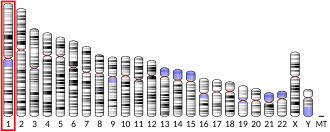
| Locus | Chr. 1 p34.1 | ||||||
| |||||||
Leprecan (P3H1) is a protein associated with osteogenesis imperfecta5 type VIII.
Leprecan is part of a superfamily of 2OG-Fe(II) dioxygenase, along with DNA repair protein AlkB, and disease resistant EGL-9. The enzyme was found to be a type of hydroxylases used in the substrate formation of protein glycosylation.6
Activities
Leprecan, a proteoglycan, has demonstrated prolyl hydroxylase activity; prolyl hydroxylases hydroxylate proline residues.7 Prolyl 3-hydroxylase 1, P3H1, forms a larger complex with CRTAP and cyclophilin B, CyPB, in the endoplasimic reticulum. The complex hydroxylates a single proline residue, Pro986, on collagen chains.8 Recessive forms of Osteogenesis Imperfecta are partly caused by a mutation in the LEPRE1 gene. The mutation in the gene encodes prolyl 3-hydroxylase 1. The malfunctioning prolyl 3-hydroxylase in leprecan leads to inappropriate collagen folding. This is due to the instability caused by the absence of hydroxyproline. Hydroxyproline is the product of hydroxylating a proline residue.9
Structure
Leprecan, also known as P3H1, forms a tight complex with CRTAP and cyclophilin B (PPIB), a collagen processing enzyme complex named PCP complex (P3H1-CRTAP-PPIB). Cryo-electron microscopy (cryo-EM) studies have revealed that the PCP complex consists of P3H1, CRTAP, and PPIB in a 1:1:1 stoichiometry.10 The complex features a "face-to-face" spatial arrangement, with the prolyl hydroxylation site of the C-terminal domain of P3H1 and the prolyl isomerization site of PPIB positioned at the "top" of the complex. Below these dual-catalytic sites lies an X-shaped base formed by CRTAP and the N-terminal domain of P3H1, which exhibit similar 3D foldings. The surface of the PCP complex also harbors several potential collagen-binding sites, as indicated by EM density corresponding to a synthetic peptide with the COL1A1 sequence. Furthermore, the PCP complex has the ability to dimerize, forming a hexameric structure.
References
References
- GRCh38: Ensembl release 89: ENSG00000117385 – Ensembl, May 2017
- GRCm38: Ensembl release 89: ENSMUSG00000028641 – Ensembl, May 2017
- "Human PubMed Reference:". National Center for Biotechnology Information, U.S. National Library of Medicine.
- "Mouse PubMed Reference:". National Center for Biotechnology Information, U.S. National Library of Medicine.
- Cabral WA, Chang W, Barnes AM, Weis M, Scott MA, Leikin S, et al. (March 2007). "Prolyl 3-hydroxylase 1 deficiency causes a recessive metabolic bone disorder resembling lethal/severe osteogenesis imperfecta". Nature Genetics. 39 (3): 359–365. doi:10.1038/ng1968. PMC 7510175. PMID 17277775.
- Aravind L, Koonin EV (2001-02-19). "The DNA-repair protein AlkB, EGL-9, and leprecan define new families of 2-oxoglutarate- and iron-dependent dioxygenases". Genome Biology. 2 (3) RESEARCH0007. doi:10.1186/gb-2001-2-3-research0007. PMC 30706. PMID 11276424.
- Lauer M, Scruggs B, Chen S, Wassenhove-McCarthy D, McCarthy KJ (July 2007). "Leprecan distribution in the developing and adult kidney". Kidney International. 72 (1): 82–91. doi:10.1038/sj.ki.5002269. PMID 17495866.
- Chang W, Barnes AM, Cabral WA, Bodurtha JN, Marini JC (January 2010). "Prolyl 3-hydroxylase 1 and CRTAP are mutually stabilizing in the endoplasmic reticulum collagen prolyl 3-hydroxylation complex". Human Molecular Genetics. 19 (2): 223–234. doi:10.1093/hmg/ddp481. PMC 2796888. PMID 19846465.
- Homan EP, Lietman C, Grafe I, Lennington J, Morello R, Napierala D, et al. (January 2014). "Differential effects of collagen prolyl 3-hydroxylation on skeletal tissues". PLOS Genetics. 10 (1) e1004121. doi:10.1371/journal.pgen.1004121. PMC 3900401. PMID 24465224.
- Li W, Peng J, Yao D, Rao B, Xia Y, Wang Q, et al. (September 2024). "The structural basis for the collagen processing by human P3H1/CRTAP/PPIB ternary complex". Nature Communications. 15 (1) 7844. doi:10.1038/s41467-024-52321-6. PMC 11381544. PMID 39245686.
External links
External links
- leprecan+protein,+human at the U.S. National Library of Medicine Medical Subject Headings (MeSH)