| Legrandella Temporal range:
| |
|---|---|
| |
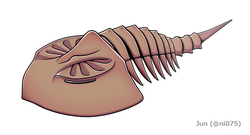
| Reconstruction of Legrandella lombardii | |
| |
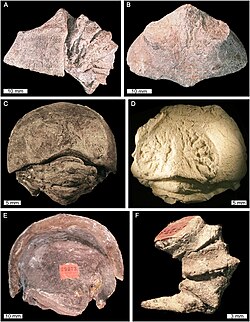
| Fossils of L. lombardii, holotype (A–C, E, F) and plastoparatype (D) | |
Scientific classification 
| |
| Kingdom: | Animalia |
| Phylum: | Arthropoda |
| Subphylum: | Chelicerata |
| Clade: | Euchelicerata |
| Clade: | Prosomapoda |
| Genus: | †Legrandella Eldredge, 1974 |
| Type species | |
| †Legrandella lombardii Eldredge, 1974
| |
Legrandella is a genus of synziphosurine,1 a paraphyletic group of fossil chelicerate arthropods.23 Legrandella was regarded as part of the clade Prosomapoda.245637 Fossils of the single and type species, L. lombardii, have been discovered in deposits of the Devonian period in Cochabamba, Bolivia.72
The prosoma of Legrandella covered by a vaulted carapace with anterior projection, blunt genal cornua (posterolateral corners), humped cardiac lobe and pairs of radiated grooves.1 Alongside Pseudoniscus roosevelti, Legrandella lombardii is one of the few synziphosurine species that confirmed to have lateral compound eyes.8 The eyes are slit-like, located just below the ophthalmic ridges on each side of the carapace.1 The opisthosoma is externally 11-segmented, subdivided into a 8-segmented preabdomen and 3-segmented postabdomen.1 Tergite of the 1st preabdomimal segment is a reduced microtergite while the remaining 7 tergite possess axial nodes and spine-like tergopleurae (lateral extension).1 each of the postabdominal segment is cylindrical and bore reduced tergopleurae.1 The telson is triangular in cross section, but the distal region is yet to be discovered.1
References
References
- Eldredge, Niles; Smith, LeGrande (1974). "Revision of the suborder Synziphosurina (Chelicerata, Merostomata) : with remarks on merostome phylogeny. American Museum novitates ; no. 2543". hdl:2246/2745.
{{cite journal}}: Cite journal requires|journal=(help) - Lamsdell, James C. (2013). "Revised systematics of Palaeozoic 'horseshoe crabs' and the myth of monophyletic Xiphosura". Zoological Journal of the Linnean Society. 167 (1): 1–27. doi:10.1111/j.1096-3642.2012.00874.x. ISSN 0024-4082.
- Bicknell, Russell D. C.; Pates, Stephen (2020). "Pictorial Atlas of Fossil and Extant Horseshoe Crabs, With Focus on Xiphosurida". Frontiers in Earth Science. 8: 98. Bibcode:2020FrEaS...8...98B. doi:10.3389/feart.2020.00098. hdl:1959.11/29455. ISSN 2296-6463.
- Selden, Paul A.; Lamsdell, James C.; Qi, Liu (2015). "An unusual euchelicerate linking horseshoe crabs and eurypterids, from the Lower Devonian (Lochkovian) of Yunnan, China". Zoologica Scripta. 44 (6): 645–652. doi:10.1111/zsc.12124. ISSN 0300-3256. S2CID 55264483.
- Lamsdell, James C.; Briggs, Derek E. G.; Liu, Huaibao P.; Witzke, Brian J.; McKay, Robert M. (2015). "A new Ordovician arthropod from the Winneshiek Lagerstätte of Iowa (USA) reveals the ground plan of eurypterids and chasmataspidids". The Science of Nature. 102 (9–10): 63. Bibcode:2015SciNa.102...63L. doi:10.1007/s00114-015-1312-5. ISSN 0028-1042. PMID 26391849. S2CID 8153035.
- Bicknell, Russell D. C.; Lustri, Lorenzo; Brougham, Tom (2019-12-01). "Revision of "Bellinurus" carteri (Chelicerata: Xiphosura) from the Late Devonian of Pennsylvania, USA". Comptes Rendus Palevol. 18 (8): 967–976. doi:10.1016/j.crpv.2019.08.002. hdl:1959.11/28072. ISSN 1631-0683.
- Dunlop, J. A.; Penney, D.; Jekel, D. (2020). "A summary list of fossil spiders and their relatives" (PDF). World Spider Catalog. Natural History Museum Bern. pp. 1–296.
- Bicknell, Russell D. C.; Amati, Lisa; Ortega-Hernández, Javier (2019-11-14). "New insights into the evolution of lateral compound eyes in Palaeozoic horseshoe crabs". Zoological Journal of the Linnean Society. 187 (4): 1061–1077. doi:10.1093/zoolinnean/zlz065. hdl:1959.11/27440. ISSN 0024-4082.