Article · Wikipedia archive · Last revised Jul 20, 2026

Lattice stool

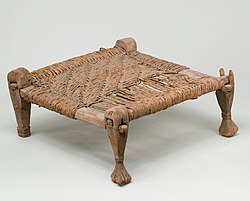
The lattice stool was the most popular type of stool in ancient Egypt. It is rectangular in form with a combination of features. These features would include: square section legs connected by a perimeter stretcher, a single cove, double cove or flat seat, vertical and diagonal struts joining the stretcher with the seat rail, and a seat surface material that consisted of woven reeds, wooden slats or various natural fibers. Holes were drilled into the seat rails in order to pass the woven material through the holes during the weaving process for a stronger integrity of the seat. Stools were one of the earliest types of seating and were used by all levels of society.

Last revised
Jul 20, 2026
Read time
≈ 1 min
Length
170 w
Citations
Source
Stool with woven seat, 1991–1450 BC, wood and reed, height: 13 cm; Metropolitan Museum of Art source ↗

The lattice stool was the most popular type of stool in ancient Egypt. It is rectangular in form with a combination of features. These features would include: square section legs connected by a perimeter stretcher, a single cove, double cove or flat seat, vertical and diagonal struts joining the stretcher with the seat rail, and a seat surface material that consisted of woven reeds, wooden slats or various natural fibers. Holes were drilled into the seat rails in order to pass the woven material through the holes during the weaving process for a stronger integrity of the seat. Stools were one of the earliest types of seating and were used by all levels of society.

See also

See also

References

References

  • Pile, John F. (2003). Interior Design (3rd ed.). Prentice Hall.
  • Blakemore, Robbie G. (1997). History of Interior Design and Furniture, From Ancient Egypt to Nineteenth-Century Europe. New York: Wiley.