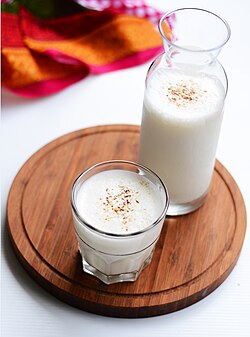
 A carafe and glass of lassi | |
| Type | Yogurt beverage |
|---|---|
| Place of origin | Indian subcontinent |
| Associated cuisine | Punjabi, Indian, Pakistani |
| Serving temperature | Chilled |
| Main ingredients | Yogurt, water |
Lassi (pronounced [ləsːi]) is a yogurt–based beverage with a smoothie-like consistency.12 The word 'lassi' for the drink is a borrowing from Hindi, first attested in 1882; its ultimate origin is unclear, and has been suggested as derived ultimately from Sanskrit lasya (stickiness)3 or rasah (juice).4
Lassi is prepared by blending yogurt, water, and spices. In Punjab, where the drink originated,5 the yogurt is traditionally made from water buffalo milk.6 Variations include the addition of salt, cumin or cardamom.5 Lassi is traditionally served in a clay cup known as kulhar.5 In the 21st century, lassi is commonly consumed in many world regions.5
Varieties
Namkin / Namkeen lassi
Namkin or namkeen (salty) lassi is made by adding salt, black pepper, cumin, and sugar to the yogurt-water mixture.17
Lassi masalewal
Lassi masalewal (spicy lassi) is made by adding ingredients such as almonds, ginger, green chilies, and pistachios to namkin lassi.1
Meethi lassi
Meethi (sweet) lassi is made by adding cardamom, rosewater, and saffron to the yogurt-water mixture.18
Bhang lassi
Bhang lassi is a cannabis-infused drink that contains bhang, a liquid derivative of cannabis, which has effects similar to other eaten forms of cannabis.9 It is legal in many parts of India and mainly sold during Holi, when pakoras containing bhang are also sometimes eaten. Uttar Pradesh has licensed bhang shops where bhang lassi and other products can be bought.10
Others
Fruits such as mangos and strawberries may be added to the yogurt-water mixture to yield, for example, mango lassi and strawberry lassi.18
Gallery
-
 Lassi served in a restaurant.
 -
 Mint lassi
 -
 Bhang lassi
 -
 Lassi served in a brass cup in Patiala
 -

-
 A style of lassi from Odisha
References
References
- Kurlansky, Mark (2018). Milk! A 10,000-Year Food Fracas. New York: Bloomsbury Publishing. p. 266. ISBN 978-1632863829.
- Vij, Vikram & Dhalwala, Meeru (2006). Vij's Elegant and Inspired Indian Cuisine. New York: Douglas & McIntyre. p. 191. ISBN 978-1553651840. OCLC 865244252.
- "lassi". Merriam-Webster. Retrieved 28 June 2026.
- Fiegl, Amanda (1 July 2010). "What's a Lassi?". Smithsonian Magazine.
- Siciliano-Rosen, Laura. "Lassi". Encyclopædia Britannica. Archived from the original on 6 December 2017. Retrieved 24 July 2022.
- Semali, Ladislaus (2002). What is Indigenous Knowledge? Voices from the Academy. Taylor & Francis. p. 173.
- Vijayakar, Sunil (2016). Indian Kitchen: Authentic Dishes from India. Bath: Paragon Books. p. 217. ISBN 978-1474815147.
- Shah, Niraalee (2021). Indian Etiquette: A Glimpse Into India's Culture. Notion Press. p. 289.
- Staelens, Stefanie (10 March 2015). "The Bhang Lassi Is How Hindus Drink Themselves High for Shiva". Vice.com. Archived from the original on 2017-08-11. Retrieved 2017-08-10.
- Anthony Bourdain: No Reservations Collection 2, Episode 5; Final Segment.