  | |
| Observation data Epoch J2000.0 Equinox J2000.0 (ICRS) | |
|---|---|
| Constellation | Lupus |
| Right ascension | 15h 08m 50.61639s1 |
| Declination | −45° 16′ 47.4950″1 |
| Apparent magnitude (V) | 4.042 (4.43 + 5.23)3 |
| Characteristics | |
| Spectral type | B3 V4 (B3 V + B3 V)5 |
| U−B color index | −0.672 |
| B−V color index | −0.182 |
| Astrometry | |
| Radial velocity (Rv) | +9.80±1.786 km/s |
| Proper motion (μ) | RA: −15.881 mas/yr Dec.: −26.801 mas/yr |
| Parallax (π) | 4.20±0.66 mas1 |
| Distance | approx. 800 ly (approx. 240 pc) |
| Absolute magnitude (MV) | −2.757 |
| Orbit8 | |
| Period (P) | 70.8±0.8 yr |
| Semi-major axis (a) | 0.2597±0.0021″ |
| Eccentricity (e) | 0.6283±0.0090 |
| Inclination (i) | 71.59±0.41° |
| Longitude of the node (Ω) | 26.64±0.61° |
| Periastron epoch (T) | 1997.907 ± 0.105 |
| Argument of periastron (ω) (secondary) | 299.9±1.1° |
| Details | |
| λ Lup A | |
| Mass | 8.148 M☉ |
| Rotational velocity (v sin i) | 135 km/s |
| Age | 28.1±4.19 Myr |
| λ Lup B | |
| Mass | 5.84 M☉ |
| Other designations | |
| λ Lup, CD−44°9889, HD 133955, HIP 74117, HR 5626, SAO 225483, WDS J15088-4517AB10 | |
| Database references | |
| SIMBAD | data |
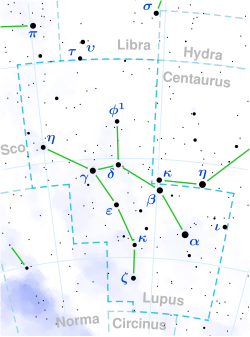
Lambda Lupi, Latinized from λ Lupi, is a triple star11 system in the southern constellation of Lupus. It is visible to the naked eye with a combined apparent visual magnitude of 4.04.2 Based upon an annual parallax shift of just 4.201 mas as seen from Earth, it is located roughly 800 light years from the Sun. The system has a peculiar velocity of 27.4±4.9 km/s relative to its neighbors, making it a candidate runaway star system.9 It is a member of the Upper Centaurus–Lupus sub-group in the Scorpius–Centaurus OB association.12
The two visible components of this system orbit each other over a period of 70.8 years with a large eccentricity of 0.63.8 The primary component has a visual magnitude of 4.43, while the secondary is of magnitude 5.23.3 Both are B-type main sequence stars with a stellar classification of B3 V.5 One of the pair is itself a double-lined spectroscopic binary, making this a triple star system.11
References
References
- van Leeuwen, F. (2007), "Validation of the new Hipparcos reduction", Astronomy and Astrophysics, 474 (2): 653–664, arXiv:0708.1752, Bibcode:2007A&A...474..653V, doi:10.1051/0004-6361:20078357, S2CID 18759600.
- Mermilliod, J.-C. (1986), "Compilation of Eggen's UBV data, transformed to UBV (unpublished)", Catalogue of Eggen's UBV Data, SIMBAD, Bibcode:1986EgUBV........0M.
- Eggleton, P. P.; Tokovinin, A. A. (September 2008), "A catalogue of multiplicity among bright stellar systems", Monthly Notices of the Royal Astronomical Society, 389 (2): 869–879, arXiv:0806.2878, Bibcode:2008MNRAS.389..869E, doi:10.1111/j.1365-2966.2008.13596.x, S2CID 14878976.
- Houk, Nancy (1978), Michigan catalogue of two-dimensional spectral types for the HD stars, vol. 2, Ann Arbor: Dept. of Astronomy, University of Michigan, Bibcode:1978mcts.book.....H.
- Edwards, T. W. (April 1976), "MK classification for visual binary components", Astronomical Journal, 81: 245–249, Bibcode:1976AJ.....81..245E, doi:10.1086/111879. The system is listed in Table II as −44°9889.
- de Bruijne, J. H. J.; Eilers, A.-C. (October 2012), "Radial velocities for the HIPPARCOS-Gaia Hundred-Thousand-Proper-Motion project", Astronomy & Astrophysics, 546: 14, arXiv:1208.3048, Bibcode:2012A&A...546A..61D, doi:10.1051/0004-6361/201219219, S2CID 59451347, A61.
- Anderson, E.; Francis, Ch. (2012), "XHIP: An extended hipparcos compilation", Astronomy Letters, 38 (5): 331, arXiv:1108.4971, Bibcode:2012AstL...38..331A, doi:10.1134/S1063773712050015, S2CID 119257644.
- Tokovinin, Andrei (2012), "Speckle Interferometry and Orbits of "Fast" Visual Binaries", The Astronomical Journal, 144 (2), 56, arXiv:1206.1882, Bibcode:2012AJ....144...56T, doi:10.1088/0004-6256/144/2/56, S2CID 118586009.
- Tetzlaff, N.; et al. (January 2011), "A catalogue of young runaway Hipparcos stars within 3 kpc from the Sun", Monthly Notices of the Royal Astronomical Society, 410 (1): 190–200, arXiv:1007.4883, Bibcode:2011MNRAS.410..190T, doi:10.1111/j.1365-2966.2010.17434.x, S2CID 118629873.
- "* lam Lup". SIMBAD. Centre de données astronomiques de Strasbourg. Retrieved 2017-03-07.
{{cite web}}: CS1 maint: postscript (link) - Nitschelm, C. (December 2004), "Discovery and confirmation of some double-lined spectroscopic binaries in the Sco-Cen Complex", in Hilditch, R. W.; Hensberge, H.; Pavlovski, K. (eds.), In Spectroscopically and Spatially Resolving the Components of the Close Binary Stars, Proceedings of the Workshop held 20-24 October 2003 in Dubrovnik, Croatia, ASP Conference Series, vol. 318, San Francisco: Astronomical Society of the Pacific, pp. 291–293, Bibcode:2004ASPC..318..291N.
- Wolff, S. C.; et al. (2007), "Rotational Velocities for B0-B3 Stars in Seven Young Clusters: Further Study of the Relationship between Rotation Speed and Density in Star-Forming Regions", The Astronomical Journal, 133 (3): 1092–1103, arXiv:astro-ph/0702133, Bibcode:2007AJ....133.1092W, doi:10.1086/511002, S2CID 119074863.
External links
External links
- Kaler, James B. (June 20, 2014), "Lambda Lupi", Stars, University of Illinois, retrieved 2017-03-08.