  | |
| Observation data Epoch J2000.0 Equinox J2000.0 (ICRS) | |
|---|---|
| Constellation | Grus |
| Right ascension | 22h 06m 06.88568s1 |
| Declination | −39° 32′ 36.0659″1 |
| Apparent magnitude (V) | 4.472 |
| Characteristics | |
| Evolutionary stage | giant |
| Spectral type | K3 III3 |
| U−B color index | +1.6282 |
| B−V color index | +1.3692 |
| Astrometry | |
| Radial velocity (Rv) | +38.804 km/s |
| Proper motion (μ) | RA: −23.801 mas/yr Dec.: −124.581 mas/yr |
| Parallax (π) | 13.47±0.22 mas1 |
| Distance | 242 ± 4 ly (74 ± 1 pc) |
| Absolute magnitude (MV) | +0.125 |
| Details6 | |
| Mass | 2.4 M☉ |
| Radius | 22.3 R☉ |
| Luminosity | 155 L☉ |
| Surface gravity (log g) | 2.13 cgs |
| Temperature | 4,269 K |
| Other designations | |
| λ Gru, CD−40°14639, FK5 1581, HD 209688, HIP 109111, HR 8411, SAO 2135437 | |
| Database references | |
| SIMBAD | data |
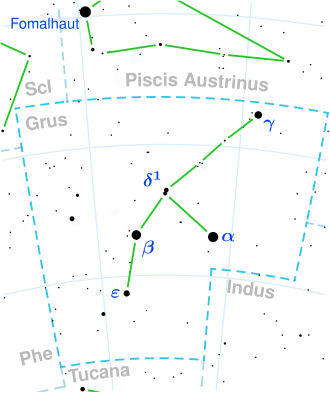
Lambda Gruis, Latinized from λ Gruis, is a solitary,8 orange-hued star in the southern constellation of Grus. With an apparent visual magnitude of 4.47,2 it is visible to the naked eye as a faint point of light. The distance to this star, as determined using an annual parallax shift of 13.47 mas as seen from the Earth,1 is around 242 light years. It is drifting further away with a radial velocity of +39 km/s,4 having come to within 183 light-years some 805,000 years ago.5
This is an evolved K-type giant star with a stellar classification of K3 III,3 having exhausted the supply of hydrogen at its core then cooled and expanded off the main sequence. It has about 2.4 times the mass of the Sun and has expanded to 22.3 times the Sun's radius. The star is radiating 155 times the Sun's luminosity from its photosphere at an effective temperature of 4,269 K.6
References
References
- van Leeuwen, F. (2007), "Validation of the new Hipparcos reduction", Astronomy and Astrophysics, 474 (2): 653–664, arXiv:0708.1752, Bibcode:2007A&A...474..653V, doi:10.1051/0004-6361:20078357, S2CID 18759600.
- Jennens, P. A.; Helfer, H. L. (September 1975), "A new photometric metal abundance and luminosity calibration for field G and K giants", Monthly Notices of the Royal Astronomical Society, 172 (3): 667–679, Bibcode:1975MNRAS.172..667J, doi:10.1093/mnras/172.3.667.
- Houk, N. (1978), Michigan catalogue of two-dimensional spectral types for the HD stars, vol. 2, Dept. of Astronomy, University of Michigan, Bibcode:1978mcts.book.....H.
- Gontcharov, G. A. (November 2006), "Pulkovo Compilation of Radial Velocities for 35495 Hipparcos stars in a common system", Astronomy Letters, 32 (11): 759–771, arXiv:1606.08053, Bibcode:2006AstL...32..759G, doi:10.1134/S1063773706110065, S2CID 119231169.
- Anderson, E.; Francis, Ch. (2012), "XHIP: An extended hipparcos compilation", Astronomy Letters, 38 (5): 331, arXiv:1108.4971, Bibcode:2012AstL...38..331A, doi:10.1134/S1063773712050015, S2CID 119257644.
- Cruzalèbes, P.; et al. (June 2010), "Angular diameter estimation of interferometric calibrators. Example of λ Gruis, calibrator for VLTI-AMBER", Astronomy and Astrophysics, 515: 15, arXiv:1003.4399, Bibcode:2010A&A...515A...6C, doi:10.1051/0004-6361/200913686, S2CID 118484809, A6.
- "lam Gru". SIMBAD. Centre de données astronomiques de Strasbourg. Retrieved 2017-06-26.
{{cite web}}: CS1 maint: postscript (link) - Eggleton, P. P.; Tokovinin, A. A. (September 2008), "A catalogue of multiplicity among bright stellar systems", Monthly Notices of the Royal Astronomical Society, 389 (2): 869–879, arXiv:0806.2878, Bibcode:2008MNRAS.389..869E, doi:10.1111/j.1365-2966.2008.13596.x, S2CID 14878976.