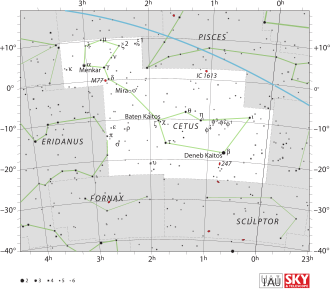
  | |
| Observation data Epoch J2000 Equinox ICRS | |
|---|---|
| Constellation | Cetus1 |
| Right ascension | 02h 59m 42.893s2 |
| Declination | +08° 54′ 26.589″2 |
| Apparent magnitude (V) | 4.711 |
| Characteristics | |
| Spectral type | B6III3 |
| U−B color index | −0.4711 |
| B−V color index | −0.109±0.0061 |
| Astrometry | |
| Radial velocity (Rv) | 10.2±2.84 km/s |
| Proper motion (μ) | RA: 8.382 mas/yr2 Dec.: −16.385 mas/yr2 |
| Parallax (π) | 7.3207±0.1451 mas2 |
| Distance | 446 ± 9 ly (137 ± 3 pc) |
| Absolute magnitude (MV) | −1.521 |
| Details | |
| Mass | 5.01±0.055 M☉ |
| Radius | 5.46 R☉ |
| Luminosity | 6521 L☉ |
| Temperature | 13,940±7107 K |
| Rotational velocity (v sin i) | 1318 km/s |
| Age | 100-1256 Myr |
| Other designations | |
| Menkar, λ Cet, 91 Cet, BD+08°455, FK5 1083, HD 18604, HIP 13954, HR 896, SAO 1108899 | |
| Database references | |
| SIMBAD | data |
Lambda Ceti is a star in the equatorial constellation of Cetus. Its name is a Bayer designation that is Latinized from λ Ceti, and abbreviated Lambda Cet or λ Cet. Historically, the star bore the traditional name Menkar, although today that name is more commonly associated with α Ceti. With an apparent visual magnitude of 4.71,1 it is faintly visible to the naked eye. Based on parallax measurement of 7.32 mas as seen from Earth, it is located at a distance of approximately 446 light-years (137 pc) from the Sun. The star is drifting further away with a line of sight velocity component of 10 km/s.4
This star, along with α Cet (Menkar), γ Cet (Kaffaljidhma), δ Cet, μ Cet, ξ1 Cet and ξ2 Cet were Al Kaff al Jidhmah, "the Part of a Hand".10
In Chinese, 天囷 (Tiān Qūn), meaning Circular Celestial Granary, refers to an asterism consisting of λ Ceti, α Ceti, κ1 Ceti, μ Ceti, ξ1 Ceti, ξ2 Ceti, ν Ceti, γ Ceti, δ Ceti, 75 Ceti, 70 Ceti, 63 Ceti and 66 Ceti. Consequently, the Chinese name for λ Ceti itself is 天囷三 (Tiān Qūn sān, English: the Third Star of Circular Celestial Granary.)11
Lambda Ceti is a blue giant star with stellar classification B6III. It is an estimated 100-125 million years old,6 and is spinning rapidly with a projected rotational velocity of 131 km/s.8 It has five5 times the mass of the Sun and 5.4 times the Sun's radius. The star is radiating 9206 times the Sun's luminosity at an effective temperature of 13,940 K.7
References
References
- Anderson, E.; Francis, Ch. (2012), "XHIP: An extended hipparcos compilation", Astronomy Letters, 38 (5): 331, arXiv:1108.4971, Bibcode:2012AstL...38..331A, doi:10.1134/S1063773712050015 XHIP record for this object at VizieR.
- Vallenari, A.; et al. (Gaia collaboration) (2023), "Gaia Data Release 3. Summary of the content and survey properties", Astronomy and Astrophysics, 674: A1, arXiv:2208.00211, Bibcode:2023A&A...674A...1G, doi:10.1051/0004-6361/202243940, S2CID 244398875 Gaia DR3 record for this source at VizieR.
- Lesh, Janet Rountree (December 1968), "The Kinematics of the Gould Belt: an Expanding Group?", Astrophysical Journal Supplement, 17: 371, Bibcode:1968ApJS...17..371L, doi:10.1086/190179.
- Gontcharov, G. A. (November 2006), "Pulkovo Compilation of Radial Velocities for 35495 Hipparcos stars in a common system", Astronomy Letters, 32 (11): 759–771, arXiv:1606.08053, Bibcode:2006AstL...32..759G, doi:10.1134/S1063773706110065, S2CID 119231169.
- Hohle, M. M.; et al. (April 2010), "Masses and luminosities of O- and B-type stars and red supergiants", Astronomische Nachrichten, 331 (4): 349, arXiv:1003.2335, Bibcode:2010AN....331..349H, doi:10.1002/asna.200911355, S2CID 111387483.
- Kaler, James B., "LAMBDA CET (Lambda Ceti, the former "Menkar")", Stars, University of Illinois, retrieved 2010-09-30.
- Zorec, J.; et al. (2009), "Fundamental parameters of B supergiants from the BCD system. I. Calibration of the (λ_1, D) parameters into Teff", Astronomy and Astrophysics, 501 (1): 297–320, arXiv:0903.5134, Bibcode:2009A&A...501..297Z, doi:10.1051/0004-6361/200811147, S2CID 14969137.
- Simón-Díaz, S.; et al. (January 2017), "The IACOB project. III. New observational clues to understand macroturbulent broadening in massive O- and B-type stars", Astronomy & Astrophysics, 597: 17, arXiv:1608.05508, Bibcode:2017A&A...597A..22S, doi:10.1051/0004-6361/201628541, S2CID 3478126, A22.
- "lam Cet", SIMBAD, Centre de données astronomiques de Strasbourg, retrieved 2010-09-30
- Allen, R. H., "Cetus, the Whale or Sea Monster", Star Name, p. 160, retrieved 2026-02-24.
- (in Chinese) AEEA (Activities of Exhibition and Education in Astronomy) 天文教育資訊網 2006 年 7 月 11 日 Archived 2012-02-04 at the Wayback Machine