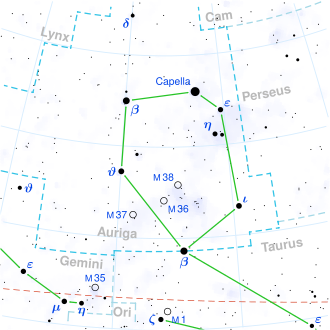
  | |
| Observation data Epoch J2000 Equinox ICRS | |
|---|---|
| Constellation | Auriga |
| Right ascension | 05h 19m 08.475s1 |
| Declination | +40° 05′ 56.59″1 |
| Apparent magnitude (V) | 4.712 |
| Characteristics | |
| Evolutionary stage | subgiant1 |
| Spectral type | G1 V3 or G1.5 IV-V Fe-14 |
| U−B color index | +0.132 |
| B−V color index | +0.622 |
| R−I color index | 0.32 |
| Astrometry | |
| Radial velocity (Rv) | +66.36±0.121 km/s |
| Proper motion (μ) | RA: +520.569 mas/yr1 Dec.: −664.488 mas/yr1 |
| Parallax (π) | 79.6021±0.1005 mas1 |
| Distance | 40.97 ± 0.05 ly (12.56 ± 0.02 pc) |
| Absolute magnitude (MV) | 4.205 |
| Details | |
| Mass | 1.081+0.054 −0.0296 M☉ |
| Radius | 1.331±0.0213 R☉ |
| Luminosity | 1.732±0.0223 L☉ |
| Surface gravity (log g) | 4.027 cgs |
| Temperature | 5,890±4.38 K |
| Metallicity [Fe/H] | +0.129 dex |
| Rotational velocity (v sin i) | 210 km/s |
| Age | 4,9 5.0–7.911 Gyr |
| Other designations | |
| λ Aur, 15 Aurigae, BD+39°1248, FK5 1145, GC 6494, GJ 197, HD 34411, HIP 24813, HR 1729, SAO 40233, PPM 47977, WDS J05191+4006A, LFT 403, LHS 1753, LTT 1162512 | |
| Database references | |
| SIMBAD | data |
| ARICNS | data |
Lambda Aurigae is a Sun-like9 star in the northern constellation of Auriga.13 Its name is a Bayer designation that is Latinized from λ Aurigae, and abbreviated Lambda Aur or λ Aur. This star is visible to the naked eye with an apparent visual magnitude of 4.71.2 Based upon parallax measurements, it is 41 light-years (13 parsecs) distant from the Earth.1 The star is drifting further away with a high radial velocity of +66.5 km/s,14 having come to within 24.4 ly (7.5 pc) some 117,300 years ago.15 It has a high proper motion, traversing the celestial sphere at the rate of 0.844″ per year.16
Properties
This is a G-type main sequence star with a stellar classification of G1 V.3 It is sometimes listed with a class of G1.5 IV-V Fe-1,4 which indicates the spectrum is showing some features of a more evolved subgiant star along with a noticeable underabundance of iron. In terms of composition it is similar to the Sun, while the mass and radius are slightly larger.6 It is 73% more luminous than the Sun3 and radiates this energy from its outer atmosphere at an effective temperature of 5890 K.8 At this heat, the star glows with the yellow hue of a G-type star.17 It has a low level of magnetic activity and is a candidate Maunder minimum analog.18
Lambda Aurigae has been examined for the presence of excess infrared emission that may indicate the presence of a circumstellar disk of dust, but no significant surplus has been observed.9 It is a possible member of the Epsilon Indi Moving Group of stars that share a common motion through space. The space velocity components of this star are [U, V, W] = [+76, –39, –6] km/s.19
Name
This star may have been called by the name Al Hurr, meaning the fawn in Arabic.20 Lambda Aurigae, along with μ Aur and σ Aur, were Kazwini's Al Ḣibāʽ (ألحباع), the Tent.20 According to the catalogue of stars in the Technical Memorandum 33-507 - A Reduced Star Catalog Containing 537 Named Stars, Al Ḣibāʽ were the title for three stars : λ Aur as Al Ḣibāʽ I, μ Aur as Al Ḣibāʽ II and σ Aur as Al Ḣibāʽ III.21
In Chinese, 咸池 (Xián Chí), meaning Pool of Harmony, refers to an asterism consisting of λ Aurigae, ρ Aurigae and HD 36041.22 Consequently, the Chinese name for λ Aurigae itself is 咸池三 (Xián Chí sān, English: the Third Star of Pool of Harmony.)23
Observation
From Earth, Lambda Aurigae has an apparent magnitude of 4.71. The closest large neighboring star to Lambda Aurigae is Capella, located 4.5 light-years (1.4 parsecs) away.24 Hypothetically viewed from Lambda Aurigae, Capella's quadruple star system would have an apparent magnitude of approximately -5.48,25 about 40 times brighter than Sirius can be seen at maximum brightness from Earth.26
References
References
- Vallenari, A.; et al. (Gaia collaboration) (2023), "Gaia Data Release 3. Summary of the content and survey properties", Astronomy and Astrophysics, 674: A1, arXiv:2208.00211, Bibcode:2023A&A...674A...1G, doi:10.1051/0004-6361/202243940, S2CID 244398875 Gaia DR3 record for this source at VizieR.
- Johnson, H. L.; et al. (1966), "UBVRIJKL photometry of the bright stars", Communications of the Lunar and Planetary Laboratory, 4 (99): 99, Bibcode:1966CoLPL...4...99J.
- Boyajian, Tabetha S.; et al. (February 2012), "Stellar Diameters and Temperatures. I. Main-sequence A, F, and G Stars", The Astrophysical Journal, 746 (1): 101, arXiv:1112.3316, Bibcode:2012ApJ...746..101B, doi:10.1088/0004-637X/746/1/101, S2CID 18993744.. See Table 10.
- Keenan, Philip C.; McNeil, Raymond C. (1989), "The Perkins catalog of revised MK types for the cooler stars", Astrophysical Journal Supplement Series, 71: 245, Bibcode:1989ApJS...71..245K, doi:10.1086/191373.
- Holmberg, J.; et al. (July 2009), "The Geneva-Copenhagen survey of the solar neighbourhood. III. Improved distances, ages, and kinematics", Astronomy and Astrophysics, 501 (3): 941–947, arXiv:0811.3982, Bibcode:2009A&A...501..941H, doi:10.1051/0004-6361/200811191, S2CID 118577511.
- Takeda, Genya; et al. (February 2007), "Structure and Evolution of Nearby Stars with Planets. II. Physical Properties of ~1000 Cool Stars from the SPOCS Catalog", The Astrophysical Journal Supplement Series, 168 (2): 297–318, arXiv:astro-ph/0607235, Bibcode:2007ApJS..168..297T, doi:10.1086/509763, S2CID 18775378.
- Chen, Y. Q.; et al. (February 2000), "Chemical composition of 90 F and G disk dwarfs", Astronomy and Astrophysics Supplement, 141 (3): 491–506, arXiv:astro-ph/9912342, Bibcode:2000A&AS..141..491C, doi:10.1051/aas:2000124, S2CID 16273589.
- Kovtyukh, V. V.; et al. (2003), "High precision effective temperatures for 181 F-K dwarfs from line-depth ratios", Astronomy and Astrophysics, 411 (3): 559–564, arXiv:astro-ph/0308429, Bibcode:2003A&A...411..559K, doi:10.1051/0004-6361:20031378, S2CID 18478960.
- Greaves, J. S.; et al. (August 2009), "Debris discs around nearby solar analogues", Monthly Notices of the Royal Astronomical Society, 397 (2): 757–762, arXiv:0907.3677, Bibcode:2009MNRAS.397..757G, doi:10.1111/j.1365-2966.2009.15048.x, S2CID 17758971.
- Takeda, Yoichi; et al. (February 2005), "High-Dispersion Spectra Collection of Nearby F--K Stars at Okayama Astrophysical Observatory: A Basis for Spectroscopic Abundance Standards", Publications of the Astronomical Society of Japan, 57 (1): 13–25, Bibcode:2005PASJ...57...13T, doi:10.1093/pasj/57.1.13.
- Mamajek, Eric E.; Hillenbrand, Lynne A. (November 2008), "Improved Age Estimation for Solar-Type Dwarfs Using Activity-Rotation Diagnostics", The Astrophysical Journal, 687 (2): 1264–1293, arXiv:0807.1686, Bibcode:2008ApJ...687.1264M, doi:10.1086/591785, S2CID 27151456.
- "lam Aur", SIMBAD, Centre de données astronomiques de Strasbourg, retrieved 2012-08-19.
- Kaler, James, "LAMBDA AUR (Lambda Aurigae)", Stars, retrieved 2011-12-11.
- Brown, A. G. A.; et al. (Gaia collaboration) (August 2018), "Gaia Data Release 2: Summary of the contents and survey properties", Astronomy & Astrophysics, 616, A1, arXiv:1804.09365, Bibcode:2018A&A...616A...1G, doi:10.1051/0004-6361/201833051 Gaia DR2 record for this source at VizieR.
- Bailer-Jones, C.A.L.; et al. (2018), "New stellar encounters discovered in the second Gaia data release", Astronomy & Astrophysics, 616: A37, arXiv:1805.07581, Bibcode:2018A&A...616A..37B, doi:10.1051/0004-6361/201833456, S2CID 56269929.
- Lépine, Sébastien; Shara, Michael M. (March 2005), "A Catalog of Northern Stars with Annual Proper Motions Larger than 0.15" (LSPM-NORTH Catalog)", The Astronomical Journal, 129 (3): 1483–1522, arXiv:astro-ph/0412070, Bibcode:2005AJ....129.1483L, doi:10.1086/427854, S2CID 2603568.
- "The Colour of Stars", Australia Telescope, Outreach and Education, Commonwealth Scientific and Industrial Research Organisation, December 21, 2004, archived from the original on March 18, 2012, retrieved 2012-01-16.
- Lubin, Dan; et al. (March 2012), "Frequency of Maunder Minimum Events in Solar-type Stars Inferred from Activity and Metallicity Observations", The Astrophysical Journal Letters, 747 (2): L32, Bibcode:2012ApJ...747L..32L, doi:10.1088/2041-8205/747/2/L32.
- Kovacs, N.; Foy, R. (August 1978), "A detailed analysis of three stars in the Eggen's Epsilon INDI moving group", Astronomy and Astrophysics, 68 (1–2): 27–31, Bibcode:1978A&A....68...27K.
- Allen, R. H. (1963), Star Names: Their Lore and Meaning (Reprint ed.), New York, NY: Dover Publications Inc, p. 91, ISBN 978-0-486-21079-7, retrieved 2010-12-12.
{{citation}}: CS1 maint: ignored ISBN errors (link) - Rhoads, Jack W. (November 15, 1971), Technical Memorandum 33-507-A Reduced Star Catalog Containing 537 Named Stars, California Institute of Technology: Jet Propulsion Laboratory, retrieved 2025-05-13.
- (in Chinese) 中國星座神話, written by 陳久金. Published by 台灣書房出版有限公司, 2005, ISBN 978-986-7332-25-7.
- (in Chinese) AEEA (Activities of Exhibition and Education in Astronomy) 天文教育資訊網 2006 年 7 月 13 日 Archived 2011-07-16 at the Wayback Machine
- Capella 4, SolStation, archived from the original on December 25, 2001, retrieved 10 February 2023.
- Combined apparent magnitude of 2 stars, WolframΑlpha, retrieved 10 February 2023.
- "Magnitude Arithmetic", Weekly Topic, Caglow, archived from the original on 1 February 2012, retrieved 10 February 2023.