| Kosrae flying fox | |
|---|---|
| |
Scientific classification 
| |
| Kingdom: | Animalia |
| Phylum: | Chordata |
| Class: | Mammalia |
| Infraclass: | Placentalia |
| Order: | Chiroptera |
| Family: | Pteropodidae |
| Genus: | Pteropus |
| Species: | P. ualanus
|
| Binomial name | |
| Pteropus ualanus Peters, 1883
| |
| |
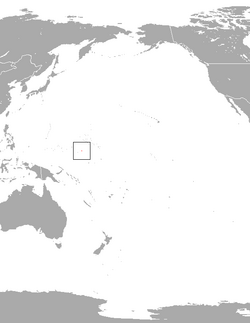
| Kosrae flying fox range | |

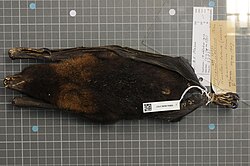
The Kosrae flying fox (Pteropus ualanus) is a species of megabat in the genus Pteropus found on the island of Kosrae, Micronesia.3
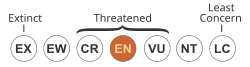
The Kosrae flying fox (Pteropus ualanus) has recovered to 2,000–3,000 bats but faces ongoing threats.4
Etymology
Pteropus ualanus was first documented in 1824 by French biologist René Primevère Lesson. Lesson first identified Pteropus ualanus as Pteropus karaudren; however, P. karaudren was later recognized as a synonym for P. mariannus.3 The first specimen was collected in 1827 by Russian biologist Heinrich von Kittlitz.4 The first specimen was collected in 1827 by Russian biologist Heinrich von Kittlitz.4
Conservation
Pteropus ualanus is vulnerable to population bottlenecks because of their geographic location. In 1926, P. ualanus nearly went extinct due to a population bottleneck caused by an unknown disease.4
References
References
- Hayes, F.E. & Wiles, G. (2020). "Pteropus ualanus". The IUCN Red List of Threatened Species. 2020. IUCN: e.T136531A21979719.
- "Appendices | CITES". cites.org. Retrieved 2022-01-14.
- D. E. Wilson & D. M. Reeder, 2005: Mammal Species of the World: A Taxonomic and Geographic Reference. Third Edition. The Johns Hopkins University Press, Baltimore
- Hayes, Floyd E.; Engbring, John (2020-06-01). "Historic and recent status of the Kosrae flying fox (Pteropus ualanus) (Chiroptera: Pteropidae) on Kosrae, Micronesia". Journal of Asia-Pacific Biodiversity. 13 (2): 141–150. doi:10.1016/j.japb.2020.02.008. ISSN 2287-884X.