| Knightoconus Temporal range: Dresbachian
~ | |
|---|---|
| |
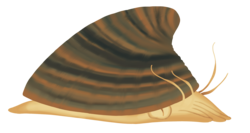
| Artistic reconstruction of Knightoconus antarcticus | |
Scientific classification 
| |
| Kingdom: | Animalia |
| Phylum: | Mollusca |
| Class: | Monoplacophora |
| Order: | †Kirengellida |
| Family: | †Hypseloconidae |
| Genus: | †Knightoconus Yochelson et al., 19732 |
| Species: | †K. antarcticus
|
| Binomial name | |
| †Knightoconus antarcticus Yochelson et al., 19732
| |
Knightoconus antarcticus is an extinct species of fossil monoplacophoran from the Cambrian Minaret Formation of Antarctica.2 It is thought to represent an ancestor to the cephalopods. It had a chambered conical shell, but lacked a siphuncle.3
Taxonomic debate
The absence of a siphuncle in K. antarcticus has been taken as evidence against its being an ancestor of cephalopods, as factors that would allow a siphuncle to penetrate preexisting septal chambers remain unknown. The prevailing argument suggests that a strand of tissue remained attached to the previous septum as the mollusc moved forwards and deposited its next septum, stopping that new septum from closing completely and becoming mineralised itself.4
Ten or more septa are found in mature individuals, occupying around a third of the shell – septa form very early and have been found in specimens as small as 2 mm in length.5 Unlike monoplacophoran fossils, there is no evidence of muscle scarring in Knightoconus fossils.5 Scars from the closely related Hypseloconus have been used to determine its orientation.6 Knightoconus started life with an exogastric shell that became endogastric as the organism grew.7
An alternate taxonomy is: Tergomya: Kiringellida: Hypseloconidae.1
References
References
- "†Knightoconus Yochelson et al. 1973". Paleobiology Database. Retrieved 1 July 2025.
- Yochelson, E.L.; Flower, R.H. & Webers, G.F. (1973). "The bearing of the new Late Cambrian monoplacophoran genus Knightoconus upon the origin of the Cephalopoda". Lethaia. 6 (3): 275–309. Bibcode:1973Letha...6..275Y. doi:10.1111/j.1502-3931.1973.tb01199.x.
- Boyle (2005). "Chapter 3: Origin and Evolution". Cephalopods – ecology and fisheries. p. 36. doi:10.1002/9780470995310.ch3. ISBN 9780632060481.
- Holland, C.H. (1987) [1986]. "The nautiloid cephalopods: A strange success". Journal of the Geological Society. President's anniversary address. 144 (1): 1–15. Bibcode:1987JGSoc.144....1H. doi:10.1144/gsjgs.144.1.0001. S2CID 128629737.
- Webers, G.F. & Yochelson, E.L. (1989). "Late Cambrian molluscan faunas and the origin of the Cephalopoda". In Crame, J.A. (ed.). Origins and Evolution of the Antarctic Biota. Special Publications. Vol. 47. London, UK: Geological Society. p. 29. doi:10.1144/GSL.SP.1989.047.01.04. S2CID 128682549.
- Peel, J. S. (1991). "Functional Morphology of the Class Helcionelloida Nov., and the Early Evolution of the Mollusca". In Simonetta, A. M.; Conway Morris, S (eds.). The Early Evolution of Metazoa and the Significance of Problematic Taxa. Cambridge University Press. pp. 157–177. ISBN 978-0-521-40242-2.
- Webers, G.F.; Pojeta, J. Jr. & Yochelson, E.L. (1992). "Cambrian Mollusca from the Minaret Formation, Ellsworth Mountains, West Antarctica". Geology and Paleontology of the Ellsworth Mountains, West Antarctica. Geological Society of America. pp. 181–248. ISBN 978-0-8137-1170-6.