King Crimson | |
|---|---|
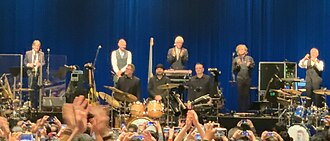
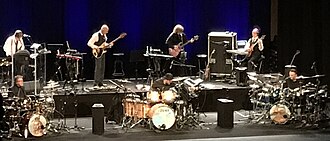 King Crimson in Nijmegen on 22 June 2019. Top L–R: Mel Collins, Tony Levin, Jakko Jakszyk, Robert Fripp. Bottom L–R: Pat Mastelotto, Jeremy Stacey, and Gavin Harrison. | |
| Background information | |
| Origin | London, England |
| Genres | |
| Works | |
| Years active |
|
| Labels | |
| Spinoffs | |
| Spinoff of | |
| Past members | |
| Website | dgmlive |
King Crimson were an English progressive rock band formed in London in 1968 by Robert Fripp, Michael Giles, Greg Lake, Ian McDonald and Peter Sinfield. Guitarist and leader Fripp remained the only constant member throughout the band's history.12 The band drew inspiration from a wide variety of music, incorporating elements of classical, jazz, folk, heavy metal, gamelan, blues, industrial, electronic, and experimental music. They also exerted a strong influence on the early 1970s progressive rock movement, including on contemporaries such as Yes and Genesis, and continue to inspire subsequent generations of artists across multiple genres.3 The band has earned a large cult following, especially in the 21st century.45
The band's debut album, In the Court of the Crimson King (1969), remains their most commercially successful and influential release,6 and is frequently cited as one of the most significant albums of the progressive rock genre.7 Following the breakdown of the original line-up, the next two albums, In the Wake of Poseidon and Lizard (both 1970), were recorded during a period of instability in the band's personnel, before a settled line-up of Fripp, Sinfield, Mel Collins, Boz Burrell and Ian Wallace recorded Islands in 1971. In mid-1972, Fripp disbanded this line-up, recruited new members Bill Bruford (formerly of Yes), John Wetton (formerly of Family), David Cross and Jamie Muir, and changed the group's musical approach, drawing from European free improvisation and modernist classical music and developing ever more complex compositions. The band released three more albums, Larks' Tongues in Aspic (1973), Starless and Bible Black and Red (both 1974), before Fripp disbanded King Crimson at the end of 1974.
After seven years of inactivity, King Crimson was recreated in 1981 with Fripp, Bruford and new American members Adrian Belew and Tony Levin. Drawing influence from African music, gamelan, post-punk and New York minimalism, this band lasted three years, recording the albums Discipline (1981), Beat (1982) and Three of a Perfect Pair (1984). Following a decade-long hiatus, they reformed in 1994, adding Pat Mastelotto (formerly of Mr. Mister) and Trey Gunn for a sextet line-up Fripp called "The Double Trio". The double trio undertook another three-year cycle of activity that included the EP Vrooom (1994) and the album Thrak (1995). Fripp, Belew, Mastelotto and Gunn reunited in 1999 as a quartet,8 called "The Double Duo", releasing The ConstruKction of Light (2000) and The Power to Believe (2003). After another hiatus, the band reformed for a 2008 tour celebrating the 40th anniversary of their 1968 formation, with Levin returning in place of Gunn and Gavin Harrison of Porcupine Tree being added.
Following another hiatus (2009–2012), during which Fripp was thought to be retired, King Crimson came together again in 2013, this time as a septet with an unusual three-drummer frontline, and new singer and secondary guitarist Jakko Jakszyk. This version of King Crimson, which expanded to an octet in 2017, toured from 2014 to 2021. After the band's final show in 2021, Fripp commented that King Crimson had "moved from sound to silence".9
History
1967–1968: Giles, Giles and Fripp
In August 1967, brothers Michael and Peter Giles, drummer and singer/bassist respectively, and professional musicians in working bands since their mid-teens in Dorset, England, advertised for a "singing organist" to join a new group they were forming.1011 Fellow Dorset musician Robert Fripp – a guitarist who neither sang or played organ – responded, and Giles, Giles and Fripp was born. The trio signed to Deram Records and recorded one album, The Cheerful Insanity of Giles, Giles and Fripp, released in 1968. They hovered on the edge of success, but were never able to make a commercial breakthrough.101213
Attempting to expand their sound, the three recruited Ian McDonald on keyboards and woodwinds. McDonald brought along two other participants: his then-girlfriend, former Fairport Convention singer Judy Dyble, whose brief tenure with the group ended when the two split,1415 and lyricist, roadie, and art strategist Peter Sinfield, with whom he had been writing songs – a partnership initiated when McDonald had said to Sinfield (regarding his band Creation), "Peter, I have to tell you that your band is hopeless, but you write some great words. Would you like to get together on a couple of songs?"16 Fripp, meanwhile, saw Clouds at the Marquee Club in London, which spurred him to incorporate classical-inspired melodies into his writing and utilise improvisation to find new ideas.17
No longer interested in Peter Giles's more whimsical pop songs, Fripp recommended that his old friend, fellow guitarist and singer Greg Lake, could join to replace either Peter or Fripp himself. Peter Giles later called it one of Fripp's "cute political moves".15 According to Michael Giles, his brother had become disillusioned with the band's lack of success and departed before Fripp ever made this suggestion.1814
1968–1969: Original line-up and In the Court of the Crimson King
The first incarnation of King Crimson—Fripp, Michael Giles, Lake, McDonald, and Sinfield—was formed on 30 November 1968 with rehearsals beginning on 13 January 1969.1419 Sinfield coined the band's name in "a moment of pressured panic". Sinfield had already used the term "crimson king" in a set of lyrics before his involvement with Giles, Giles and Fripp. Sinfield insisted that the name did not refer to Beelzebub, prince of demons, and that a "crimson king" was any ruler during whose reign there were "societal rumblings" and "sort of the dark forces of the world".2021 According to Fripp, King Crimson is a synonym for Beelzebub, which is an anglicised form of the Arabic phrase "B'il Sabab", meaning "the man with an aim", to which he related.2223
At this early point, McDonald was the primary composer, with vital contributions from Fripp and Lake, while Sinfield wrote all the lyrics on his own, and also designed and operated the band's unique stage lighting, being credited with "words and illumination" on the album sleeve. Inspired by the Moody Blues, McDonald suggested the group purchase a Mellotron keyboard, and this became a key component of the early Crimson sound.24 Sinfield described the original Crimson thus: "If it sounded at all popular, it was out. So it had to be complicated, it had to be more expansive chords, it had to have strange influences. If it sounded, like, too simple, we'd make it more complicated, we'd play it in 7/8 or 5/8, just to show off".25
King Crimson's first live performance was at the Speakeasy Club in London on 9 April 1969 (with Yes guitarist Peter Banks and David Bowie among the audience).2627 Their big breakthrough came on 5 July 1969 by playing as a support act at the Rolling Stones' free concert in Hyde Park, London, before an estimated 500,000 people.2814
The debut album, In the Court of the Crimson King, was released in October 1969 on Island Records. Fripp would later describe it as having been "an instant smash" and "New York's acid album of 1970" (notwithstanding Fripp and Giles's assertion that the band never used psychedelic drugs).19 The Who guitarist and composer Pete Townshend called the album "an uncanny masterpiece".29 The album contains Sinfield's gothic lyrics, and its sound was described as having "dark and doom-laden visions".3031 Its opening track "21st Century Schizoid Man" has been described as "proto-metal" and the song's lyrics criticise the Vietnam War.332 In contrast to the blues-based hard rock of the contemporary British and American scenes, King Crimson presented a more Europeanised approach that blended antiquity and modernity.3334 The band's music drew on a wide range of influences provided by all five group members. These elements included classical music, the psychedelic rock spearheaded by Jimi Hendrix, folk, jazz, military music (partially inspired by McDonald's stint as an army musician) and free improvisation.3323429
After playing gigs across England, the band toured the United States with various pop and rock acts, their first show being at Goddard College in Plainfield, Vermont. While the band found success and critical acclaim,35 creative tensions were already developing.14 Giles and McDonald, still striving to cope with King Crimson's rapid success and the realities of touring life, became uneasy with their musical direction. Although he was neither the dominant composer nor the frontman, Fripp was very much the group's driving force and spokesman, leading them into progressively darker and more intense musical areas. McDonald and Giles, now favouring a lighter and more nuanced romantic style, became increasingly uncomfortable, and told Fripp they would be leaving the band upon the conclusion of the US tour.36 To keep the band together, Fripp offered to resign himself, but McDonald declared that King Crimson was "more (him) than them" and that he and Giles should therefore be the ones to leave.37 McDonald later said he "was probably not emotionally mature enough to handle it" and made a "rash decision to leave without consulting anyone".38 The original line-up played their last show at the Fillmore West in San Francisco on 14 December 1969, a little over one year after forming,19 with McDonald's and Giles's departures made official in January 1970.15 Live recordings of the band from 1969 were released in 1997 on Epitaph and in 2010 on the In the Court of the Crimson King (1969) box set. McDonald and Giles, as a spin-off duo from King Crimson,39 released a self-tiled album in 1971.40 Giles would go on to work as a session drummer, while McDonald would co-form Foreigner in 1976.
1970: In the Wake of Poseidon and Lizard
King Crimson spent 1970 in a state of flux with various line-up changes, thwarted tour plans, and difficulties in finding a satisfactory musical direction, while Fripp was learning and developing as a songwriter during the writing process of the next three albums.41 As well as guitar, Fripp took on keyboard duties, while Sinfield expanded his creative role to operating synthesizers.
Following McDonald's and Giles's departure, Lake, unsure of the band's future without them, began discussions with Keith Emerson of the Nice about possibly forming a new band together. With Fripp and Sinfield planning the recording of the second King Crimson album, and Lake's position uncertain, the band's management booked Elton John to sing on the album, a decision cancelled by Fripp after he listened to John's then-only album, Empty Sky, and deemed his singing style to be not right for King Crimson.4243 Lake agreed to stay with the band until Emerson had completed remaining commitments with the Nice, at which point he left to form Emerson, Lake & Palmer with Emerson and Carl Palmer of Atomic Rooster. On the resulting In the Wake of Poseidon album, Lake provided all the lead vocals except on "Cadence and Cascade", which featured Fripp's old school friend Gordon Haskell.4445 The sessions also included Michael and Peter Giles on drums and bass respectively,4446 saxophonist Mel Collins (formerly of the band Circus),47 and jazz pianist Keith Tippett.48
Upon its release in May 1970, In the Wake of Poseidon reached No. 4 in the UK and No. 31 in the US. It received some criticism from those who thought it sounded too similar to their first album.49 With no set band to perform the new material, Fripp and Sinfield brought Mel Collins and Gordon Haskell in as full-time members, with Haskell doubling as lead vocalist and bassist and Collins playing woodwinds and keyboards, while Andy McCulloch joined as the band's new drummer.5048
Fripp and Sinfield wrote the band's third album, Lizard, with Haskell, Collins, and McCulloch having no say in the direction of the material. In addition to the core band, several session musicians contributed to the Lizard recording, including the returning Keith Tippett, who was offered to be a member of the new line-up, but due to other commitments could only work with the band as an occasional guest musician,51 and two members of Tippett's band, Mark Charig on cornet and Nick Evans on trombone. Oboe and cor anglais player Robin Miller also appeared, while Jon Anderson of Yes was brought in to sing a section of the album's title track, "Prince Rupert Awakes", which Fripp and Sinfield considered to be outside Haskell's natural range and style. Lizard featured stronger jazz and chamber-classical influences than previous albums.1548 The album contains Sinfield's "phantasmagorical" lyrics, including "Happy Family" (an allegory of the break-up of the Beatles),52 and the title track, a suite which took up the entire second side, describing a medieval battle and its outcome.53
Released in December 1970, Lizard reached No. 29 in the UK and No. 113 in the US. Described retrospectively as an "outlier",52 the album had been made by a group in disagreement over method and taste. The more rhythm-and-blues-oriented Haskell and McCulloch both found the music difficult to relate to, and tedious and confusing to record. Collins disliked how his parts were composed, while both Fripp and Haskell detested Sinfield's lyrics.50 This line-up of the band did not survive much longer than the Lizard recording sessions. Haskell quit the band acrimoniously during initial tour rehearsals, after refusing to sing live with distortion and electronic effects on his voice, and McCulloch departed soon after.1415 With Sinfield not being a musician and Fripp having seemingly given up on the band, Collins was left to search for new members.50
1971–1972: Islands
After a search for a drummer to replace McCulloch, Ian Wallace was secured. Fripp was re-energised by the addition of a new member, and he joined Collins and Wallace to audition singers and bassists. Singers who tried out included Bryan Ferry of Roxy Music (Sinfield would produce Roxy Music's first album in 1972) and even one of the band's managers, John Gaydon.5054 The position eventually went to Raymond "Boz" Burrell.14 John Wetton was invited to join on bass, but declined in order to join Family instead.5556 Rick Kemp (later of Steeleye Span) rehearsed with the band, but declined the final offer to formally join.48 Fripp decided to teach Burrell to play bass rather than continue the labored auditions. Though he had not played bass before, Burrell had played enough acoustic guitar to assist him in learning the instrument quickly. Wallace was able to further instruct Burrell in functioning on the instrument in a rhythm section.57
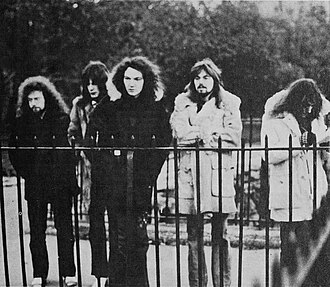
With a line-up now complete, King Crimson began touring in May 1971, the first time they had played live since the original line-up's last show on 14 December 1969. The concerts were well received, but musical differences and the somewhat wilder lifestyles of Collins, Wallace, and Burrell alienated the non-drug-taking Fripp, who began to withdraw socially from his bandmates, creating further tension.50
In 1971, the new King Crimson formation recorded Islands. Sinfield, who now favoured a softer approach, took lyrical inspiration from Homer's Odyssey, musical inspiration from jazz players like Miles Davis and Ahmad Jamal, and a trip to the Balearic Islands.205859 Islands featured the instrumental "Sailor's Tale", with a droning Mellotron and Fripp's banjo-inspired guitar solo; the raunchy blues-rocker "Ladies of the Road", a tribute to groupies which featured Wallace and Collins singing Beatlesque backing vocals; and "Song of the Gulls", which was developed from the instrumental "Suite No. 1" from Giles, Giles & Fripp's 1968 album60 and would be the only time the band would utilize an orchestra.4861 Burrell disliked Sinfield's lyrics, and one of the band members allegedly called Islands "an airy-fairy piece of shit".6263
Released in December 1971, Islands charted at No. 30 in the UK and No. 76 in the US. That same month, the band undertook a short tour of the United States, after which Fripp informed Sinfield that he could no longer work with him and asked him to leave King Crimson.20586465 In January 1972, the remaining four members broke up acrimoniously in rehearsals, owing partially to Fripp's refusal to play a composition by Collins.50 He later cited this as "quality control", with the idea that King Crimson would perform the "right" kind of music.15
In order to fulfill touring contracts in the United States in 1972, Fripp, Collins, Burrell, and Wallace reformed with the intention of disbanding immediately after the tour.50 Recordings from various North American dates during January and February 1972 were released as Earthbound in June of that year. The album was noted for its performance style, that occasionally veered towards funk, and for Burrell's scat singing on the improvised pieces, but was criticised for its poor sound quality.6667 Better-quality live recordings from this era would be released in 2002 as Ladies of the Road and in 2017 on the Sailors' Tales (1970–1972) box set.
By this time the musical rift between Fripp and the rest of the band had grown very wide. Wallace, Burrell, and Collins favoured improvised blues- and funk-influenced music; Fripp would later describe the 1971–1972 line-up as more of a jam band than an "improvising" band, an opinion with which Wallace disagreed. Personal relations, however, improved during the tour to the point where most of the band wanted to continue; nonetheless, Fripp opted to part company with the other three and reconstitute King Crimson with new musicians, as he felt the other members would not fully engage with the musical direction he now had in mind.62 Collins went on to join Camel, Burrell co-formed Bad Company, and Wallace became a session musician, most notably playing on several Bob Dylan albums and the Traveling Wilburys' first album.
1972–1975: Larks' Tongues in Aspic, Starless and Bible Black, Red and hiatus
"It was going to be an interesting ride when ... I wasn't given a setlist when I joined the band, more a reading list. Ouspensky, J. G. Bennett, Gurdjieff and Castaneda were all hot. Wicca, personality changes, low-level magic, pyromancy – all this from the magus in the court of the Crimson King. This was going to be more than three chords and a pint of Guinness."
The next incarnation of King Crimson was radically different from the previous configurations. Fripp's four new recruits were free-improvising percussionist Jamie Muir; drummer Bill Bruford, who had left Yes at a critical and commercial peak in their career in favour of the "darker" Crimson;69 bassist and vocalist John Wetton, who left Family; and violinist, keyboardist and flautist David Cross, whom Fripp had met when he was invited to a rehearsal of Waves, a band Cross was working in.1470
Fripp and Wetton were this incarnation's primary composers, each writing segments independently and fitting together those which they found compatible.71 With Sinfield gone, the band asked Wetton's friend Richard Palmer-James, formerly of Supertramp, to be their new lyricist.14 Unlike Sinfield, Palmer-James was not an official member of King Crimson, having no involvement with the band other than writing lyrics, which he would mail to them from his home in Germany.7273 Following a period of rehearsals, King Crimson resumed touring on 13 October 1972 at the Zoom Club in Frankfurt,74 with the band's penchant for improvisation and Muir's startling stage presence gaining them renewed press attention.70
In January and February 1973, King Crimson recorded Larks' Tongues in Aspic in London; the album was released that March.75 The band's new sound was exemplified by the album's two-part title track, which emphasised the sharp instrumental interplay of the band and drew influence from modernist classical music, noisy free improvisation, and heavy metal. The record displayed Muir's unusual approach to percussion, which included a self-modified drum kit, assorted toys, a bullroarer,76 mbira, gongs, balloons, a thunder sheet and chains. On stage, Muir also employed unpredictable, manic movements, bizarre clothing, and fake blood capsules which he occasionally spit or applied to the head; this was the sole example of such on-stage theatrics in the band's long history.77557879 The album reached No. 20 in the UK and No. 61 in the US.
After a period of further touring, Muir departed in 1973, quitting the music industry altogether. Muir told King Crimson's management that a musician's life was not for him, and he had chosen to join a Scottish Buddhist monastery. He offered to serve a period of notice which the management declined. Instead of giving the real reason for Muir's departure, the management informed the rest of the band and the public that Muir had sustained an onstage injury caused by a gong landing on his foot.805570
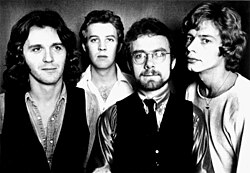
With Muir gone, the remaining members continued as a four-piece, releasing Starless and Bible Black in March 1974. Earning a positive Rolling Stone review,8182 most of the album was recorded live during the band's late 1973 tour, with the recordings carefully edited and overdubbed to sound like studio recordings, while "The Great Deceiver", "Lament" and the second half of "The Night Watch" were recorded entirely in the studio.8384 The album reached No. 28 in the UK and No. 64 in the US.
Following the album's release, the band began to divide once more, this time over performance. Musically, Fripp found himself positioned between Bruford and Wetton, who played with such force and increasing volume that Fripp once compared them to "a flying brick wall", and Cross, whose amplified acoustic violin was consistently drowned out by the rhythm section, leading him to concentrate more on keyboards. An increasingly frustrated Cross began to withdraw both musically and personally, with the result being that he was voted out of the group following the band's 1974 tour.1585
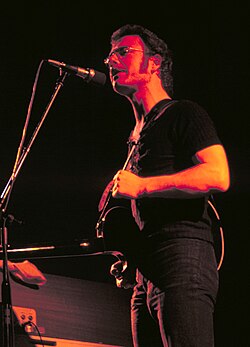
In July 1974, Fripp, Bruford, and Wetton began recording Red.14 Before recording began, Fripp, now increasingly disillusioned with the music industry, turned his attention to the works of English mystic John G. Bennett and had a spiritual experience in which "the top of my head blew off".86 Most of the album had been developed during live improvisations before Fripp "withdrew his opinion", leaving his bandmates to direct the sessions. The album contains one live track, "Providence", recorded on 30 June 1974 in Providence, Rhode Island with Cross on violin. Several guest musicians, including former members Ian McDonald and Mel Collins on saxophones, contributed to the album.8788 Released on 6 October 1974,89 Red went to No. 45 in the UK and No. 66 in the US. AllMusic later called it "an impressive achievement" for a group about to disband,90 with "intensely dynamic" musical chemistry between the band members.91
Two months before the release of Red, King Crimson's future looked bright, with talks regarding the possibility of McDonald rejoining the group. However, Fripp wished not to tour as he felt increasingly disenchanted by the group and the music industry. He also felt the world was going to drastically change by 1981 and that he had to prepare for it.9287 Despite a band meeting while touring the US in which Fripp expressed a desire to end the band,93 the group did not formally disband until 25 September 1974; the following month Fripp announced in an interview with Trouser Press magazine that King Crimson had "ceased to exist" and was "completely over for ever and ever".1494 It was later revealed that Fripp had attempted to replace himself with McDonald and Steve Hackett of Genesis, but this was rejected by the managers.9596
Following the band's disbandment, the live album USA was released in May 1975, formed of recordings from their 1974 North American tour. It received some positive reviews,67 including being deemed "a must" for fans of the band and "insanity you're better off having".9798 Issues with the tapes rendered some of Cross's playing inaudible, so Eddie Jobson of Roxy Music was hired to perform violin and keyboard overdubs; further edits were also made to allow the music to fit on a single LP.99 More live recordings from the 1972–1974 era would be issued as The Night Watch in 1997, and as part of the box sets The Great Deceiver (1992), Larks' Tongues in Aspic (1972–1973) (2012), The Road to Red (1974), and Starless (1973–1974) (both 2014). After short stints with Roxy Music and Uriah Heep, Wetton went on to co-form U.K. with Bruford in 1977, and Asia in 1981; Bruford, in addition to U.K., formed the jazz fusion band Bruford. From 1975 to 1980, King Crimson were completely inactive.
1981–1984: Discipline, Beat, Three of a Perfect Pair and second hiatus

In the late autumn of 1980, having spent several years on spiritual pursuits and then gradually returning to music (including playing guitar for David Bowie, Brian Eno, Peter Gabriel and Daryl Hall; pursuing an experimental solo career; and leading the instrumental new wave band The League of Gentlemen), Fripp decided to form a new "first division" rock group.100
Having recruited Bruford as drummer, Fripp then asked the American singer and guitarist Adrian Belew, who had previously played with Bowie and Frank Zappa, to join;101 this was the first time Fripp would actively seek collaboration with another guitarist in a band, and therefore indicative of his desire to create something unlike any of his previous work.102 After touring with Talking Heads, Belew agreed to join and also become the band's lyricist. Bruford's suggestion of bassist Jeff Berlin of Bruford was rejected as Fripp thought his playing was "too busy",103 so auditions were held in New York; on the third day, Fripp left after roughly three auditions, only to return several hours later with session bassist Tony Levin (who got the job after playing a single chorus of "Red").68 Fripp later confessed that, had he known that Levin (whom Fripp had played with in Peter Gabriel's group) was available and interested, he would have selected him without holding auditions. Fripp named the new quartet Discipline, and they went to England to rehearse and write new material. They made their live debut at Moles Club in Bath, Somerset on 30 April 1981, and completed a short UK tour supported by the Lounge Lizards.104105106 By October 1981, the band had opted to change their name to King Crimson.14
Fripp intended to create the sound of a "rock gamelan", with an interlocking rhythmic quality to the paired guitars that he found similar to Indonesian gamelan ensembles.107 In 1981, King Crimson recorded Discipline in London with producer Rhett Davies, who had previously worked with Belew on Talking Heads' Remain in Light and with Fripp on Eno's Another Green World and Before and After Science. The album displayed a very different version of the band, with newer influences including post-punk, new wave, funk, minimalism, pointillism, world music and African percussion,108109110111 and a sound described in The New Rolling Stone Album Guide as having a "jaw-dropping technique" of "knottily rhythmic, harmonically demanding workouts".91 The title track was described as a postminimalist rock song.112 Fripp concentrated on playing complex picked arpeggios, while Belew provided an arsenal of guitar sounds that "often mimic animal noises"; both also experimented with guitar synthesisers.113114 In addition to bass guitar, Levin used the Chapman Stick, a ten-string hybrid guitar and bass instrument played by two-handed tapping, in an "utterly original style".115116117 Bruford experimented with Simmons SDSV electronic drums and largely eschewed cymbals. The band's songs were shorter in comparison to previous King Crimson albums, shaped by Belew's pop sensibilities and quirky approach to writing lyrics. Though the band's previous taste for improvisation was now tightly reined in, one instrumental ("The Sheltering Sky") emerged from group rehearsals, while the noisy, half-spoken/half-shouted "Indiscipline" was a part-written, part-improvised piece created in order to give Bruford a chance to escape from the strict rhythmic demands of the rest of the album.15 Released in September 1981, Discipline reached No. 41 in the UK and No. 45 in the US.
In June 1982, King Crimson followed Discipline with Beat, the first King Crimson album recorded with the same line-up as the album preceding it.118 Beat was also the group's only album where Fripp had no involvement in the original mixing, with Davies and Belew undertaking production duties.119120 The album was themed around the lives and works of Beat Generation writers, reflected in song titles such as "Neal and Jack and Me" (inspired by Neal Cassady and Jack Kerouac), "Heartbeat" (inspired by Carolyn Cassady's "Heart Beat: My Life with Jack and Neal"), "The Howler" (inspired by Allen Ginsberg's "Howl") and "Waiting Man" (inspired by William Burroughs). The album contained themes of life on the road, existential angst and romanticism.121122123 While Beat was more pop-influenced than Discipline,124 it also featured the improvised "Requiem", which featured Frippertronics, a guitar technique invented by Eno and Fripp using a tape loop system.125
The recording of Beat was marred by tension within the band, with Belew suffering stress over his duties as frontman, lead singer, and principal songwriter. On one occasion, he clashed with Fripp and ordered him out of the studio.126119 As Beat reached No. 39 in the UK and No. 52 in the US, King Crimson resumed touring. "Heartbeat" was released as a single (paired with the band's first music video), which peaked at No. 57 on the Billboard Mainstream Rock chart. Around this time the band released the VHS The Noise: Live in Frejus, a document of a show played at the Arena in Fréjus, France on 27 August 1982, co-headlining with Roxy Music (whose set from the same show was also released on VHS as The High Road). This footage was later re-released as part of the Neal and Jack and Me DVD in 2004.
King Crimson's next album, Three of a Perfect Pair, was recorded in 1983 in the UK and US and released in March 1984. Having encountered difficulty in both writing and determining a direction for the album, the band chose to record and call the album's first half a "left side" – four pop-oriented songs and an instrumental – and the second, mostly-instrumental half a "right side" which contained more experimental work, improvisations that drew influence from industrial music127 and a third movement of "Larks' Tongues in Aspic". Stress during the writing process and the tension between the band members manifested in both lyrical content and music.113128129130 The 2001 remaster of the album included an "other side", a collection of remixes and improvisational out-takes plus Levin's humorous song, "The King Crimson Barbershop".131132 Three of a Perfect Pair peaked at No. 30 in the UK and No. 58 in the US, with the title track and "Sleepless" being released as singles. The live video Three of a Perfect Pair: Live in Japan was released later in 1984 on VHS (and later also included on the Neal and Jack and Me DVD). The last concert of the Three of a Perfect Pair tour, at the Spectrum in Montreal on 11 July 1984, was recorded and released in 1998 as Absent Lovers: Live in Montreal.133 Further live recordings of the 1980s band would be released in 2016 as part of the On (and off) The Road (1981–1984) box set. Despite their conflict, the musicians remained professional on stage.116
"Robert broke up the group, again, for the umpteenth time, dwelling at length, I suppose, on our lack of imagination, ability, direction and a thousand other things we were doubtless missing. I suppose this only because I remember not listening to this litany of failures. Might as well quit while you're ahead, I thought."
Following the 1984 tour, Fripp dissolved King Crimson for the second time, exactly ten years after the band's 1974 split. Bruford and Belew expressed frustration over this; Belew recalled the first he had heard of it was through a report in Musician magazine.134135
1994–1999: The Double Trio, Vrooom, Thrak and the ProjeKcts
In the summer of 1991, Belew met with Fripp in England to express an interest in reviving King Crimson.136 That year saw the release of the retrospective box set Frame by Frame: The Essential King Crimson.137 A follow-up box set, The Great Deceiver, appeared the following year as the first release on Fripp's newly-established record label Discipline Global Mobile (DGM),138 formed with producer David Singleton. Subsequently, DGM would be the primary home for Fripp's work, with larger album releases distributed to bigger record companies (initially Virgin Records), and smaller releases handled by DGM. This afforded Fripp and his associates greater creative freedom and more control over all aspects of their work.139
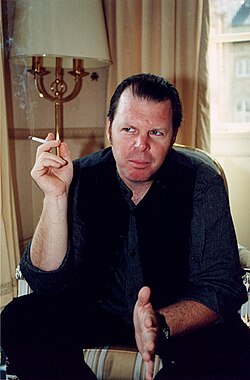
In late 1991, Fripp asked former Japan singer David Sylvian to join a new King Crimson line-up. Sylvian declined the offer, but agreed to work with Fripp on a collaborative album; the resulting album The First Day was issued in 1993 under the name Sylvian/Fripp.140 In June 1993, Fripp began to assemble a larger version of King Crimson featuring Belew and Levin, Chapman Stick player Trey Gunn (a veteran of Fripp's Guitar Craft courses and a session musician on The First Day)141 and drummer Jerry Marotta,14277143 with whom Fripp and Levin had played in Peter Gabriel's band.144 After Sylvian/Fripp's closing concerts at the Royal Albert Hall in December 1993,140145 Fripp decided to ask the tour's drummer Pat Mastelotto, formerly of Mr. Mister, to join instead of Marotta.143 Bruford would become the last member of the 1980s quartet to return to the band.77 Bruford later said he had lobbied Fripp at the last minute because he believed that Crimson was still very much "his gig", and that Fripp had come up with a philosophical explanation for utilizing both Mastelotto and Bruford later. One of the conditions Fripp imposed upon Bruford if he were to return was to give up all creative control to Fripp.68 Fripp later explained that he had a vision of a "Double Trio" with two guitarists, two bassists, and two drummers while driving along the Chalke Valley in Wiltshire one afternoon in 1992.115136
Following rehearsals in Woodstock, New York, the group released the EP Vrooom in October 1994. This revealed the new King Crimson sound, which featured the interlocking guitars of the 1980s mixed with the layered, heavier feel of the 1973–74 line-up.146 There was also a vague influence from the industrial music of that time.147148 Many of the songs were written or finalised by Belew, and displayed stronger elements of 1960s pop than before; in particular, a Beatles influence.149 Bruford would refer to this line-up as sounding like "a dissonant Shadows on steroids".68 As with previous line-ups, new technology was utilised, including MIDI (which Belew and Gunn used to control guitar synthesisers and Fripp used to replace Frippertronics with "Soundscapes")139150151 and the Warr Guitar with which Gunn replaced his Chapman Stick in 1995.152 The double trio began touring on 28 September 1994 in Buenos Aires, Argentina; portions of these concerts were released on the double live CD set B'Boom: Live in Argentina in 1995.
"The meaning of THRAK ... the first one is: a sudden and precise impact moving from direction and commitment in service of an aim ... The second definition is: 117 guitars almost hitting the same chord simultaneously. So, the album THRAK, what is it? 56 minutes and 37 seconds of songs and music about love, dying, redemption and mature guys who get erections."
In October and December 1994, King Crimson recorded their eleventh studio album, Thrak, at Peter Gabriel's Real World Studios.146 Containing revised versions of the songs from Vrooom, plus some new tracks, the album was described by Q magazine as having "jazz-scented rock structures, characterised by noisy, angular, exquisite guitar interplay" and an "athletic, ever-inventive rhythm section",154 while being in tune with the sound of alternative rock of the mid-1990s.155 Examples of the band's efforts to integrate their multiple elements could be heard on the accessible (but complex) songs "Dinosaur" and "Sex Sleep Eat Drink Dream", the more straightforward ballad "One Time", as well as "Radio I" and "Radio II"- a pair of Fripp's Soundscapes instrumentals.149
King Crimson resumed touring in 1995 and into 1996. Dates from October and November 1995 were recorded and released on the live album Thrakattak in May 1996, which is an hour of improvised music integrating sections from performances of Thrak's title track in the United States and Japan as mixed and arranged into a single work by David Singleton.15615722 A more conventional live recording from the period was later made available as the double CD release Vrooom Vrooom (2001), while a full 1995 concert was released on VHS in 1996 as Live in Japan and re-released on DVD in 1999 as Déjà Vrooom. The double trio would be further honoured by the Thrak (1994–1997) box set in 2015.
The band began rehearsing again in May 1997 in Nashville, Tennessee. Fripp was dissatisfied with the quality of the new music being developed by the band, and longstanding friction between himself and Bruford resurfaced. The resulting atmosphere and the lack of workable material almost broke the band up altogether. Instead, the six members opted to work in four smaller groups (or "fraKctalisations", as Fripp called them) known as ProjeKcts. This enabled the group to continue developing ideas and searching for a new direction without the practical difficulty and expense of convening all six musicians at once. From late 1997 to early 1999, ProjeKct One (Fripp, Bruford, Levin, Gunn), ProjeKct Two (Fripp, Belew, Gunn), ProjeKct Three (Fripp, Gunn, Mastelotto), and ProjeKct Four (Fripp, Levin, Gunn, Mastelotto) played live in the United States and the United Kingdom, with recordings from these performances released on The ProjeKcts box set in 1999. These largely-improvised recordings, along with ProjeKct Two's 1998 studio album Space Groove, showed influences including jazz, industrial, techno and drum and bass.158159 Music critic J. D. Considine considered the ProjeKcts' work "frequently astonishing" but lacking in melody.91 The four live performances of ProjeKct One in December 1997 would be Bruford's last involvement with King Crimson.159
1999–2003: The Double Duo, The ConstruKction of Light and The Power to Believe
King Crimson reconvened in 1999. With Levin busy with session work, and believing Bruford to be more concerned with his jazz band Earthworks than Crimson, Fripp decided the next phase of King Crimson would be a "Double Duo" of himself, Belew, Gunn, and Mastelotto.160 This line-up recorded The ConstruKction of Light at Belew's home studio in Mount Juliet, Tennessee.159161162 Fripp was inspired by Tool's album Undertow during the writing process of The ConstruKction of Light.163 Released in May 2000, the album reached No. 129 in the UK. Most of the pieces were metallic, harsh and industrial metal–influenced,8 featuring Mastelotto performing exclusively on electronic drums, Gunn taking over the bass role on Warr Guitar, and a different take on the interlocking guitars of the 1980s quartet.159 With the exception of an "industrial blues" sung by Belew through a voice changer (under the pseudonym of "Hooter J. Johnson"), the songs were dense and complex.1644165 The album also contained the fourth installment of "Larks' Tongues in Aspic". It received a negative reception for lacking new ideas.166 At the same time as recording The ConstruKction of Light, the band also recorded an album of improvised instrumentals, Heaven and Earth, released under the name ProjeKct X.167
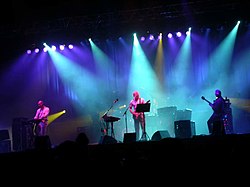
King Crimson toured to support both albums, including double bill shows with Tool.168 The tour was documented on the live album Heavy ConstruKction in 2000 and the Heaven & Earth (1997–2008) box set in 2019.169 Led Zeppelin bassist John Paul Jones and his band supported Crimson on some live shows.170
On 9 November 2001, King Crimson released a limited edition live EP called Level Five,171 featuring three new pieces: "Dangerous Curves", "Level Five" and "Virtuous Circle", plus versions of "The ConstruKction of Light" and ProjeKct's "The Deception of the Thrush", followed by an unlisted track called "ProjeKct 12th and X" after one minute of silence.172 A second EP followed in October 2002, Happy with What You Have to Be Happy With. This featured eleven tracks (including a live version of "Larks' Tongues in Aspic, Part IV"). Half of the tracks were processed vocal snippets by Belew, and the songs themselves varied between Soundscapes, gamelan, heavy metal and blues.159173
The double duo line-up released King Crimson's thirteenth album, The Power to Believe, in March 2003.174 Fripp described it as "the culmination of three years of Crimsonising".175 The album incorporated, reworked and retitled versions of "Deception of the Thrush" ("The Power to Believe III"), tracks from their previous two EPs, and an extract from a Fripp Soundscape with added instrumentation and vocals, alongside "Level Five" (the final installment of the "Larks' Tongues in Aspic" suite).159176 The Power to Believe reached No. 162 in the UK and No. 150 in the US. King Crimson toured in 2003 to support the album; recordings from it were used for the live album EleKtrik: Live in Japan. 2003 also saw the release of the DVD Eyes Wide Open, a compilation of the band's shows Live at the Shepherds Bush Empire (London, 3 July 2000) and Live in Japan (Tokyo, 16 April 2003).
In November 2003, Gunn left the group to pursue solo projects and was replaced by Levin.177178 The band reconvened in early 2004 for rehearsals, but nothing developed from these sessions; they then went on another hiatus.16114 At this point, Fripp was publicly reassessing his desire to work within the music industry, often citing the unsympathetic aspects of the life of a touring musician, such as "the illusion of intimacy with celebrities".179180181 Two retrospective box sets, The 21st Century Guide to King Crimson Volume One 1969–1974 and The 21st Century Guide to King Crimson Volume Two 1981–2003, were issued in 2004 and 2005 respectively.
On 21 September 2006, former King Crimson member Boz Burrell died of a heart attack,182 followed by another former member, Ian Wallace, who died of esophageal cancer on 22 February 2007.183
2008: 40th Anniversary tour and third hiatus
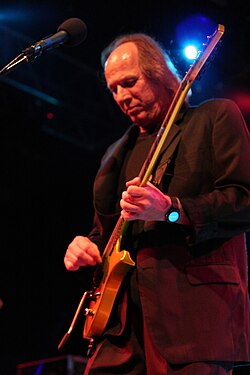
A new King Crimson formation was announced in 2007: Fripp, Belew, Levin, Mastelotto, and a new second drummer, Gavin Harrison of Porcupine Tree.14 In August 2008, after a period of rehearsals, the five completed the band's 40th Anniversary Tour. The setlists featured no new material, drawing instead from the existing Larks' Tongues-era/Discipline-era/Double Trio/Double Duo repertoire.159184 Additional shows were planned for 2009, but were cancelled due to scheduling clashes with Belew.185186
King Crimson began another hiatus after the 40th Anniversary Tour.187188 Belew continued to lobby for reviving the band, and discussed it with Fripp several times in 2009 and 2010. Among Belew's suggestions was a temporary reunion of the 1980s line-up for a thirtieth anniversary tour: an idea declined by both Fripp and Bruford, the latter commenting "I would be highly unlikely to try to recreate the same thing, a mission I fear destined to failure."189190191 In December 2010, Fripp wrote that the King Crimson "switch" had been set to "off" since October 2008, citing several reasons for this decision.192
In August 2012, Fripp announced his planned retirement from the music industry, leaving the future of King Crimson uncertain.193
2014–2021: The Seven-Headed Beast and Three Over Five line-ups
Prior to Fripp's retirement announcement, a band called Jakszyk, Fripp and Collins (subtitled "A King Crimson ProjeKct") had released an album called A Scarcity of Miracles in 2011. The band featured guitarist and singer Jakko Jakszyk (who had previously performed King Crimson material alongside former members with 21st Century Schizoid Band), Fripp and Mel Collins, with Tony Levin playing bass and Stick and Gavin Harrison drumming. At one point, Fripp referred to the band as "P7" (ProjeKct Seven).192 Unusually for a ProjeKct, it was based around "finely crafted" and "mid-paced" original songs derived from improvised sessions.194195
In September 2013, Fripp announced King Crimson's return to activity with a "very different reformation to what has gone before: seven players, four English and three American, with three drummers".193 He cited several reasons to make a comeback, varying from the practical to the whimsical: "I was becoming too happy. Time for a pointed stick."196197 The new line-up drew from both the previous line-up (retaining Fripp, Levin, Harrison and Mastelotto) and the Scarcity of Miracles project (Jakszyk and Collins), with Guitar Craft alumnus and former R.E.M./Ministry drummer Bill Rieflin as the seventh member.14198 Belew was not asked to take part, thus ending his 32-year tenure in King Crimson.199 This version of the group took on the nickname of "the Seven-Headed Beast".95
This drastically revamped King Crimson had no plans to record in the studio, focusing instead on playing "reconfigured" versions of past material live.200 According to Levin, the band "were instructed/advised by Robert Fripp to look at the older classic King Crimson material as if we had written it. And so we did that with a lot of older material that the band had done before the '80s. We didn't actually cover that much of the '80s material outside of a few songs."201
For the most part, this approach would remain consistent for the remainder of the band's lifetime. In early 2014, the band's repertoire included songs from the run of albums between In the Court of the Crimson King and Larks' Tongues in Aspic for the first time since 1974, as well as reviving song material from Red. No songs with vocals by Belew were included in the setlist, although some instrumentals from his tenure were played. Some material from A Scarcity of Miracles was also incorporated into the band's repertoire.
After rehearsing in England, King Crimson toured North America from 9 September to 6 October.202203204 Recordings from the Los Angeles dates were released as Live at the Orpheum; this included the newly-written instrumentals "Banshee Legs Bell Hassle" and "Walk On: Monk Morph Chamber Music".
Tours of Europe, Canada, and Japan followed in the later half of 2015.205 Brand-new songs mainly written by Fripp and Jakszyk were debuted at the concerts, as well as drum showcases. A live recording from the Canadian leg of the tour was released at the end of February 2016 as Live In Toronto, which included the new songs "Radical Action (To Unseat the Hold of Monkey Mind)" and "Meltdown". A European tour was planned for 2016. Following Rieflin's decision to take a break from music, drummer Jeremy Stacey of Noel Gallagher's High Flying Birds was called in place for dates from September.206
The live album Radical Action to Unseat the Hold of Monkey Mind, was released in September 2016, drawing from 2015 concert dates of Japan, Canada and France featuring Rieflin. A 4-disc set aimed at documenting the band's ever-evolving live setlist, it included one performance of every song the band presented onstage during the tour and concert footage mostly recorded in Takamatsu, Japan, on 19 December 2015.
On 7 December 2016, founding King Crimson member Greg Lake died of cancer.207 Another former King Crimson member, John Wetton, died of colon cancer on 31 January 2017.208
On 3 January 2017, Rieflin returned to King Crimson.209 Since the band also wished to retain Stacey, King Crimson became an octet, which Fripp initially referred to as the "Double Quartet Formation".210 Rieflin later eschewed drumming with the group and became King Crimson's first full-time keyboardist, with Fripp rechristening the line-up the "Three Over Five" (or "Five Over Three") formation.211212
On 2 June 2017, King Crimson released a new live EP named Heroes, featuring a cover of the David Bowie song of the same name. The EP was intended as a tribute to Bowie, for whom Fripp had provided distinctive guitar work on the albums "Heroes" (1977) and Scary Monsters (and Super Creeps) (1980).213 The video for King Crimson's version of "Heroes" won "Video of the Year" at the 2017 Progressive Music Awards.214 Shortly afterwards, King Crimson embarked on the first leg of a North American tour, from 11 June until 19 July.215216 On 3 September, Robert Fripp said that his differences with Adrian Belew had been resolved and that, while there were "no current plans for [him] to come out with the current formation," he could potentially be invited back to the band in the future. Belew subsequently confirmed this.5217
On 14 October 2017, King Crimson released another contemporary live album, Live in Chicago, recorded on tour in June of the same year. As had been the case with its two predecessors, it included new material (in this case "Bellscape & Orchestral Werning", "The Errors" and "Interlude"); it also documented the return to the live set of material from Lizard (in the form of "Cirkus", which the band had begun adding to their sets in 2016, and the second half of the title suite), as well as new arrangements of some Belew-era songs.
On 13 October 2017, it was announced that Rieflin would be unable to join the Three Over Five Formation on the 2017 Autumn tour in the U.S. He was temporarily replaced by Seattle-based Crafty Guitarist Chris Gibson.218 During 2018, King Crimson performed the extensive 33-date Uncertain Times tour through the UK and Europe between 13 June and 16 November.219
Although the band continued to avoid studio recording, April 2018 saw the full release of another live album, Live in Vienna, presenting the complete concert in Vienna on 1 December 2016. The album was originally scheduled for worldwide release in 2017, but was postponed in lieu of Live in Chicago; however, it was only released in Japan in September 2017, with a bonus disc with recordings from the band's tour there in December 2015. The worldwide release added a performance of "Fracture", plus three pieces drawn from the nightly Fripp-composed introductory soundscapes with improvisations by Collins and Levin: these pieces were arranged and realised by David Singleton, reflecting similar work he'd performed for Thrakattak twenty years earlier.220 On 20 October 2018, a further live album/video was released, Meltdown: Live in Mexico City, recorded during dates in July 2017.
On 6 April 2019, it was announced at a press conference that Rieflin would take another break from King Crimson to attend to family matters; his place on keyboards for the 2019 50th anniversary tour was set to be taken by Theo Travis of Soft Machine, an occasional duo collaborator with Fripp.9596 Although Travis joined the band for rehearsals, Fripp said on 2 May that the band had decided that it was no longer possible to have other musicians deputising for Rieflin and for this reason would "proceed as a Seven-Headed Beast" without Travis.221 Rieflin's parts were divided among Fripp, Stacey, Jakszyk, Collins, and Levin.222223 On 11 June, King Crimson's entire discography was made available on streaming services, as part of the band's 50th anniversary celebration.224
On 24 March 2020, Rieflin died of cancer.225 In the same year, King Crimson collaborator Keith Tippett died after several years of illness on 14 June,226 and former bassist and singer Gordon Haskell died from lung cancer on 15 October.227
King Crimson toured North America and then Japan in 2021.228 Recordings from dates on the American leg of the tour were released as the "official bootleg" live album Music Is Our Friend: Live in Washington and Albany, featuring music from across the band's lifetime plus two new Tony Levin cadenzas.229230
2022: In the Court of the Crimson King documentary; end of band activity
Following the band's 2021 tour dates, King Crimson ceased activity without expressly announcing a breakup. Fripp cited practical reasons for concluding the band's touring career, such as the old age of several of the members and the rising cost of services during the COVID-19 pandemic.231232
On 9 February 2022, founding King Crimson member Ian McDonald died of cancer.38
In March 2022, the documentary film In the Court of the Crimson King was premiered at the 2022 SXSW Film Festival. Directed by Toby Amies and filmed between 2019 and 2021, it covered live and backstage activity by the then-current band but also featured a historical overview plus contributions from Crimson alumni Ian McDonald, Michael Giles, Bill Bruford, Adrian Belew and Trey Gunn (as well as prolonged interview footage with the late Bill Rieflin). Amies described the film's development as follows: "What began as a traditional documentary about the legendary band King Crimson as it turned fifty, mutated into an exploration of time, death, family, and the transcendent power of music to change lives; but with jokes."233
As of 2022, no King Crimson activity was planned for the future, excepting ongoing archive/curatorial matters.234 Levin said in a late 2022 interview that "the sense I got from Robert [Fripp] was that it's over. Maybe King Crimson will speak to him in the future in some way, and will revive its head with who-knows-what line up?"235 At a post-screening Q&A session for In the Court of the Crimson King, Fripp referred to the seven-member 2021 line-up of King Crimson as "the final incarnation" of the band. Asked if there could ever be a line-up that did not include him, he answered negatively, stating "I see the whole. I see the music. I see the musicians. I see the audience and I see the music industry [...] and you have to engage with all of that to have the overview. So that's the quick answer".236
2021–present: Post-breakup activity and rumoured fourteenth studio album
The 2021 retirement of King Crimson's "Seven-Headed Beast" line-up, and Fripp's subsequent statement that the band had finished, left a certain amount of written/performed King Crimson music unrecorded in the studio, although some of that material had appeared on live recordings from the time. New original songs performed in concert by the band had included "Meltdown", "Radical Action", "Radical Action II", "The Errors", and more.237 Versions of two Fripp/Jakszyk songs originally intended for King Crimson ("Uncertain Times" and "Separation") had also emerged on Jakszyk's 2020 solo album Secrets and Lies, with participation from Fripp, Harrison, Levin and Collins.238
Following the most recent retirement of the band, Jakko Jakszyk hinted, suggested and ultimately stated that this material will see formal release as a studio album, the band's first in over twenty years since the release of The Power to Believe.239 In August 2021, Jakszyk referred to the existence of "about forty to fifty minutes' worth of new (King Crimson) stuff, a number of songs I've co-written with Robert and some instrumental things he's written. During the lockdown Gavin suggested, 'Why don't we record these things so we've at least got studio recordings of this material?' That doesn't mean we're going to make a new album or it's ever gonna come out, but we have started this process."240
In a November 2024 interview with Louder Sound, Jakszyk was questioned about the band's future and mentioned the possibility of new studio recordings being released, stating: "The honest answer is, you'll have to ask Robert. It's all in his hands. He's retired a million times before, but he is 78. One of the things we have been doing of late is recording studio versions of the new material [only previously played live]. We've used the live recordings as a template, and I've done guitars, overdubs and backing vocals. Whether that comes out as a King Crimson album or whether it lies in the vaults, I don't know."241
Eight months later, in a July 2025 interview with Goldmine magazine, Jakszyk stated that "as we speak, we're doing a King Crimson studio album" and confirmed that it featured the most recent band line-up. He cautioned "when that will come out and what format or how — that's beyond my brief. But yeah, we've been doing it piecemeal, and then a couple of months ago, the management said, 'Can we?' So, yeah. I've been recording that with a view to it coming out in some format at some point. But who knows when?... There also are future plans for some live film of us playing in various places. There's an ongoing thread. Whether that ever means we'll ever play live again, I don't know, especially after Robert's recent [heart attack]." He confirmed that the new album would feature the studio versions of new songs performed by the band between 2014 and 2021, and that "some other bits and pieces will emerge from putting it together. I think so."242243 This news suggests that despite Fripp's 2021 announcement, King Crimson may still be active (albeit as a studio project).
In a DGM homepage and Facebook post on 11 July 2025, while suggesting the possibility of "an album the very sound of which no-one has ever heard before. A sound driven by the three drummers," David Singleton both clarified and cautioned speculation about the album. He commented that "it is true that [the three] drummers have now recorded studio versions of their parts – separately, so that there is perfect separation. So there is indeed the seed of a new recording. Whether it is an album, whether it sees the light of day, whether it is something else is unknown. As is the outcome of any creative process. So yes, recordings have taken place. We are building a new studio, and when it is complete I am looking forward to seeing what may, or may not, exist. Getting excited about the possibility of a new album, as has been happening in some quarters, is however somewhat premature. Carts before horses."244245
In a May 2026 interview, Fripp stated that the rumoured new album never came to fruition, that he would not play live again, and that King Crimson's career was over for good.246
Artistry
Musical style and influences
When it comes to the absurdly resourceful bench of progressive rock bands, King Crimson were probably the most versatile of them all. [...] Ceaselessly shifting line-ups [inspired] entirely new sounds. One could play a song from their first, third, and fifth albums and the average listener would have no clue it was the same band. And that, in some regards, is the premise and essence of progressive rock.
King Crimson have been described musically as progressive rock,14 art rock,248 and post-progressive,249 with their earlier works being described as proto-prog.250 Their music was initially grounded in the rock of the 1960s, especially the acid rock and psychedelic rock movements. The band played Donovan's "Get Thy Bearings" in concert,251 and were known to play the Beatles' "Lucy in the Sky with Diamonds" in their rehearsals.252 However, for their own compositions, King Crimson (unlike the rock bands that had come before them) largely stripped away the blues-based foundations of rock music and replaced them with influences derived from classical composers. The first incarnation of King Crimson played the Mars section of Gustav Holst's suite The Planets live and later the band used Mars as a foundation for the song "Devil's Triangle".253254 As a result of this influence, In the Court of the Crimson King is frequently viewed as the nominal starting point of the progressive rock movements.255 King Crimson also initially displayed strong jazz influences, especially on its signature track "21st Century Schizoid Man".3256 The band also drew on English folk music for compositions such as "Moonchild"257 and "I Talk to the Wind".256257 In the 1972 lineup, Fripp's intention was to combine the music of Jimi Hendrix, Igor Stravinsky and Béla Bartók.4129
The 1981 reunion of the band brought in even more elements, displaying the influence of funk, post-punk, new wave, gamelan music and minimalist classical composers such as Philip Glass, Steve Reich and Terry Riley.2581048 For its 1994 reunion, King Crimson reassessed both the mid-1970s and 1980s approaches in the light of new technology, intervening music forms such as drum and bass and techno,159 and further developments in industrial music, as well as expanding the band's ambient textural content via Fripp's Soundscapes.
The 2013 version of the band returned, for the most part, to the band's 1960s and 1970s influences and repertoire259260 but addressed them via current technology and rearrangements suited to a larger ensemble of more experienced musicians,261 while also incorporating the new standard tuning262 used by Fripp since 1984.263
Compositional approaches
Several King Crimson compositional approaches remained constant throughout the band's lifetime. These included:
- The use of a gradually building rhythmic motif.264 These include "The Devil's Triangle" (an adaptation and variation on the Gustav Holst piece Mars played by the original King Crimson, based on a complex pulse in 5
4 time over which a skirling melody is played on a Mellotron), 1973's "The Talking Drum" (from Larks' Tongues in Aspic), 1984's "Industry" (from Three of a Perfect Pair) and 2003's "Dangerous Curves" (from The Power to Believe).265 - An instrumental piece (often embedded as a break in a song) in which the band played an ensemble passage of considerable rhythmic and polyrhythmic complexity.266 An early example is the band's initial signature tune "21st Century Schizoid Man", but the "Larks' Tongues in Aspic" series of compositions (as well as pieces of similar intent such as "THRAK" and "Level Five") went deeper into polyrhythmic complexity, delving into rhythms that wander into and out of general synchronisation with each other, but with all 'finishing' together through polyrhythmic synchronisation. These polyrhythms were particularly abundant in the band's 1980s work, which contained gamelan-like rhythmic layers and continual overlaid staccato patterns in counterpoint.
- The composition of difficult solo passages for individual instruments, such as the guitar break on "Fracture" on Starless and Bible Black.267
- The juxtaposition of ornate tunes and ballads with unusual, often dissonant noises (such as "Cirkus" from Lizard, "Ladies of the Road" from Islands and "Eyes Wide Open" from The Power to Believe).
- The use of improvisation.
- Ascending note structure (e.g. "Facts of Life" and "THRAK").
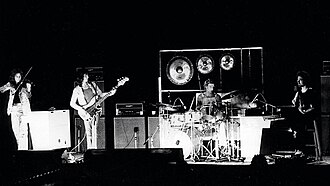
Improvisation
"We're so different from each other that one night someone in the band will play something that the rest of us have never heard before and you just have to listen for a second. Then you react to his statement, usually in a different way than they would expect. It's the improvisation that makes the group amazing for me. You know, taking chances. There is no format really in which we fall into. We discover things while improvising and if they're really basically good ideas we try and work them in as new numbers, all the while keeping the improvisation thing alive and continually expanding."
King Crimson incorporated improvisation into their performances and studio recordings from the beginning, some of which was embedded into pieces such as "Moonchild", "Providence", "Requiem" and "No Warning",269 including passages of restrained silence, as with Bill Bruford's contribution to the improvised "Trio".270 Rather than using the standard jazz or rock "jamming" format for improvisation (in which one soloist at a time takes centre stage while the rest of the band lies back and plays along with established rhythm and chord changes), King Crimson improvisation consisted of musicians collectively making creative decisions and contributions as the music is being played. Individual soloing was largely eschewed; each musician was to listen to each other and to the group sound, to be able to react creatively within the group dynamic. Fripp has used the metaphor of "magic" to describe this process, in particular when the method works particularly well.268271
Similarly, King Crimson's improvised music was varied in sound and the band has been able to release several box sets and albums consisting mostly or entirely of improvised music,272 such as the Thrakattak album,156 and the band's series of ProjeKcts.158 Occasionally, particular improvised pieces were recalled and reworked in different forms at different shows, becoming more and more refined and eventually appearing on official studio releases.78159
Influence and legacy
King Crimson have been influential both on the early 1970s progressive rock movement and numerous contemporary artists. Genesis and Yes were directly influenced by the band's usage of the mellotron,2733 and many King Crimson band members were involved in other notable bands: Bruford in Yes; Lake in Emerson, Lake & Palmer; McDonald in Foreigner; Burrell in Bad Company, and Wetton in King Crimson spin-off U.K.274 and Asia. Canadian rock band Rush's drummer Neil Peart credited the adventurous and innovative style of Michael Giles as an influence on his own approach to percussion.275 King Crimson also influenced progressive rock keyboardist Michael Quatro, who included a cover of The Court of the Crimson King featuring guitar by Ted Nugent on his 1972 debut album Paintings.276
King Crimson's influence extends to many bands from diverse genres, especially of the 1990s and 2000s. Kurt Cobain, the frontman of the grunge band Nirvana, had stated that the album Red had a major influence on the sound of their final studio album In Utero.29 Tool are known to be heavily influenced by King Crimson,168277 with vocalist Maynard James Keenan joking on a tour with them: "Now you know who we ripped off. Just don't tell anyone, especially the members of King Crimson."278 Modern progressive, experimental, psychedelic and indie rock bands have cited them as an influence as well, including MGMT,279 The Fierce and the Dead,280 the Mars Volta,281282 Primus,283284 Black Country, New Road,285 Mystery Jets,286287 Fanfarlo,288 Phish,289 and Anekdoten, who first practiced together playing King Crimson songs.290 Steven Wilson, the leader of Porcupine Tree, was responsible for remixing King Crimson's back catalogue in surround sound and said that the process had an enormous influence on his solo albums,291 and his band was influenced by King Crimson.292 In November 2012 the Flaming Lips in collaboration with Stardeath and White Dwarfs released a track-by-track reinterpretation of In the Court of the Crimson King entitled Playing Hide and Seek with the Ghosts of Dawn.293 Colin Newman, of Wire, said he saw King Crimson perform many times, and that they influenced him deeply.294 The seminal hardcore punk group Black Flag acknowledge Wetton-era King Crimson as an influence on their experimental period in the mid-1980s.295 Melvin Gibbs said that the Rollins Band was influenced most by King Crimson, using similar chords.296297 Bad Religion cites the lyrics of "21st Century Schizoid Man" on their single "21st Century (Digital Boy)" and the name of their record label, Epitaph (founded by their guitarist Brett Gurewitz), comes from the song of the same name on Crimson's debut album.298 Living Colour guitarist Vernon Reid considered Robert Fripp as one of his guitar influences.299
King Crimson have frequently been cited as pioneers of progressive metal300301 and as an influence on bands of this genre, including Dream Theater,302 Opeth,303 Mastodon,304305 Between the Buried and Me,306307 Leprous,308309 Haken,310 the Ocean,311 Caligula's Horse,312 Last Chance to Reason,313 and Indukti.314 Members of metal bands Mudvayne,315 Voivod,316 Enslaved,317318 Yob,319 Pyrrhon,320 and Pallbearer321 have cited King Crimson as an influence. Heavy experimental and avant-garde acts like the Dillinger Escape Plan,322 Neurosis,323 Zeni Geva,324 Ancestors,325 and Oranssi Pazuzu326 all cite King Crimson's influence.
Other artists affected by King Crimson include video game composer Nobuo Uematsu,327328 noise music artist Masami Akita of Merzbow,329 jazz guitarist Dennis Rea of Land,330 folktronica exponent Juana Molina,331 hip hop producer RJD2,332 hip hop and soul composer Adrian Younge,333 film director Hal Hartley,334 and folk-pop singer Ian Kelly.335
Golden Wind, the fifth part of the Japanese manga and anime franchise JoJo's Bizarre Adventure, has its main antagonist Diavolo possess a Stand known as King Crimson. Stephen King's The Dark Tower also has its main antagonist, the Crimson King, named after the band.
Related legacy/cover bands featuring former King Crimson members
Since the early 2000s, several bands containing former, recent or current King Crimson members have toured and recorded, performing King Crimson music.
Active between 2002 and 2005, the 21st Century Schizoid Band reunited several former King Crimson members who had played on the band's first four albums. The band featured Ian McDonald, Mel Collins, Peter Giles and Michael Giles (the latter subsequently replaced by Ian Wallace),336 and was fronted by Jakko Jakszyk, a decade prior to his own recruitment into King Crimson. The band engaged in several tours, played material from King Crimson's '60s and '70s catalogue, and recorded several live albums. The band disbanded upon Wallace's death in 2007.337338
Since 2007, Tony Levin has led the trio Stick Men, which also features Pat Mastelotto. The band was initially completed by Chapman Stick player Michael Bernier, replaced in 2010 by touch guitarist and former Fripp student Markus Reuter.339340 This band includes (and reinterprets) King Crimson compositions in their live sets.341 Reuter and Mastelotto also play together as a duo (previously called "Tuner"), within which they have been known to rework the mid-1980s King Crimson instrumental "Industry" live. Starting in 2023, Reuter, Mastelotto and Trey Gunn revived the moniker "Tuner" (re-styled as "Tu-ner") to perform music from the Double Duo era of King Crimson, plus material from each of their respective solo and combined careers.342
Between 2011 and 2014, Stick Men and Adrian Belew's Power Trio band (Belew plus drummer Tobias Ralph and bass player Julie Slick)343 joined forces to play and tour as The Crimson ProjeKCt, covering the music made during the '80s and '90s.185344 Following the return of King Crimson in 2014, the Crimson ProjeKct name has been formally abandoned, but the Stick Men and the Power Trio have still performed together from time to time, usually under names like "Belew, Levin, Mastelotto and friends".345
During his solo career, including performances with the Power Trio, Adrian Belew has performed various versions of King Crimson songs.346347348
In March 2024, a new spin-off supergroup349 called Beat performing the 1980s King Crimson repertoire was announced: this featured former members Adrian Belew and Tony Levin along with guitarist Steve Vai and drummer Danny Carey of Tool. Fripp and Bruford had both declined offers to join, but gave their blessings to the group. Fripp also suggested the eventual project name, "Beat" (after the 1982 King Crimson album).350 The band went on to tour the United States during the latter half of 2024.
Band members
Final line-up
- Robert Fripp – guitar, keyboards, Mellotron, electronics (1968–1974, 1981–1984, 1994–2008, 2013–2021)
- Mel Collins – saxophones, flute, bass flute, clarinet, bass clarinet, Mellotron, backing vocals (1970–1972, 2013–2021)
- Tony Levin – bass guitar, Chapman Stick, upright bass, synthesisers, backing vocals (1981–1984, 1994–1999, 2003–2008, 2013–2021)
- Pat Mastelotto – drums, percussion, programming (1994–2008, 2013–2021)
- Gavin Harrison – drums, percussion (2007–2008, 2013–2021)
- Jakko Jakszyk – lead vocals, guitar, flute, keyboards (2013–2021)
- Jeremy Stacey – drums, keyboards, backing vocals (2016–2021)
Discography
- In the Court of the Crimson King (1969)
- In the Wake of Poseidon (1970)
- Lizard (1970)
- Islands (1971)
- Larks' Tongues in Aspic (1973)
- Starless and Bible Black (1974)
- Red (1974)
- Discipline (1981)
- Beat (1982)
- Three of a Perfect Pair (1984)
- Thrak (1995)
- The Construkction of Light (2000)
- The Power to Believe (2003)
References
References
- Meagher, John (1 April 2023). "King Crimson: how a new film captures Robert Fripp's eccentric reign". Irish Independent. Retrieved 20 June 2024.
Jazz, experimental rock, metal, math-rock, industrial: under their perfectionist leader Robert Fripp, the band have pushed boundaries like few others. They are still doing so, yet the prog rock tag continues to dog them.
- Pareles, Jon (19 September 2022). "Robert Fripp Lightens Up". The New York Times. ISSN 0362-4331. Retrieved 20 June 2024.
As the guitarist and leader of King Crimson — the band he founded in 1969 — Fripp, 76, has written music that's barbed, visceral, complex and ambitious, seizing the vanguard of progressive rock yet reaching a broad audience.
- Shteamer, Hank (1 October 2019). "King Crimson's '21st Century Schizoid Man': Inside Prog's Big Bang". Rolling Stone. Archived from the original on 6 February 2021. Retrieved 7 February 2021.
- Niester, Alan (27 November 2000). "In the court of the Crimson fanatics". The Globe and Mail. Archived from the original on 14 March 2021. Retrieved 14 March 2021.
- Shteamer, Hank (15 April 2019). "The Crimson King Seeks a New Court". Rolling Stone. Archived from the original on 26 October 2021. Retrieved 19 March 2021.
- Buckley 2003, p. 477, "Opening with the cataclysmic heavy-metal of "21st Century Schizoid Man", and closing with the cathedral-sized title track,"
- "Rocking the Classics". Ulike.net. Archived from the original on 30 August 2009. Retrieved 28 September 2014.
In his 1997 book Rocking the Classics, critic/musicologist Edward Macan noted that In the Court of the Crimson King "may be the most influential progressive rock album ever released"
- Freeman, Phil (10 October 2019). "A Tribute To In The Court Of The Crimson King, Released 50 Years Ago Today". stereogum.com. Archived from the original on 7 February 2021. Retrieved 7 February 2021.
- Colothan, Scott (8 December 2021). "Robert Fripp says King Crimson have 'moved from sound to silence'". Planet Rock. H Bauer Publishin. Retrieved 26 June 2024.
- Eder, Bruce. "Giles, Giles and Fripp". AllMusic. Archived from the original on 3 February 2021. Retrieved 8 August 2007.
- "Interview with Robert Fripp". Musician magazine (archived page from elephant-talk.com). August 1984. Archived from the original on 13 June 2021. Retrieved 15 March 2021.
- Planer, Lindsay. "The Cheerful Insanity of Giles, Giles & Fripp". allmusic.com. Archived from the original on 4 November 2020. Retrieved 25 January 2021.
- Smith, Sid (30 November 2005). "Digging Giles, Giles & Fripp". dgmlive.com. Archived from the original on 16 March 2021. Retrieved 17 March 2021.
- Eder, Bruce. "King Crimson Biography". AllMusic. Archived from the original on 14 May 2019. Retrieved 19 August 2007.
- Smith, Sid (2002). In The Court of King Crimson. Helter Skelter Publishing. Retrieved on 12 June 2009.
- "Interview with Peter Sinfield". Modern Dance (archived page from elephant-talk.com). Archived from the original on 16 December 2020. Retrieved 15 March 2021.
- Pascall, Jeremy (1984). The Illustrated History of Rock Music. Golden Books Publishing. Retrieved on 4 September 2007.
- Giles, Michael (November 2020). "King Crimson: "The spirit of KC '69 was an open collaboration of ideas, energy, freedom of expression, spontaneity and taking risks by going into the unknown"". Shindig! (Interview). Interviewed by Martin Ruddock. Archived from the original on 1 July 2022. Retrieved 29 April 2022.
- Epitaph (CD). King Crimson. Discipline Global Mobile. 1997.
{{cite AV media notes}}: CS1 maint: others in cite AV media (notes) (link) - Rob Young (5 September 2014). "King Crimson: "Without friction you don't get heat!"". Uncut. Archived from the original on 1 July 2022. Retrieved 29 April 2022.
- Sinfield, Peter (2001). "King Crimson - Enclosures of the word kind". songsouponsea.com (Interview). Interviewed by Jon Green; Jon Swinghammer; Sid Smith; Andrew Keeling; Agulló Xavier. Archived from the original on 30 November 2021. Retrieved 10 February 2021.
Sinfield: ...any ruler who presided over an intense period of learning, yearning and burning and apparently benificial [sic] progress (HA) towards the elevation of mankind - Since Fred2 is a such a suitable archytype for said societal rumblings (allegoricaly speaking) -It would be churlish of me to quibble!
Green: Judging from your response to Jon Swinghammer, you consciously conceived the Crimson King as a composite of several historical figures.
Sinfield:"Ok - It was that ... and a game of archetypes, symbols, and purposefully 'vulgar' colours. (The Magus/Gormenghast/The Lord of the Rings/The Prince/The Hidden Persuaders, some Heinlein...) It may amuse /confuse you to know that I wrote the whole song words and v. dodgy "Dylanesque" tune many months before I became with involved GG&F who became King Crimson.
Keeling: Is the name King Crimson really a synonym for Beelzebub?
Sinfield: Despite the possibility that I may have flippantly (an 'r' is optional) have stated it to be so... it is not. Granted that the name was taken from In the Court of the Crimson King in a moment of pressured panic. - Fripp, Robert (2001). "The Double Trio - Robert Fripp". dgmlive.com. Archived from the original on 31 December 2021. Retrieved 31 December 2021.
- "Robert Fripp on the King Crimson name". Song Soup on Sea – Peter Sinfield's website (songsouponsea.com). Archived from the original on 8 August 2007. Retrieved 29 August 2007.
- "Ian McDonald Conversation on Mellotrons: Pt. 1 of 8". YouTube. 24 August 2008. Archived from the original on 29 October 2021. Retrieved 17 June 2010.
- "Prog Rock Britannia: An Observation in Three Movements". BBC. 2 January 2009. Archived from the original on 16 March 2017. Retrieved 13 May 2012.
- "King Crimson 1969". 7 November 2016. Archived from the original on 26 September 2023. Retrieved 25 February 2021.
- "David Bowie sees King Crimson live".
- Planer, Lindsay. "King Crimson - Live in Hyde Park: July 5, 1969". allmusic.com. Archived from the original on 3 December 2021. Retrieved 10 March 2021.
- Varga, George (10 June 2017). "Legendary King Crimson still making shape-shifting music". The San Diego Union-Tribune. Archived from the original on 26 January 2021. Retrieved 9 February 2021.
- Eder, Bruce. "In the Court of the Crimson King". AllMusic. Archived from the original on 9 January 2016. Retrieved 29 August 2007.
- Harrington, Richard (20 March 1992). "King Crimson: Reign Of Wagnerian Rock". Washington Post. Archived from the original on 9 July 2023. Retrieved 27 July 2022.
- Reed, Ryan (11 November 2019). "King Crimson: In the Court of the Crimson King (50th Anniversary)". Pitchfork. Archived from the original on 27 January 2021. Retrieved 7 February 2021.
- Hamad, Michael (8 December 2016). "In Memoriam: An Interview With Greg Lake From 2012". Hartford Courant. Archived from the original on 3 February 2021. Retrieved 7 February 2021.
- Farber, Jim (9 November 2017). "King Crimson talks ever-changing band, music". Foster's Daily Democrat. Archived from the original on 2 February 2021. Retrieved 7 February 2021.
- "Greg Lake estate auction coming in May". Goldmine. 17 April 2019. Archived from the original on 27 January 2021. Retrieved 7 February 2021.
- "King Crimson 1969 - A Personal Throughview From The Guitarist".
- Tamm 1990, p. 36.
- Shteamer, Hank (10 February 2022). "Ian McDonald, King Crimson and Foreigner Co-Founder, Dead at 75". Rolling Stone. Retrieved 11 February 2022.
{{cite magazine}}: CS1 maint: deprecated archival service (link) - "McDonald and Giles". The Spectator. Vol. 226. 1971. p. 231. Retrieved 20 November 2025.
- Martin, Bill (14 December 2015) [1998]. Listening to the Future: The Time of Progressive Rock, 1968–1978. Open Court. p. 182. ISBN 9780812699449. Retrieved 20 November 2025.
- Fripp, Robert (11 March 2001). "Robert Fripp's Diary: Nashville". dgmlive.com. Archived from the original on 30 June 2022. Retrieved 20 May 2022.
- Hayward, Keith (2013). Tin Pan Alley: The Rise of Elton John. Soundcheck Books. p. 180. ISBN 9780957570009. Archived from the original on 4 October 2023. Retrieved 25 February 2021.
- "Robert Fripp stopped Elton John from joining King Crimson: "I cancelled the sessions"".
- Smith, Sid (June 2010). "In The Wake Of Poseidon - The Long View". dgmlive.com. Archived from the original on 24 February 2021. Retrieved 24 February 2021.
- Smith, Sid (12 December 2016). "Cadence And Cascade And Greg". dgmlive.com. Archived from the original on 23 November 2021. Retrieved 18 July 2022.
- New Musical Express 28 February 1970: "Giles played on the session because he and another ex-member, Ian McDonald, have not yet been replaced in the group"
- Disc magazine 21 March 1970: "New King Crimson addition...flautist Mel Collins from Circus."
- Kelman, John (11 November 2017). "King Crimson: Sailors' Tales 1970-1972". All About Jazz. Archived from the original on 10 February 2021. Retrieved 24 February 2021.
- Kelman, John (23 April 2005). "King Crimson: In The Wake Of Poseidon". All About Jazz. Archived from the original on 10 April 2021. Retrieved 8 March 2021.
- Smith, Sid (5 December 2021). "King Crimson and the making of Islands". loudersound.com. Archived from the original on 20 December 2021. Retrieved 20 December 2021.
- Eder, Bruce. "Keith Tippett Biography". allmusic.com. Archived from the original on 15 June 2020. Retrieved 24 February 2021.
- Lynch, Dave. "King Crimson - Lizard". allmusic.com. Archived from the original on 18 November 2021. Retrieved 2 February 2021.
- Tamm 1990, p. 47.
- "Revisiting King Crimson's Second LP, 'In the Wake of Poseidon'". Ultimate Classic Rock. 15 May 2015. Archived from the original on 4 May 2018. Retrieved 19 May 2018.
- Hussey, Neil (14 June 2016). "Aspic of Love". Record Collector. Archived from the original on 7 February 2021. Retrieved 7 February 2021.
- Smith, Sid (23 March 2018). "Happy Larks' Day". dgmlive.com. Archived from the original on 10 February 2021. Retrieved 22 February 2021.
- Wallace, Ian (April 2003). "Interview with IAN WALLACE". dmme.net (Interview). Interviewed by Dmitry M. Epstein. Archived from the original on 12 March 2023. Retrieved 22 February 2021.
- Sinfield, Peter (May 2010). "Interview". Rockerilla (Interview). Interviewed by Max Marchini. Archived from the original on 27 November 2021. Retrieved 25 February 2021.
- Manfred Pfister; Ralf Hertel, eds. (15 December 2007). Performing National Identity: Anglo-Italian Cultural Transactions. Brill-Rodopi. p. 291. doi:10.1163/9789401205238. ISBN 978-9042023147. S2CID 201339702. Archived from the original on 4 October 2023. Retrieved 25 February 2021.
- Smith, Sid (March 2010). "Islands - The Long View". dgmlive.com. Archived from the original on 26 April 2021. Retrieved 26 April 2021.
- Tamm 1990, p. 49-50.
- Smith, Sid (9 June 2022). "Earthbound At 50". dgmlive.com. Archived from the original on 9 June 2022. Retrieved 10 June 2022.
- Tamm 1990, p. 69.
- Fripp, Robert (14 September 1999). "Robert Fripp's Diary". dgmlive.com. Archived from the original on 25 February 2021. Retrieved 25 February 2021.
- Fripp, Robert (15 April 1997). "King Crimson 1969 - A Personal Throughview From The Guitarist". dgmlive.com. Archived from the original on 16 May 2021. Retrieved 25 February 2021.
...I had difficulties with some of Peter's words on the subsequent Crimson albums, as he had with the music, on "In The Court" Peter's words are in a category of their own.
- Planer, Lindsay. "King Crimson - Earthbound". allmusic.com. Archived from the original on 28 June 2021. Retrieved 2 February 2021.
- Jones, Chris. "Earthbound, USA & Thrak review". BBC Music (bbc.co.uk). Archived from the original on 9 January 2009. Retrieved 15 March 2021.
- Bruford, Bill "Bill Bruford – the Autobiography", Jawbone Press, 2009
- Rowell, David (28 May 2015). "The epic tale of listening to seven live concert recordings by the band Yes in a single day". The Washington Post. Archived from the original on 8 November 2020. Retrieved 7 February 2021.
- Smith, Sid (June 2012). "Larks Tongues In Aspic - The Long View". dgmlive.com. Archived from the original on 16 May 2022. Retrieved 25 March 2022.
- Curtiss, Ron; Weiner, Aaron (3 June 2016). "John Wetton (King Crimson, U.K., Asia): The Complete Boffomundo Interview". YouTube. Archived from the original on 15 September 2016. Retrieved 3 March 2019. Event occurs at 4:34-13:48.
- Eder, Bruce. "Richard Palmer-James Biography". allmusic.com. Archived from the original on 17 January 2021. Retrieved 10 February 2021.
- Breznikar, Klemen (21 August 2020). "Richard Palmer-James Interview | Supertramp, King Crimson …". It's Psychedelic Baby! Magazine. Archived from the original on 20 October 2020. Retrieved 4 August 2021.
- Planer, Lindsay. "King Crimson Live at the Zoom Club, 1972". allmusic.com. Archived from the original on 21 September 2021. Retrieved 10 February 2021.
- Eder, Bruce. "Larks' Tongues in Aspic". AllMusic. Archived from the original on 9 January 2016. Retrieved 29 August 2007.
- Francis, Basil (30 December 2012). "Issue 2012-054: King Crimson Special Part 2". Dutch Progressive Rock Page. Archived from the original on 26 January 2021. Retrieved 5 March 2021.
- Bruford, Bill; Mastelotto, Pat (November 1995). "King Crimson's Bill Bruford & Pat Mastelotto A Perfect Pair". Modern Drummer Magazine (Interview). No. 192. Interviewed by William F. Miller. Archived from the original on 5 January 2019. Retrieved 4 February 2021.
- Kelman, John (22 October 2012). "King Crimson: Larks' Tongues In Aspic (40th Anniversary Series Box)". All About Jazz. Archived from the original on 10 February 2021. Retrieved 22 February 2021.
- Bruford, Bill (29 October 2019). "Bill Bruford on His Ups and Downs With Yes and King Crimson, Life After Retirement". Rolling Stone (Interview). Interviewed by Hank Shteamer. Archived from the original on 16 February 2022. Retrieved 19 February 2022.
- Fripp, Robert (6 December 1973). "K. Crimson's Fripp: 'Music's Just a Means for Magic'". Rolling Stone (Interview). No. 149. Interviewed by Cameron Crowe. Los Angeles. Archived from the original on 28 February 2018. Retrieved 7 February 2021.
- Eder, Bruce. "Starless and Bible Black". AllMusic. Archived from the original on 29 December 2014. Retrieved 29 August 2007.
- Fletcher, Gordon (6 June 1974). "Starless and Bible Black". Rolling Stone. Archived from the original on 2 October 2007. Retrieved 29 August 2007.
- Smith, Sid (3 August 2011). "Starless & Bible Black 40th Anniversary Edition". dgmlive.com. Archived from the original on 22 February 2021. Retrieved 22 February 2021.
- Smith, Sid (29 March 2020). "The making of King Crimson's Starless And Bible Black". loudersound.com. Archived from the original on 4 April 2021. Retrieved 22 February 2021.
- Hughes, Rob (30 October 2013). "King Crimson: The Road To Red". Louder. Archived from the original on 23 September 2021. Retrieved 22 February 2021.
- Tamm 1990, p. 66-67.
- Smith, Sid (May 2009). "Red - The Long View". dgmlive.com. Archived from the original on 26 February 2021. Retrieved 11 March 2021.
- Kelman, John (20 October 2013). "King Crimson: The Road To Red". All About Jazz. Archived from the original on 12 May 2021. Retrieved 11 March 2021.
- Smith, Sid (6 October 2015). "On This Date 41 Years Ago..." dgmlive.com. Archived from the original on 11 March 2021. Retrieved 11 March 2021.
- Eder, Bruce. "Red". AllMusic. Archived from the original on 15 January 2014. Retrieved 29 August 2007.
- Brackett, Nathan (2004). "Christian Hoard". The new Rolling Stone album guide. Palmer, Alaska: Fireside Books. pp. 456–457–458. ISBN 0743201698. Archived from the original on 19 January 2010.
- Tamm 1990, p. 66-68-92.
- "23 Jun 1974 Aquinas College, Grand Rapids". DGM Live. 8 March 2004. Archived from the original on 30 August 2018. Retrieved 29 August 2018.
- Fripp, Robert (18 October 1974). "Robert Fripp Would Like a Word". Trouser Press (Interview). Interviewed by Ihor Slabicky. New York. Archived from the original on 22 April 2021. Retrieved 17 March 2021.
- Shteamer, Hank (8 April 2019). "King Crimson's 50th Anniversary Press Day: 15 Things We Learned". Rolling Stone. Archived from the original on 19 January 2021. Retrieved 15 March 2021.
- Fripp, Robert (6 April 2019). "King Crimson - Sheer Visceral Power". Innerviews (Interview). Interviewed by Anil Prasad; Sid Smith. Archived from the original on 28 February 2021. Retrieved 7 March 2021.
- "Article". Acton Gazette. 17 July 1975.
- "Article". Cashbox. 10 May 1975.
- Smith, Sid (23 August 2006). "The Collectable King Crimson Competition". dgmlive.com. Archived from the original on 4 February 2021. Retrieved 7 February 2021.
- Tamm 1990, p. 10-73-110.
- Prato, Greg. "Adrian Belew". AllMusic. Archived from the original on 7 March 2021. Retrieved 29 August 2007.
- Tamm 1990, p. 29-111.
- Tamm 1990, p. 111.
- Smith, Sid (June 2011). "Discipline - The Long View". dgmlive.com. Archived from the original on 6 March 2021. Retrieved 24 February 2021.
- Fripp, Robert (7 September 2005). "Robert Fripp's Diary: DGM HQ". dgmlive.com. Archived from the original on 24 February 2021. Retrieved 24 February 2021.
- Brown, Mick (11 May 1981). "Robert Fripp's Discipline, the Lounge Lizards: Her Majesty's Theatre, London". The Guardian. Archived from the original on 21 April 2021. Retrieved 24 February 2021.
- Tamm 1990, p. 117.
- Tamm 1990, p. 116.
- Prato, Greg. "Discipline". AllMusic. Archived from the original on 4 December 2015. Retrieved 29 August 2007.
- Woodard, Josef (20 May 1993). "ROBERT FRIPP : Pioneering Progressive Rock Guitar Guru Returns". Los Angeles Times. Archived from the original on 5 February 2021. Retrieved 7 February 2021.
- Smith, Sid (10 June 2019). "King Crimson". Record Collector. Archived from the original on 6 April 2023. Retrieved 7 June 2022.
- Anderson, Rick. "King Crimson Discipline". allmusic.com. Archived from the original on 20 May 2022. Retrieved 20 May 2022.
- Palmer, Robert (20 May 1984). "King Crimson: Despite Upheaval, The Band Plays On". The New York Times. Archived from the original on 6 April 2023. Retrieved 7 February 2021.
- Banks, Joe (26 April 2017). "King Crimson – 10 of the best". theguardian.com. Archived from the original on 12 November 2020. Retrieved 24 February 2021.
- Strauss, Neil (22 November 1995). "POP REVIEW; Double A Trio And the Music Debates". The New York Times. Archived from the original on 14 May 2022. Retrieved 15 May 2022.
- Kelman, John (13 November 2016). "King Crimson: On (And Off) The Road". All About Jazz. Archived from the original on 20 April 2021. Retrieved 22 February 2021.
- Palmer, Robert (1 November 1981). "Why Robert Fripp Resurrected King Crimson". The New York Times. Archived from the original on 14 July 2022. Retrieved 7 February 2021.
- Fitzsimons, Jim; Arthur, Douglas (29 August 2014). "Never Found in the '80s: King Crimson". Tampa Bay Times. Archived from the original on 18 February 2022. Retrieved 18 February 2022.
- Smith, Sid (18 June 2014). "It Was On This Date In 1982". dgmlive.com. Archived from the original on 3 March 2021. Retrieved 22 February 2021.
- Fripp, Robert (12 June 2013). "Robert Fripp's Diary: Bredonborough". dgmlive.com. Archived from the original on 24 September 2021. Retrieved 22 February 2021.
- Browning, Boo (29 July 1982). "Homage to the Gurus of Beat". The Washington Post. Archived from the original on 22 February 2021. Retrieved 22 February 2021.
- Palmer, Robert (14 July 1982). "The Pop Life". The New York Times. Archived from the original on 22 February 2021. Retrieved 22 February 2021.
- Prato, Greg. "King Crimson Heartbeat". allmusic.com. Archived from the original on 22 February 2021. Retrieved 22 February 2021.
- Barnes, Mike (26 September 2016). "King Crimson - Beat/Three Of A Perfect Pair album review". loudersound.com. Archived from the original on 23 September 2021. Retrieved 22 February 2021.
- Tamm 1990, p. 9-120.
- Smith, Sid (18 June 2020). "Happy Birthday Beat". Dgmlive.com. Archived from the original on 20 April 2021. Retrieved 21 April 2021.
- Tamm 1990, p. 119-120.
- Smith, Sid (May 2016). "Three Of A Perfect Pair - The Long View". dgmlive.com. Archived from the original on 26 February 2021. Retrieved 7 February 2021.
- Puterbaugh, Parke (10 May 1984). "Album Reviews: King Crimson – Three of a Perfect Pair". Rolling Stone. Archived from the original on 2 May 2009. Retrieved 11 March 2021.
- Himes, Geoffrey (29 June 1984). "King Crimson's 3 Pair". The Washington Post. Archived from the original on 28 August 2017. Retrieved 7 February 2021.
- "King Crimson - Three of a Perfect Pair - 30th Anniversary Edition". shop.schizoidshop.com. Archived from the original on 28 January 2021. Retrieved 4 February 2021.
- Reed, Ryan (3 February 2017). "King Crimson: Beat & Three of a Perfect Pair". Relix. Archived from the original on 19 September 2021. Retrieved 26 February 2021.
- "King Crimson - Absent Lovers". shop.schizoidshop.com. Archived from the original on 5 February 2021. Retrieved 17 February 2021.
- Weigel, David (2017). The Show That Never Ends: The Rise and Fall of Prog Rock. W. W. Norton & Company. pp. 267–268. ISBN 9780393356021. Archived from the original on 4 October 2023. Retrieved 4 February 2021.
- Bruford, Bill (1998). "Bill Bruford - Ferocious Intensity". Innerviews (Interview). Interviewed by Anil Prasad. Archived from the original on 11 February 2021. Retrieved 7 March 2021.
And it's certainly not me that precipitates these long pauses in King Crimson's career either—it's always Robert Fripp who wants to stop and have 10 years off. We do move along in a rather torturous manner.
- Fripp, Robert (22 March 1995). "ROBERT FRIPP: Round Table Interview" (Interview). Interviewed by Michael Black. Virgin records, New York City. Archived from the original on 4 February 2021. Retrieved 7 February 2021.
- "New Albums". Music Week. 2 November 1991. p. 14.
- "ROBERT FRIPP prt 4 interviewed by BAS ANDRIESSEN London september 7 1999".
- Deming, Mark. "Robert Fripp Biography". allmusic.com. Archived from the original on 25 June 2021. Retrieved 4 February 2021.
- Tingen, Paul (June 1994). "David Sylvian: Recording Tin Drum & The First Day". Sound on Sound. Archived from the original on 23 November 2021. Retrieved 23 November 2021.
- Gunn, Trey (1994). "Trey Gunn Interlocking Contexts". Innerviews (Interview). Interviewed by Anil Prasad. Archived from the original on 19 May 2021. Retrieved 22 February 2021.
- Fricke, David (June 1993). "The Return Of The Crimson King". Rolling Stone. Archived from the original on 25 October 2021. Retrieved 27 November 2021.
- Gunn, Trey; Marotta, Jerry (2018). "Security Project - Looking for a Spark". Innerviews (Interview). Interviewed by Anil Prasad. Archived from the original on 21 November 2021. Retrieved 22 November 2021.
Prasad: In June 1993, both Jerry and Trey were announced as members for what would become King Crimson's THRAK line-up. Why did you not end up in the final lineup, Jerry?
Marotta: I did the Sylvian-Fripp record The First Day with Robert in 1993 and then there was a tour for it that I didn't do. Pat Mastelotto was the drummer for that tour. I think Robert felt Pat was more suited for King Crimson than I was. I had never heard a King Crimson record back then. I wasn't a fan. I never lobbied for the position. I didn't know what to think of it. What happened is there was a conversation with Robert afterwards during which he said "Jerry, you're a fantastic drummer. You're just not the right drummer for King Crimson" and that was the end of it. - Easlea, Daryl (7 October 2015). "Peter Gabriel: The Story Behind His Remastered Early Albums". loudersound.com. Archived from the original on 22 November 2021. Retrieved 22 November 2021.
- Lindsay Planer. "Robert Fripp / David Sylvian - Damage". AllMusic. Archived from the original on 22 November 2021. Retrieved 22 November 2021.
- Gioffre, Daniel. "THRAK". AllMusic. Archived from the original on 9 January 2016. Retrieved 29 August 2007.
- Kopp, Bill (20 August 2021). "Brutal Finesse: A Preview of King Crimson at Ravinia". Newcity. Archived from the original on 21 August 2021. Retrieved 17 February 2022.
- Bambarger, Bradley (2 February 1998). "King Crimson - THRAK (1995) album review". Rolling Stone. Archived from the original on 19 September 2008. Retrieved 19 May 2018.
{{cite magazine}}: CS1 maint: bot: original URL status unknown (link) - Kelman, John (25 October 2015). "King Crimson: THRAK BOX - Live And Studio Recordings 1994-1997". All About Jazz. Archived from the original on 22 February 2021. Retrieved 22 February 2021.
- Barnes, Mike (August 2008). "Travis And Fripp Thread". Wire. No. 294. p. 57. Archived from the original on 9 February 2021. Retrieved 22 February 2021.
- Kelman, John (14 December 2005). "Robert Fripp: Love Cannot Bear: Soundscapes - Live In The USA". All About Jazz. Archived from the original on 28 November 2021. Retrieved 29 November 2021.
With the advent of guitar synthesizers and more sophisticated digital processing, Frippertronics evolved into Soundscapes
- Gunn, Trey (29 October 2016). "Exclusive Interview With Trey Gunn". ultimate-guitar.com (Interview). Interviewed by Steven Rosen. Archived from the original on 17 September 2021. Retrieved 22 February 2021.
- Definition retrieved from reproduced Fripp press release on Thrak Football Enterprises homepage Archived 9 August 2009 at the Wayback Machine, retrieved 14 June 2009
- "Article". Q. May 1995.
- "THRAK". Vox. May 1995.
- Planer, Lindsay. "Thrakattak". AllMusic. Archived from the original on 9 January 2016. Retrieved 29 August 2007.
- Smith, Sid (27 May 2021). "Thrakattak At 25". dgmlive.com. Archived from the original on 18 February 2022. Retrieved 18 February 2022.
- Planer, Lindsay. "King Crimson A Beginner's Guide to Projekcts". allmusic.com. Archived from the original on 22 February 2021. Retrieved 22 February 2021.
- Kelman, John (8 June 2019). "King Crimson: Heaven & Earth: Live And In The Studio 1997-2008". All About Jazz. Archived from the original on 5 March 2021. Retrieved 22 February 2021.
- Fripp, Robert (16 October 1999). "Robert Fripp's Diary: Saturday 16 October 1999". dgmlive.com. Archived from the original on 28 June 2022. Retrieved 21 April 2022.
- Smith, Sid (March 2019). "Happy Birthday TPTB". dgmlive.com. Archived from the original on 6 March 2022. Retrieved 6 March 2022.
- Fripp, Robert (8 December 1999). "Robert Fripp's Diary". dgmlive.com. Archived from the original on 24 September 2021. Retrieved 22 February 2021.
- Fripp, Robert (18 November 1999). "Robert Fripp's Diary: Yesterday-today was a turning point". dgmlive.com. Retrieved 29 October 2023.
- Gill, Andy (5 May 2000). "This week's album releases". The Independent. Archived from the original on 6 February 2021. Retrieved 7 February 2021.
- "Orange Peel". dgmlive.com. 2003. Archived from the original on 4 February 2021. Retrieved 7 February 2021.
- Nickey, Jason. "The ConstruKction of Light". AllMusic. Archived from the original on 9 January 2016. Retrieved 29 August 2007.
- Hayes, Kelvin. "Heaven and Earth". AllMusic. Archived from the original on 2 February 2021. Retrieved 29 August 2007.
- Bond, Laura (6 August 2001). "Tool Stretch Out And Slow Down in Show With King Crimson". MTV.com. Archived from the original on 24 September 2021. Retrieved 14 March 2021.
- "King Crimson - Heaven And Earth Boxed Set". shop.schizoidshop.com. Archived from the original on 7 March 2021. Retrieved 24 February 2021.
- "Zeppelin's John Paul Jones Brings The 'Thunder'". billboard.com. 5 March 2002. Archived from the original on 25 January 2021. Retrieved 7 February 2021.
- Planer, Lindsay. "Level Five". AllMusic. Archived from the original on 30 October 2019. Retrieved 13 January 2018.
- "King Crimson - Level Five". Burningshed.com. Archived from the original on 7 October 2016. Retrieved 19 May 2018.
- Planer, Lindsay. "Happy With What You Have to Be Happy With". AllMusic. Archived from the original on 9 January 2016. Retrieved 29 August 2007.
- Planer, Lindsay. "The Power to Believe". AllMusic. Archived from the original on 9 January 2016. Retrieved 29 August 2007.
- Fripp, Robert (1 November 2002). "Robert Fripp's Diary: Bredonborough". dgmlive.com. Archived from the original on 2 April 2023. Retrieved 13 May 2023.
- "King Crimson - The Power To Believe (40th Anniversary Series)". shop.schizoidshop.com. Archived from the original on 20 January 2021. Retrieved 22 February 2021.
- Fripp, Robert (20 November 2003). "Robert Fripp's Diary: Hotel Quite Acceptable, Mexico City". dgmlive.com. Archived from the original on 10 February 2021. Retrieved 10 February 2021.
- Fripp, Robert (11 January 2006). "Robert Fripp's Diary: DGM HQ". dgmlive.com. Archived from the original on 10 February 2021. Retrieved 10 February 2021.
- Fripp, Robert (26 October 2003). "Robert Fripp's Diary: Hotel Continuing to Be Acceptable". dgmlive.com. Archived from the original on 25 January 2021. Retrieved 7 February 2021.
- Fripp, Robert (14 November 2003). "Robert Fripp's Diary: Crimbus Outside Hotel Adequate The Charm Of Which Is Fading". dgmlive.com. Archived from the original on 30 January 2021. Retrieved 7 February 2021.
- Fripp, Robert (27 February 2004). "Robert Fripp's Diary: Hotel Quite Acceptable, Paris". dgmlive.com. Archived from the original on 25 January 2021. Retrieved 7 February 2021.
- Eder, Bruce. "Boz Burrell Biography". allmusic.com. Archived from the original on 18 February 2021. Retrieved 7 March 2021.
- Eder, Bruce. "Ian Wallace Biography". allmusic.com. Archived from the original on 7 March 2021. Retrieved 7 March 2021.
- Kelman, John (4 September 2008). "King Crimson: Park West, Chicago, Illinois August 7, 2008". All About Jazz. Archived from the original on 4 March 2021. Retrieved 7 March 2021.
- Smith, Sid (10 September 2014). "The Return Of The King". loudersound.com. Archived from the original on 4 February 2021. Retrieved 7 February 2021.
- Fripp, Robert (29 October 2008). "Robert Fripp's Diary: Bredonborough". dgmlive.com. Archived from the original on 25 January 2021. Retrieved 7 February 2021.
- Smith, Sid (11 February 2014). "The Crimson ProjeKCt: Live In Tokyo". loudersound.com. Archived from the original on 4 February 2022. Retrieved 5 February 2022.
- Belew, Adrian (23 June 2009). "Part II: King Crimson's Adrian Belew". Crawdaddy (Interview). Interviewed by Max Mobley. Archived from the original on 12 February 2010.
- Belew, Adrian (15 June 2010). "Interview with Adrian Belew: The Guitar Man". The Aquarian (Interview). Interviewed by Patrick Slevin. Archived from the original on 4 February 2022. Retrieved 5 February 2022.
- "Adrian Belew blog posting, 15 June 2010". Elephant-blog.blogspot.com. 15 June 2010. Archived from the original on 23 July 2011. Retrieved 16 July 2011.
- "It Doesn't Matter Where You Take It From... it's Where You Take It To That Counts". Billbruford.com. 14 July 2010. Archived from the original on 10 June 2022. Retrieved 10 June 2022.
- Fripp, Robert (5 December 2010). "Robert Fripp's Diary: Marriot Downtown, 85, West Street, NYC". dgmlive.com. Archived from the original on 7 March 2021. Retrieved 7 March 2021.
- Coplan, Chris (26 September 2013). "King Crimson announce reunion for 2014". Consequence of Sound. Archived from the original on 25 September 2021. Retrieved 7 March 2021.
- Kelman, John (27 May 2011). "Jakszyk, Fripp & Collins: A Scarcity Of Miracles". All About Jazz. Archived from the original on 10 February 2021. Retrieved 7 March 2021.
- Smith, Sid (2011). "Jakszyk, Fripp and Collins A Scarcity of Miracles Review". BBC. Archived from the original on 16 March 2021. Retrieved 7 March 2021.
- "Bredonborough Rising with Devil Bug". Robert Fripp's Diary. Discipline Global Mobile. 6 September 2013. Archived from the original on 15 March 2017. Retrieved 26 July 2017.
- Fripp, Robert (24 September 2013). "Robert Fripp's Diary: Bredonborough". Archived from the original on 7 March 2021. Retrieved 7 March 2021.
- Powers, Ann (29 September 2011). "Talking Shop With Bill Rieflin, Journeyman Musician". NPR. Archived from the original on 28 February 2021. Retrieved 22 February 2021.
- Smith, Sid (24 September 2013). "New King Crimson Line-up Confirmed". Dgmlive.com. Archived from the original on 14 April 2021. Retrieved 15 March 2021.
- "King Crimson unveil new-line up and 2014 tour plans". Uncut. 25 September 2013. Archived from the original on 7 March 2021. Retrieved 7 March 2021.
- "Interview: Adrian Belew & Tony Levin Talk BEAT And Their Legacy With King Crimson" - interview by Tyler King in SFSonic, 29 July 2024
- Zivitz, Jordan (9 November 2015). "King Crimson's Tony Levin and Gavin Harrison: the complete conversation". Montreal Gazette. Postmedia Network. Archived from the original on 13 December 2015. Retrieved 11 December 2015.
- Reed, Ryan (2 June 2014). "King Crimson Reunite for 17-Show Run This Fall". Rolling Stone. Archived from the original on 9 March 2021. Retrieved 7 March 2021.
- Fricke, David (10 September 2014). "King Crimson in Albany: The Best New Band in Prog Begins a U.S Tour". Rolling Stone. Archived from the original on 9 March 2021. Retrieved 7 March 2021.
- Smith, Sid (1 July 2015). "King Crimson In Japan 2015". dgmlive.com. Archived from the original on 7 March 2021. Retrieved 7 March 2021.
- Munro, Scott (7 March 2016). "King Crimson call up drummer Jeremy Stacey". loudersound.com. Archived from the original on 21 June 2021. Retrieved 9 February 2021.
- Savage, Mark (8 December 2016). "Greg Lake: King Crimson and ELP star dies aged 69". BBC. Archived from the original on 8 December 2016. Retrieved 9 February 2021.
- Trendell, Andrew (31 January 2017). "Asia frontman, ex-King Crimson bassist John Wetton dies – NME". NME. Archived from the original on 6 April 2020. Retrieved 31 January 2017.
- "Bredonborough". Dgmlive.com. 3 January 2017. Archived from the original on 20 May 2018. Retrieved 19 May 2018.
- Young, Alex (9 January 2017). "King Crimson to tour the US in 2017, and they're bringing along four drummers". Consequence of Sound. Archived from the original on 25 September 2021. Retrieved 11 March 2021.
- Smith, Steve (22 May 2017). "King Crimson's Bill Rieflin on Summer Tour, Bowie Cover, Band's Future". Rolling Stone. Archived from the original on 16 June 2018. Retrieved 11 March 2021.
- Fripp, Robert (21 April 2017). "Robert Fripp's Diary: Breakfasting Trough, Hotel Acceptable, Bedford". Dgmlive.com. Archived from the original on 12 August 2020. Retrieved 25 April 2020.
- Smith, Sid (27 April 2017). "Crimson Release Heroes Ep". Dgmlive.com. Archived from the original on 16 September 2017. Retrieved 19 May 2018.
- Munro, Scott (15 September 2017). "Marillion, Anathema, Steve Hackett among Progressive Music Award winners". loudersound.com. Archived from the original on 22 March 2018. Retrieved 15 March 2021.
- Young, Alex (11 May 2017). "King Crimson announce full details of 2017 tour, plus David Bowie tribute EP". Consequence of Sound. Archived from the original on 25 September 2021. Retrieved 16 March 2021.
- "King Crimson to release "Official Bootleg" and more". Goldmine. 9 October 2017. Archived from the original on 27 February 2021. Retrieved 16 March 2021.
- Smith, Sid (4 September 2017). "Peace – a new beginning?". DGM Live. Archived from the original on 5 September 2017. Retrieved 5 September 2017.
- Smith, Sid (13 October 2017). "Chris Gibson joins Crim". DGM Live. Archived from the original on 13 October 2017. Retrieved 13 October 2017.
- Munro, Scott (22 November 2017). "King Crimson announce Uncertain Times UK and European tour". loudersound.com. Archived from the original on 7 March 2021. Retrieved 15 March 2021.
- Smith, Sid (19 February 2018). "Live in Vienna". DGM Live. Discipline Global Mobile. Archived from the original on 20 February 2018. Retrieved 19 February 2018.
- Scaravilli, Mariana (2 May 2019). "Irreplaceable Billness". dgmlive.com. Archived from the original on 3 May 2019. Retrieved 7 February 2021.
- Solomon, Jon (6 September 2019). "Fifty Years of Prog-Rock Wizardry With King Crimson". Westword. Archived from the original on 8 August 2020. Retrieved 11 March 2021.
- Levin, Tony (9 June 2019). "Tony Levin's Road Diary: Leipzig Warmup". Archived from the original on 13 July 2019. Retrieved 15 July 2019.
- Young, Alex (11 June 2019). "King Crimson's catalog now available on Spotify". Consequence of Sound. Archived from the original on 20 September 2021. Retrieved 9 August 2019.
- "Bill Rieflin, Drummer for King Crimson, R.E.M., Ministry, Dead at 59". Rolling Stone. 24 March 2020. Archived from the original on 25 March 2020. Retrieved 25 April 2020.
- Lifton, Dave (15 June 2020). "Keith Tippett, King Crimson Collaborator, Dies at 72". Ultimate Classic Rock. Archived from the original on 7 December 2024. Retrieved 3 December 2024.
- "Former King Crimson Bassist and Singer Gordon Haskell Dies at 74". Billboard. 18 October 2020. Retrieved 7 March 2021.
{{cite magazine}}: CS1 maint: deprecated archival service (link) - Graff, Gary (26 August 2021). "King Crimson to visit on latest — final? — North American tour". The Oakland Press. Archived from the original on 26 August 2022. Retrieved 26 August 2022.
- Ewing, Jerry (20 October 2021). "King Crimson announce new 2021 live album". loudersound.com. Archived from the original on 26 August 2022. Retrieved 26 August 2022.
- "Music Is Our Friend [Live in Washington D.C. & Albany]". AllMusic. Archived from the original on 26 August 2022. Retrieved 26 August 2022.
- Mead, David (25 August 2022). "Robert Fripp in-depth: his quest to combine Hendrix and Bartók, what made King Crimson "problematic" and why he has "no interest in gear at all"". Guitar World. Archived from the original on 25 August 2022. Retrieved 26 August 2022.
- Browne, David (14 July 2022). "King Crimson's Robert Fripp Sets Fall Release for Band Doc. But Another Tour? 'Only to Prevent World War III'". Rolling Stone. Archived from the original on 17 August 2022. Retrieved 29 August 2022.
- "Watch the Trailer for New King Crimson Documentary In the Court of the Crimson King" Archived 3 February 2024 at the Wayback Machine - article by James Rettig in Stereogum, 2 February 2022
- Sullivan, Jim (13 March 2023). "Peter Gabriel's not-so-secret Jewish weapon — and his little side project called King Crimson". Forward. Archived from the original on 15 March 2023. Retrieved 15 March 2023.
- Smith, Steve (16 December 2022). "Tony Levin". Metrograph.com. Archived from the original on 18 December 2022. Retrieved 19 January 2023.
- "Robert Fripp Talks Adrian Belew Rift at King Crimson Doc Showing" Archived 4 April 2024 at the Wayback Machine - article by Gary Graff in Ultimate Classic Rock, 25 October 25, 2022
- "King Crimson Recording First New Album Since 2003". 8 July 2025. Archived from the original on 10 July 2025. Retrieved 10 July 2025.
- John Kelman (20 October 2020). "Jakko M. Jakszyk: Secrets & Lies". All About Jazz. Archived from the original on 1 November 2023. Retrieved 1 November 2023.
- "King Crimson Recording First New Album Since 2003". 8 July 2025.
- "King Crimson Touring the U.S. for the 'Last Time'" - article by Gary Graff in Ultimate Classic Rock, 6 August 2021
- Everley, Dave (26 November 2024). "Jakko Jakszyk discusses his abandoned football and acting ambitions, and the status of Robert Fripp's band". Louder. Retrieved 29 May 2025.
- "21st Century Renaissance man: Jakko M. Jakszyk acts alone" - article by Howard Whitman in Goldmine, 7 July 2025
- "King Crimson Recording First New Album Since 2003". 8 July 2025.
- O'Donnell, Hugh (11 July 2025). "New Album Rumours". DGM Live. Retrieved 3 September 2025.
- Singleton, David (11 July 2025). "David Singleton's Facebook posting". Facebook. Retrieved 1 December 2025.
- Irwin, Corey (25 May 2026). "Robert Fripp explains why he won't revive King Crimson". Ultimate Classic Rock.
- Murphy, Sean (7 March 2023). "The 25 Best Classic Era Progressive Rock Albums". Pop Matters. Archived from the original on 24 March 2025. Retrieved 19 March 2025.
- Pete Prown; HP Newquist (1997). Legends of Rock Guitar: The Essential Reference of Rock's Greatest Guitarists. Hal Leonard Corporation. p. 78. ISBN 978-0-7935-4042-6.
...British art rock groups such as the Nice, Yes, Genesis, ELP, King Crimson, the Moody Blues and Procol Harum...
- Macan, Edward (1997). Rocking the Classics: English Progressive Rock and the Counterculture. Oxford University Press. ISBN 978-0-19-509887-7.
- McCormick, Neil (12 March 2016). "Keith Emerson, the father of progressive rock, was the Jimi Hendrix of keyboards". The Telegraph. Archived from the original on 11 January 2022.
- Smith, Sid (5 July 2018). "On This Day 49 Years Ago". dgmlive.com. Archived from the original on 24 February 2021. Retrieved 24 February 2021.
- Smith, Sid (13 January 2006). "Happy Birthday KC". dgmlive.com. Archived from the original on 24 February 2021. Retrieved 24 February 2021.
- Kelman, John (4 October 2010). "King Crimson: In The Wake Of Poseidon (40th Anniversary Series)". All About Jazz. Archived from the original on 10 February 2021. Retrieved 24 February 2021.
- Sanneh, Kelefa (12 June 2017). "The Persistence Of Prog Rock". The New Yorker. Archived from the original on 12 June 2017. Retrieved 24 February 2021.
- Gaffney, Annie (1 December 2004). "In the Court of the Crimson King". ABC Gold & Tweed Coasts (abc.net.au). Archived from the original on 27 May 2006. Retrieved 29 August 2007.
- Unterberger, Richie. "I Talk to the Wind" at AllMusic. Retrieved 16 September 2011. "King Crimson, it is not often noted, had some folk and folk-rock influences in their very early days (and the Giles, Giles & Fripp collaborations predating King Crimson). 'I Talk to the Wind' is the track that most reflects these folk influences and the influence of co-songwriter Ian McDonald (only a bandmember for the first album) in particular. Coming right after the assaultive jazz-prog rock of '21st Century Schizoid Man', the first track on their debut album in the Court of the Crimson King: An Observation by King Crimson, this gentle, subdued folky ballad was quite a contrast and served notice that King Crimson was more versatile than your average new band."
- Unterberger, Richie. "Moonchild/The Dream/The Illusion" at AllMusic. Retrieved 16 September 2011. "'Moonchild', along with 'I Talk to the Wind', was the clearest link to the folk influences borne by King Crimson on its first album, the only one that included Ian McDonald and Michael Giles among the personnel. The first three minutes or so of 'Moonchild' – really, the three minutes that are all that most listeners remember well – comprise a delicate, folky poetic ballad."
- Tamm 1990, p. 20.
- Shteamer, Hank (9 April 2019). "King Crimson's 50th Anniversary Press Day: 15 Things We Learned". Rolling Stone. Retrieved 1 April 2026.
- Max (25 August 2015). "Robert Fripp Discusses New Standard Tuning". Gear Gods. Retrieved 1 April 2026.
- "Triple Time: In the Rhythmic Court of the Crimson King". Ravinia Backstage. 25 August 2021. Retrieved 1 April 2026.
- Max (25 August 2015). "Robert Fripp Discusses New Standard Tuning". Gear Gods. Retrieved 1 April 2026.
- "New Standard Tuning: Robert Fripp's Alternate Tuning Explained". stringjoy.com. Retrieved 1 April 2026.
- "Rhythm at the heart of the expanded King Crimson" (fee required). The Boston Globe. nl.newsbank.com. 3 June 1995. Archived from the original on 9 June 2011. Retrieved 24 June 2007.
- Carter, Nick (17 March 2003). "King Crimson a study in contrasts". Milwaukee Journal Sentinel. jsonline.com. Archived from the original on 29 September 2007. Retrieved 24 June 2007.
[...] the band manages to break free of all the aural fog, as it did on the rhythmically romping "Dangerous Curves" and "The World's My Oyster Soup Kitchen Floor Wax Museum," [...]
- Whitney, Bruce (17 March 2005). "Don't miss this one from Cat Stevens: 'Majikat' is pure magic" (fee required). North Adams Transcript. nl.newsbank.com. Archived from the original on 9 June 2011. Retrieved 24 June 2007.
[...] King Crimson-esque polyrhythm [...]
- Tamm 1990, p. 64-65.
- Tamm 1990, p. 59.
- Tamm 1990, p. 69-120.
- Tamm 1990, p. 64.
- "A different shade of King Crimson: red hot" (fee required). The Atlanta Journal-Constitution. nl.newsbank.com. 22 July 2001. pp. L4. Archived from the original on 9 June 2011. Retrieved 24 June 2007.
It's not the diddling, noodling kind of improvising often associated with jazz. This has an aggressive, muscular sound that open-minded listeners can find just as rewarding as it is challenging.
- Couture, François. "King Crimson: The Great Deceiver". allmusic.com. Archived from the original on 10 November 2022. Retrieved 10 November 2022.
- Henderson, Paul (7 February 2007). "King Crimson: Court In Session". loudersound.com. Archived from the original on 26 November 2021. Retrieved 27 November 2021.
- Whitman, Howard (22 April 2025). "From solo demos to signed band: The story of Pattern-Seeking Animals". Goldmine. Retrieved 20 November 2025.
- Peart, Neil (January 2003). "Neil Peart Speaks With Zildjian..." Zildjian (Interview). Archived from the original on 6 December 2003.
- "Album Reviews". Billboard. 11 March 1972. p. 78. Retrieved 1 June 2026.
- Jabbour, Debbie (5 October 2002). "From My Perspective – Tool Concert" (PDF). Edmonton Journal. ausu.org. Archived from the original (PDF) on 25 May 2005. Retrieved 24 June 2007.
Their roots lie with seminal alternative band King Crimson [...]
- "August/September 2001 newsletter". Tool official website (toolband.com). Archived from the original on 2 May 2013. Retrieved 29 August 2007.
- The Best Show with Tom Scharpling (21 February 2024). MGMT on New Album and Favorite 90s Music Videos. Retrieved 28 August 2024 – via YouTube.
- "Music Radar - The Fierce & The Dead's Matt Stevens picks 10 essential prog-rock albums". 11 August 2015. Retrieved 18 April 2025.
- Larzen, Geir. "Mars Volta". MonsterMagazine.no (in Norwegian). Archived from the original on 14 February 2005. Retrieved 20 February 2017.
Q: Dette til tross, du kan ikke nekte for å være utpreget influert av King Crimson og Robert Fripp.
Omar Rodríguez-López: Selvfølgelig ikke! Jeg gjør faktisk ingen forsøk på å skjule min affekt for Fripps arbeider. [...] ble jeg introdusert for King Crimson, og på nytt kollapset alt, men på en konstruktiv måte.
(Q: You can't deny that you're influenced by Robert Fripp and King Crimson, right?
Omar Rodríguez-López: No, of course not! I make no attempt to hide my affection for Fripps work. [...] I was introduced to King Crimson and again everything collapsed, but in a constructive way.) - Schafer, Joseph (7 February 2013). "Deconstructing: The Rise, Demise, And Legacy Of The Mars Volta". Stereogum. Archived from the original on 21 February 2017. Retrieved 20 February 2017.
[...] In contrast, De-Loused skips Tribute's Faith No More worship and leaps straight to King Crimson (their most important influence — more on this later).
- Reymond, Laurent (19 September 2011). "Primus – Les Claypool". www.heavymusic.fr (in French). Archived from the original on 4 March 2017. Retrieved 4 March 2017.
Q: J'ai toujours pensé que « Elephant Talk » de King Crimson avait servi de base au style de Primus. Qu'en penses-tu ?
Les Claypool: Je ne sais pas si cette chanson en particulier nous a servi de base pour créer Primus, mais il est clair qu'à l'époque nous étions tous fans de cette incarnation de King Crimson et Tony Levin, Adrian Belew, Robert Fripp et Bill Bruford comptaient parmi nos plus grandes influences. Tony Levin encore plus d'ailleurs, car à mon sens il est le meilleur bassiste du monde et celui qui joue avec le plus de goût !
(Q: I always thought that King Crimson's "Elephant Talk" was the basis of Primus's style. What do you think ?
Les Claypool: I do not know if this particular song served as a basis for creating Primus, but it is clear that at the time we were all fans of this incarnation of King Crimson and Tony Levin, Adrian Belew, Robert Fripp and Bill Bruford were among our greatest influences. Tony Levin even more, because in my opinion he is the best bass player in the world and the one who plays with the most taste!) - "Say "Cheese"!". Kerrang!. No. 343. 1 June 1991.
Les Claypool: I'd say the band is a lot more like King Crimson -- the latter version, with Tony Levin, who's one of my big heroes [...] I've always liked weird, abstract stuff. That's why I asked Larry to join the band and not some Joe Satriani clone. Not that I don't like that type of playing, but I'm big on people like Adrian Belew.
- "Black Country, New Road pick their favourite records". Faroutmagazine.co.uk. 5 December 2023. Retrieved 3 December 2024.
- Carter, Hana (20 March 2016). "INTERVIEW: Mystery Jets". TheMetropolist.com. Archived from the original on 22 March 2016. Retrieved 25 February 2017.
Q: Which artists do you take inspiration from?
Blaine Harrison: Pink Floyd and King Crimson are major influences. - Maassen, Marjolein. "Interview: Mystery Jets (English version)". KillerMagazine.nl. Archived from the original on 25 February 2017. Retrieved 25 February 2017.
Over the years there have been many bands and artists who have formed what we do, whether that's King Crimson [...]
- Matt (13 February 2014). "A Heart Is A Spade Interview: Fanfarlo". www.aheartisaspade.com. Archived from the original on 5 March 2017. Retrieved 4 March 2017.
There's a whole raft of other stuff that we've been drawing inspiration from though, for instance we were listening a lot to progressive and space rock while making the record, like King Crimson [...]
- Aledort, Andy (30 September 2013). "Phish Scales: Trey Anastasio Breaks Down His Improvisation Techniques". Guitar World. Archived from the original on 23 July 2019. Retrieved 23 July 2019.
Oh, yeah, I love progressive rock. I'm a big fan of Robert Fripp [guitarist and founder of Sixties/Seventies progressive rock masters King Crimson—GW Ed.], and I still love a lot of his stuff. I was especially into his work with Brian Eno, on albums such as Another Green World, and I was really into King Crimson's Larks Tongues in Aspic, which is one of my all-time favorite albums. I like Red, too. Then there's the stuff he did later for his Discipline Records label. The "patterny" thing that Fripp is known for had a big influence on me.
- Nicholas, Steve (January 2001). "Anekdoten – "One of Sweden's brightest exports discusses the band's work and future"". Ghostland.com. Archived from the original on 25 February 2003. Retrieved 21 February 2017.
When Nicklas, Peter and I started playing together in the middle of 1990 we played covers. The first song that we started rehearsing was "Larks' Tongues in Aspic, Part 2," the second was "Lament" and I believe that the third one was "Red." We wanted to see if we could pull off playing Crimso-songs, primarily from the Wetton-era, as this was our main source for inspiration at the time.
- Moon, Grant (October 2011). "Steven Wilson: I Can't Emphasise How Much I Learned Working With King Crimson". Prog. loudersound.com (published 26 September 2016). Archived from the original on 27 September 2016. Retrieved 15 March 2021.
- Krul, Govert. "#104 Porcupine Tree's Steven Wilson: "˜Hoe een soloalbum de basis legt voor de beste teamprestatie ooit'". Progwereld.org (in Dutch). Amsterdam. Archived from the original on 22 February 2017. Retrieved 21 February 2017.
We kunnen hier winnen noch verliezen eigenlijk, maar deze band vormt samen met King Crimson toch wel de belangrijkste inspiratiebron. (We can win here or actually lose, but this band [Pink Floyd] together with King Crimson got to be the main source inspiration.)
- "Flaming Lips Release Remake of King Crimson Album". Rolling Stone. 13 November 2012. Archived from the original on 1 August 2017. Retrieved 25 February 2017.
- Ham, Robert (31 January 2017). "Wire's Colin Newman on the Music That Made Him". Pitchfork. Archived from the original on 27 February 2017. Retrieved 27 February 2017.
In the period before I was living in London, I saw King Crimson more than any other band, and they had the biggest effect on me. They were so serious. "21st Century Schizoid Man" is just get it out, put it on the table, and deal with that. The combination of heaviness, technical brilliance, and sheer bonkers arrangements was unbelievable. You don't know whether to be petrified or burst out laughing.
- Shteamer, Hank (July 2012). "#9: GREG GINN". Heavymetalbebop.com. Manhattan, New York City. Retrieved 9 December 2017.
{{cite web}}: CS1 maint: deprecated archival service (link) - Shteamer, Hank (April 2011). "Heavy Metal Be-Bop #4: Interview with Melvin Gibbs". Invisible Oranges. Brooklyn (published 24 June 2011). Archived from the original on 24 February 2017. Retrieved 23 February 2017.
Melvin Gibbs: [...] And like I said, with Rollins Band, King Crimson was a big part of it. You could almost pick out riffs sometimes.
- "INTERVIEW. 041 – Chris Haskett (Rollins Band)". Thisisfubarproductions.tumblr.com. Archived from the original on 24 February 2017. Retrieved 23 February 2017.
Chris Haskett: [...] the biggest ones that influenced the playing I did in the Rollins Band would have to be the "Red/Starless & Bible Black/Lark's Tongue"-era King Crimson work of Fripp [...]
- Gates, Kenny (30 November 2015). "A fitting Epitaph: Brett Gurewitz on punk rock, independence and making it big". Pias.com. Archived from the original on 1 August 2017. Retrieved 23 February 2017.
- "Interview:Musician's Friend's Artist Spotlight Exclusive Interview- A conversation with Vernon Reid". www.musiciansfriend.com. 27 July 2010. Archived from the original on 30 May 2017. Retrieved 26 April 2017.
[...] Robert Fripp is definitely another one who I would consider an influence.
- Wagner, Jeff (2010). Mean Deviation: Four Decades of Progressive Heavy Metal. Bazillion Points. p. 1. ISBN 978-0-9796163-3-4. Archived from the original on 4 October 2023. Retrieved 25 January 2021.
- Rivadavia, Eduardo (6 June 2018). "The Roots of Progressive Metal in 11 Songs". loudwire.com. Archived from the original on 9 November 2020. Retrieved 7 February 2021.
- BraveWords (31 July 2016). "MIKE PORTNOY Reveals Top 10 Prog Rock Albums". bravewords.com. Retrieved 28 August 2024.
- O'Neill, Christina (6 October 2016). "Opeth discuss their prog influences". Prog Magazine. Archived from the original on 30 June 2020. Retrieved 30 June 2020.
- Morgan, Anthony (2 November 2008). "Quintessence – Mastodon vocalist / bassist Troy Sanders spills the worms regarding fourth studio album Crack the Skye". LucemFero.com. Cardiff, United Kingdom. Archived from the original on 1 May 2011. Retrieved 20 February 2017.
Troy Sanders: [...] As far as Prog Rock goes, we all love King Crimson. Roughly ten years ago, our guitarist Brent introduced me to King Crimson. I've fallen in love with the group, and listen to their material all the time.
- Alexis (3 March 2005). "Mastodon Interview". Nantes, France. Archived from the original on 23 December 2010. Retrieved 20 February 2017.
Brann Dailor: We are influenced by lots of different things, kinds of music, life experiences. Our common ground musically is Neurosis and Melvins and Thin Lizzy, but there's lots of stuff, old thrash, 70 prog rock, King Crimson [...]
- Westland, Raymond (July 2015). "(((O))) : Interview: Dan Briggs from Between the Buried and Me". EchoesAndDust.com. Archived from the original on 1 August 2017. Retrieved 21 February 2017.
Q: Now you mention it, there are some fairly strong King Crimson and Yes references to be found.
Dan Briggs: Yes, that's exactly what I mean. These influences are a part of our music since the Alaska days, a good ten years ago. King Crimson is a particular big influence. We actually covered 'Three Of A Perfect Pair' in 2006. It's always been there really, but it seems to become more dominant lately. It's fun because it's a big part of our musical makeup and it's still relevant to us who we are as musicians at this point in our career. - Bacon, Matt (22 December 2015). "Farts and Aging: an Interview with Between The Buried And Me". Toiletovhell.com. Archived from the original on 24 December 2015. Retrieved 9 December 2017.
Blake Richardson: King Crimson [is an influence,] of course. Maybe not so much musically but rhythmically there is a lot of stuff I try to emulate that they do.
- Chirulescu, Andrea (3 April 2010). "Leprous, prog metal revelation from Norway". StudioRock.ro. Oslo, Norway (published 7 April 2010). Archived from the original on 22 February 2017. Retrieved 21 February 2017.
- Washington, Anthony (29 May 2015). "Interview: 20 Minutes With Einar Solberg". metromontage.com. Archived from the original on 31 January 2016. Retrieved 9 December 2017.
- "An Interview with Ross Jennings". TheProgMind.com. 14 April 2014. Archived from the original on 11 October 2016. Retrieved 21 February 2017.
[...] the 80s King Crimson records (Discipline, Beat & Three of a perfect Pair) were also a reference point for us.
- Magnotta, Andrew (31 July 2013). "An Interview with The Ocean: Permanence". The Aquarian. Archived from the original on 8 March 2017. Retrieved 7 March 2017.
Robin Staps: Crimson has always been an influence for me since I started this band at the turn of the millennium. [...]
- Morten Okkerholm; Robert Bergstein Larsen (29 October 2015). "Interview med Caligula's Horse". www.rockzeit.dk. Copenhagen, Denmark (published 6 November 2015). Archived from the original on 12 April 2016. Retrieved 27 February 2017.
- Cavaliere, Gabe (29 May 2012). "Interview with Michael Lessard of Last Chance to Reason". Dermetalkrieger.com. Archived from the original on 25 February 2017. Retrieved 25 February 2017.
Q: Your new album, Level 2, was such an incredible album. What bands helped to influence this album and how did they do that?
Michael Lessard: King Crimson was a big influence. The way they're constantly evolving and pushing the limits rhythmically and harmonically with their music is really something else. They manage to be so abstract, yet digestible. - "Indukti Interview". www.powerofmetal.dk. 26 February 2006. Archived from the original on 1 May 2017. Retrieved 24 March 2017.
- Sheaffer, Caleb (9 April 2003). "Mudvayne brings 'tongue-in-cheek' sensibility to BJC show". The Daily Collegian. Retrieved 4 March 2017.
Inspiration for Mudvayne came from bands such as Emperor, King Crimson and Porcupine Tree, McDonough said.
{{cite news}}: CS1 maint: deprecated archival service (link) - Murphy, Tom (26 February 2015). "Voivod Brought its Prog-Rock-Inspired Metal to Denver". Westword. Archived from the original on 1 August 2017. Retrieved 8 March 2017.
- O'Hagar, Sammy (4 November 2008). "ENSLAVED'S GRUTTLE KJELLSON: THE METALSUCKS INTERVIEW". MetalSucks. Archived from the original on 1 August 2017. Retrieved 8 March 2017.
- Benek. "Enslaved Interview". metalist.co.il. Retrieved 9 December 2017.
{{cite web}}: CS1 maint: deprecated archival service (link) - Brown, Kit (18 February 2015). "Mike Scheidt of Yob: The Heavy Blog Is Heavy Interview" (published 20 February 2015). Archived from the original on 23 February 2015. Retrieved 4 March 2017.
Mike Scheidt: [...] I wouldn't say that we're a progressive rock band, but we do have some of those elements, and King Crimson is definitely a big influence on us.
- Palermo, Domenic (10 March 2014). "Sxsw 2014 | Artist to Artist Interviews | Nothing Vs. Pyrrhon". www.cvltnation.com. Austin, Texas, U.S. Archived from the original on 15 April 2017. Retrieved 14 April 2017.
Doug Moore: [...] We also draw on jazz and '70s prog a fair amount, especially for the improvisational side of our sound. Mahavishnu Orchestra and King Crimson are consensus favorites of ours. [...]
- A., Mattia (15 May 2015). "CVLT Nation Interviews Pallbearer + Tour Dates". www.cvltnation.com. Archived from the original on 8 March 2017. Retrieved 7 March 2017.
Q: Who would you say are Pallbearer's biggest influences?
Joseph D. Rowland: Black Sabbath, Pink Floyd, Robin Trower, King Crimson [...] - Tsimplakos, Jason (5 November 2013). "The Dillinger Escape Plan interview". Rocking.gr. Glasgow, Scotland (published 25 November 2013). Archived from the original on 24 February 2017. Retrieved 23 February 2017.
- Samudrala, Ram (17 October 2000). "Q&A with Scott Kelly of Neurosis". www.ram.org. Archived from the original on 15 October 2018. Retrieved 26 February 2017.
- Frank, Oliver; Kollár, Bálint (May 2015). "Zeni Geva interview (2015.05)". japanvibe.net (published 1 July 2016). Archived from the original on 5 March 2017. Retrieved 4 March 2017.
Q: Zeni Geva's sound is quite unique, so I wonder what were your main musical inspirations when you started the band?
KK. Null: Swans, Slayer, Art Bears, King Crimson, etc - "Heavy Metal Time Machine – Ancestors interview". ancestorsmusic.com. 28 July 2008. Archived from the original on 2 May 2013. Retrieved 7 March 2017.
Q: Who are your musical influences?
Justin Maranga: Our influences are pretty diverse, but some are definitely more prevalent than others. I'd say that Pink Floyd and King Crimson are probably our biggest influences. [...] - Spyros (12 September 2013). "CVLT Nation Interviews: Oranssi Pazuzu". www.cvltnation.com. Archived from the original on 25 October 2014. Retrieved 7 March 2017.
- Mielke, James (15 February 2008). "A Day in the Life of Final Fantasy's Nobuo Uematsu". 1UP.com. p. 3. Archived from the original on 29 May 2016. Retrieved 23 February 2021.
- "Ned's Exclusive Interview with NOBUO UEMATSU (Composer of Final Fantasy) and Earthbound Papas!". WGRD-FM. 19 December 2011. Archived from the original on 4 January 2012. Retrieved 23 February 2021.
- "Fifteen Questions with MERZBOW – Lost and found". www.15questions.net. Archived from the original on 28 February 2017. Retrieved 27 February 2017.
[...] We were profoundly affected by King Crimson's Earthbound
- Melton, Jeff (December 2001). "Dennis Rea interview in Exposé magazine". www.dennisrea.com. Archived from the original on 9 March 2016. Retrieved 8 March 2017.
- Rosal Garaizabal, Borja (28 October 2008). "JUANA MOLINA – Elixir de la eterna juventud". www.mondosonoro.com (in Spanish). Archived from the original on 9 March 2017. Retrieved 8 March 2017.
- Kantrowitz, Sean (6 March 2007). "RJD2 Gives You His Third Hand". Okayplayer. Archived from the original on 27 October 2011. Retrieved 13 March 2017.
- "Adrian Younge Is Timeless". noisey.vice.com. Vice. 15 October 2013. Archived from the original on 13 March 2017. Retrieved 12 March 2017.
Q: Do you think you'll ever leave that soul music chamber?
Adrian Younge: Never! Oddly enough, I plan to commence work on more psychedelic rock records; however, the psychedelic rock I'm inspired by has a lot of soul like King Crimson, Iron Butterfly, Bo Hansson, etc. - Schamus, James (Fall 1992). "The simple laws of filmmaking". Filmmaker. Archived from the original on 4 September 2018. Retrieved 12 March 2017.
Hal Hartley: I made a list of all the influences I could remember from the time I was 18 to the present. Here it goes: Robert Fripp and King Crimson [...]
- Fioraso, Remington (15 July 2015). "Interview – Ian Kelly". canadianbeats.ca. Archived from the original on 14 March 2017. Retrieved 13 March 2017.
- Eder, Bruce. "Michael Giles Biography". allmusic.com. Archived from the original on 4 February 2021. Retrieved 4 February 2021.
- Staff, Rovi. "Jakko M. Jakszyk Biography". allmusic.com. Archived from the original on 4 February 2021. Retrieved 4 February 2021.
- Jakszyk, Jakko (2019). "Jakko Jakszyk - Giving Voice". Innerviews (Interview). Interviewed by Anil Prasad. Archived from the original on 7 May 2021. Retrieved 26 February 2021.
- Smith, Sid (24 September 2016). "Stick Men discuss King Crimson, Prog Noir and #livingthedream". loudersound.com. Archived from the original on 13 March 2021. Retrieved 14 March 2021.
- Reuter, Markus (2015). "Markus Reuter - Gates of Perception". Innerviews (Interview). Interviewed by Anil Prasad. Archived from the original on 25 June 2021. Retrieved 5 February 2021.
- Sullivan, Mark (19 January 2018). "Stick Men Featuring Mel Collins: Roppongi". All About Jazz. Archived from the original on 9 February 2021. Retrieved 7 February 2021.
- Reuter, Markus (19 October 2010). "Markus Reuter: (R)Evolutionary Touch Guitarist". All About Jazz (Interview). Interviewed by Jeffrey L. Melton. Archived from the original on 10 February 2021. Retrieved 16 February 2021.
- Levin, Tony; Reuter, Markus; Slick, Julie (March 2014). "Interview with THE CRIMSON PROJEkCT". dmme.net (Interview). Interviewed by Dmitry M. Epstein. Archived from the original on 22 October 2021. Retrieved 16 February 2021.
- Chamberlain, Rich (7 March 2014). "Adrian Belew talks Crimson ProjeKCt, gear and Nine Inch Nails". musicradar.com. Archived from the original on 28 November 2020. Retrieved 7 February 2021.
- "Things to Do in Westchester, Aug. 9 to 15, 2015". The New York Times. 6 August 2015. Archived from the original on 9 August 2015. Retrieved 7 February 2021.
- Joyce, Mike (19 May 1992). "Adrian Belew". The Washington Post. Archived from the original on 9 February 2021. Retrieved 10 February 2021.
- Hidding, Iris (19 January 2018). "LizZard & Adrian Belew Power Trio". backgroundmagazine.nl. Archived from the original on 9 February 2021. Retrieved 7 February 2021.
- Tady, Scott (30 March 2019). "Adrian Belew says see him while you can". The Beaver County Times. Archived from the original on 11 January 2023. Retrieved 10 February 2021.
- Roberts, Rachel (15 July 2025). ""Getting excited is somewhat premature": King Crimson manager counters Jakko Jakszyk's claims that the band are recording a new album". Guitar.com. Retrieved 20 November 2025.
- "Robert Fripp endorses new Adrian Belew Crimson project Beat". Loudersound.com. 16 March 2024.
General references
- Buckley, Peter (2003). The Rough Guide to Rock. London: Rough Guides. ISBN 1-85828-201-2.
- Tamm, Eric (1990). Robert Fripp: From Crimson King to Crafty Master. Faber and Faber. ISBN 978-0571129126.