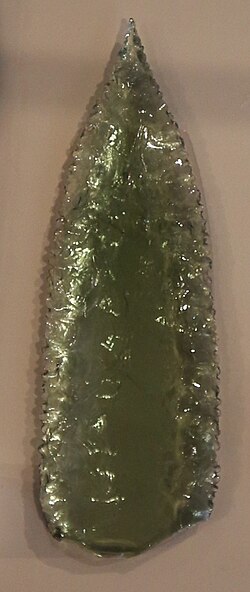
Kimberley points are a type of Aboriginal stone tool made by pressure flaking1 both discarded glass and stone.2 Best known for the points made of glass, these artifacts are an example of adaptive reuse of Western technology by a non-western culture.
They are often used as an indicator that an archaeological site is a post-contact Aboriginal site.3 There is debate in archaeological literature about the use and significance of these points, with some claims that they were made for sale to tourists and as status items, and not as hunting tools.4
References
References
- Elkin, A. P. (October 1948). "Pressure Flaking in the Northern Kimberley, Australia". Man. 48: 110–113. doi:10.2307/2791788. JSTOR 2791788.
- Balfour, Henry (1903). "On the methods employed by the natives of NW Australia in the manufacture of glass spear heads". Man. 3: 65. doi:10.2307/2839799. JSTOR 2839799.
- Harrison, Rodney (2002). "Australia's iron Age: Aboriginal post-contact metal artefacts from Old Lamboo Station, Southeast Kimberley, Western Australia" (PDF). Australasian Historical Archaeology. 20. Australasian Society for Historical Archaeology: 67–76.
- Powell, Eric A. (2008). "What's the Point?". Archaeology. 61 (5). Archived from the original on 15 June 2009. Retrieved 22 January 2011.
- Harrison, Rodney (April 1, 2004). "Kimberley points and colonial preference: new insights into the chronology of pressure flaked point forms from the southeast Kimberley, Western Australia". Archaeology in Oceania. 39: 1–11. doi:10.1002/j.1834-4453.2004.tb00552.x.
- Akerman, Kim; Fullagar, Richard; van Gijn, Annelou. "Weapons and wunan: production, function and exchange of Kimberley points". Australian Aboriginal Studies 2002/1. 1 (2002): 13–42 – via Research Gate.
- Akerman, Kim; Bindon, Peter (1995). "Dentate and related stone biface points from Northern Australia". The Beagle: Records of the Museums and Art Galleries of the Northern Territory. 12 (1995): 89–99. doi:10.5962/p.264280 – via Biodiversity Heritage Library.
- Akerman, Kim. 2008. "'Missing the Point' or 'What to Believe – the Theory or the Data'. Rationales for the Production of Kimberley Points". Aboriginal Studies 2008/2:70–79. AIATSIS Canberra.