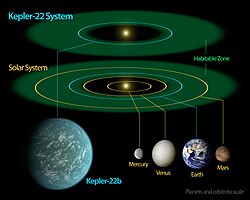
 This diagram compares the Solar System to Kepler-22 (Kepler-22b is displayed by an artist's depiction) | |
| Observation data Epoch J2000 Equinox J2000 | |
|---|---|
| Constellation | Cygnus1 |
| Right ascension | 19h 16m 52.19023s2 |
| Declination | +47° 53′ 03.9486″2 |
| Apparent magnitude (V) | 11.6643 |
| Characteristics | |
| Evolutionary stage | main sequence2 |
| Spectral type | G5V4 |
| Astrometry | |
| Radial velocity (Rv) | −4.50±0.512 km/s |
| Proper motion (μ) | RA: −39.589 mas/yr2 Dec.: −66.773 mas/yr2 |
| Parallax (π) | 5.0627±0.0110 mas2 |
| Distance | 644 ± 1 ly (197.5 ± 0.4 pc) |
| Absolute magnitude (MV) | ~5.27 |
| Absolute bolometric magnitude (Mbol) | ~4.98 |
| Details | |
| Mass | 0.857+0.051 −0.0435 M☉ |
| Radius | 0.869±0.0115 R☉ |
| Luminosity (bolometric) | 0.79 ± 0.043 L☉ |
| Luminosity (visual, LV) | ~0.67 L☉ |
| Temperature | 5596±615 K |
| Metallicity [Fe/H] | −0.255±0.0655 dex |
| Rotational velocity (v sin i) | 0.6 ± 1.03 km/s |
| Age | 7.0+4.0 −4.25 Gyr |
| Other designations | |
| KOI-87, KIC 10593626, GSC 03546-02301, 2MASS J19165219+4753040, Gaia DR2 21279417572628066566 | |
| Database references | |
| SIMBAD | data |
| Exoplanet Archive | data |
| KIC | data |
| Extrasolar Planets Encyclopaedia | data |
Kepler-22 is a Sun-like star in the northern constellation of Cygnus, the swan, that is orbited by a planet found to be unequivocally within the star's habitable zone. It is located at the celestial coordinates: Right Ascension 19h 16m 52.2s, Declination +47° 53′ 3.9″.2 With an apparent visual magnitude of 11.7,3 this star is too faint to be seen with the naked eye. It can be viewed with a telescope having an aperture of at least 4 in (10 cm).7 The estimated distance to Kepler-22 is 644 light-years (197 parsecs).2
Stellar characteristics
Kepler-22 is slightly smaller and cooler than the Sun,8 with a lower abundance of elements having more mass than helium.3 It has a spectral type of G5V, while the luminosity class remains undetermined.4 This star is radiating 79%3 of the Sun's luminosity from its outer atmosphere at an effective temperature of 5,518 K,3 giving it the yellow-hued glow of a G-type star.9 A projected rotational velocity of 0.6 km/s3 suggests it has a long period of rotation. No flare activity has been detected.10
Planetary system
| Companion (in order from star) |
Mass | Semimajor axis (AU) |
Orbital period (days) |
Eccentricity | Inclination (°) |
Radius |
|---|---|---|---|---|---|---|
| b | <9.1 M🜨 | 0.812+0.011 −0.013 |
289.863876±0.000013 | <0.72 | 89.764+0.025 −0.042 |
2.10±0.12 R🜨 |
On December 5, 2011, scientists from the Kepler mission announced that an exoplanet, Kepler-22b, had been discovered orbiting in the star's habitable zone by NASA's Kepler spacecraft.1112 This was significant in that it was the first relatively small exoplanet (about 2.4 R🜨)12 confirmed to be orbiting within a star's habitable zone.13 Its size suggests that it is not likely to be a rocky planet and is more likely to be a mini-Neptune or ocean world; while its mass has not been measured, radial velocity observations have set an upper limit of 9.1 M🜨 as of 2023.5
In popular culture
Kepler-22b is the source of the extraterrestrial signal which starts the events in the television show Pluribus.14
References
References
- Roman, Nancy G. (1987). "Identification of a constellation from a position". Publications of the Astronomical Society of the Pacific. 99 (617): 695. Bibcode:1987PASP...99..695R. doi:10.1086/132034. Constellation record for this object at VizieR.
- Vallenari, A.; et al. (Gaia collaboration) (2023). "Gaia Data Release 3. Summary of the content and survey properties". Astronomy and Astrophysics. 674: A1. arXiv:2208.00211. Bibcode:2023A&A...674A...1G. doi:10.1051/0004-6361/202243940. S2CID 244398875. Gaia DR3 record for this source at VizieR.
- "Kepler-22b". Archived from the original on 2017-03-31. Retrieved 2011-12-07.
- Schneider, Jean, "Star: Kepler-22", Extrasolar Planets Encyclopaedia, retrieved 2020-12-17
- Bonomo, A. S.; Dumusque, X.; et al. (April 2023). "Cold Jupiters and improved masses in 38 Kepler and K2 small-planet systems from 3661 high-precision HARPS-N radial velocities. No excess of cold Jupiters in small-planet systems". Astronomy & Astrophysics. arXiv:2304.05773. Bibcode:2023A&A...677A..33B. doi:10.1051/0004-6361/202346211. S2CID 258078829.
- "GSC 03546-02301 -- Star", SIMBAD, Centre de Données astronomiques de Strasbourg, retrieved 2011-12-08
- Sherrod, P. Clay; Koed, Thomas L. (2003), A Complete Manual of Amateur Astronomy: Tools and Techniques for Astronomical Observations, Astronomy Series, Courier Dover Publications, p. 9, ISBN 0486428206
- "Kepler Confirms First Planet in Habitable Zone of Sun-Like Star". Universe Today. 2011-12-05.
- "The Colour of Stars", Australia Telescope, Outreach and Education, Commonwealth Scientific and Industrial Research Organisation, December 21, 2004, archived from the original on March 18, 2012, retrieved 2012-01-16
- Armstrong, D. J.; Pugh, C. E.; Broomhall, A.-M.; Brown, D. J. A.; Lund, M. N.; Osborn, H. P.; Pollacco, D. L. (2015), "The Host Stars of Kepler's Habitable Exoplanets: Superflares, Rotation and Activity", Monthly Notices of the Royal Astronomical Society, 455 (3): 3110–3125, arXiv:1511.05306, doi:10.1093/mnras/stv2419, S2CID 16265095
- Borucki, William J.; Koch, David G.; et al. (February 2012). "Kepler-22b: A 2.4 Earth-radius Planet in the Habitable Zone of a Sun-like Star". The Astrophysical Journal. 745 (2): 120. arXiv:1112.1640. Bibcode:2012ApJ...745..120B. doi:10.1088/0004-637X/745/2/120. S2CID 50813889.
- Boyle, Rebecca (December 5, 2011). "Kepler Team Confirms First Earth-like planet in a habitable zone, And Finds 1,094 More Worlds". Popular Science. Retrieved December 5, 2011.
- "NASA Telescope Confirms Alien Planet in Habitable Zone". Space.com. 2011-12-05.
- "Charm Offensive". Pluribus. Season 1. Episode 8. 2025-12-19. Event occurs at 21:13. Apple TV.