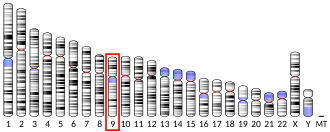
Potassium channel subfamily T, member 1, also known as KCNT1 or SLACK is a human gene that encodes the KCa4.1 protein. KCa4.1 is a member of the calcium-activated potassium channel protein family 5
Associated Conditions
Mutations in the KCNT1 gene has been shown to be a cause of Ohtahara syndrome and other congenital neurodegenerative diseases. 6
Therapeutic research
Preclinical and translational studies have investigated antisense oligonucleotide knockdown of KCNT1 as a potential therapy for KCNT1-associated developmental and epileptic encephalopathies, including studies in patient-derived neurons and prenatal human neuronal tissue. 7
See also
See also
References
References
- GRCh38: Ensembl release 89: ENSG00000107147 – Ensembl, May 2017
- GRCm38: Ensembl release 89: ENSMUSG00000058740 – Ensembl, May 2017
- "Human PubMed Reference:". National Center for Biotechnology Information, U.S. National Library of Medicine.
- "Mouse PubMed Reference:". National Center for Biotechnology Information, U.S. National Library of Medicine.
- "Entrez Gene: KCNT1 potassium channel, subfamily T, member 1".
- Møller RS, Heron SE, Larsen LH, Lim CX, Ricos MG, Bayly MA, et al. (September 2015). "Mutations in KCNT1 cause a spectrum of focal epilepsies". Epilepsia. 56 (9): e114–20. doi:10.1111/epi.13071. PMC 5915334. PMID 26122718.
- Golinski SR, Soriano K, Briegel AC, Burke MC, Tang S, Carvill GL, et al. (April 2026). "RNA targeting therapy for a prenatally enriched potassium channel associated with severe childhood epilepsy and premature death". Nature Communications. doi:10.1038/s41467-026-72334-7. PMID 42056090.
Further reading
Further reading
- Nagase T, Kikuno R, Ishikawa KI, Hirosawa M, Ohara O (February 2000). "Prediction of the coding sequences of unidentified human genes. XVI. The complete sequences of 150 new cDNA clones from brain which code for large proteins in vitro". DNA Research. 7 (1): 65–73. doi:10.1093/dnares/7.1.65. PMID 10718198.
- Kimura K, Wakamatsu A, Suzuki Y, Ota T, Nishikawa T, Yamashita R, et al. (January 2006). "Diversification of transcriptional modulation: large-scale identification and characterization of putative alternative promoters of human genes". Genome Research. 16 (1): 55–65. doi:10.1101/gr.4039406. PMC 1356129. PMID 16344560.
- Wei AD, Gutman GA, Aldrich R, Chandy KG, Grissmer S, Wulff H (December 2005). "International Union of Pharmacology. LII. Nomenclature and molecular relationships of calcium-activated potassium channels". Pharmacological Reviews. 57 (4): 463–472. doi:10.1124/pr.57.4.9. PMID 16382103. S2CID 8290401.