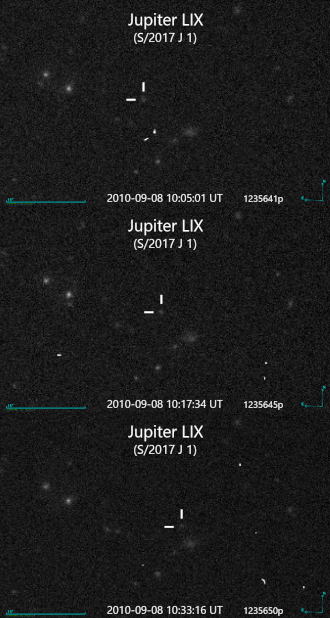
 Precovery images of Jupiter LIX taken by the Canada–France–Hawaii Telescope in 2010 | |
| Discovery | |
|---|---|
| Discovered by | Scott S. Sheppard et al. |
| Discovery date | 5 June 2017 |
| Designations | |
Designation | Jupiter LIX |
| S/2017 J 1 | |
| Orbital characteristics1 | |
| Epoch 2026-01-01 | |
| Observation arc | 14 years 2024-12-03 (last obs) |
| Periapsis | 16.8 million km |
| Apoapsis | 31.5 million km (2026-Mar-18)2 |
| 24.1 million km | |
| Eccentricity | 0.305 |
| −767 days | |
| Inclination | 144.7° |
| Satellite of | Jupiter |
| Group | Pasiphae group |
| Physical characteristics | |
| 2 km3 | |
| 23.8 | |
| 16.83 (31 obs)4 | |
Jupiter LIX, provisionally known as S/2017 J 1, is an outer irregular satellite of Jupiter on a retrograde orbit. It was reported on June 5, 2017, via a Minor Planet Electronic Circular from the Minor Planet Center.5 It is about 2 km in diameter.3
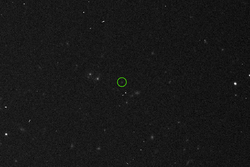
It is a member of the Pasiphae group. It has an average orbital distance of 24.1 million km, with an inclination of 144.7 degrees. Its period is 767 days.1 It came to apojove (farthest distance from Jupiter) on 18 March 2026 when it was 0.21 AU (31 million km; 20 million mi) from Jupiter.2
References
References
- Horizons output. "Jovian Osculating Orbital Elements for 2017J1 (559)". Retrieved 2026-01-20.
- "Apojove on 2026-Mar-18". JPL Horizons. Retrieved 2026-01-20.
- S.S. Sheppard (2019), Moons of Jupiter, Carnegie Science, on line
- MPC Natural Satellites (Select: Orbital Elements)
- "MPEC 2017-L47 : S/2017 J 1". Minor Planet Center. International Astronomical Union. Retrieved 5 June 2017.