Article · Wikipedia archive · Last revised Aug 3, 2026

Julius Work Calendar

The Julius Work Calendar is the earliest surviving calendar in England. It was written on parchment at Canterbury Cathedral in around 1020, and is a valuable primary source of Anglo-Saxon history. After the dissolution of the monasteries it was salvaged by Sir Robert Cotton and kept in the Cotton Library; the "Julius" in its name is a reference to where it was stored in Cotton's library. Since 2000 it has been stored in the British Museum, catalogued as Cotton MS Julius A VI. It is written in Medieval Latin.
Last revised
Aug 3, 2026
Read time
≈ 1 min
Length
175 w
Citations
Source
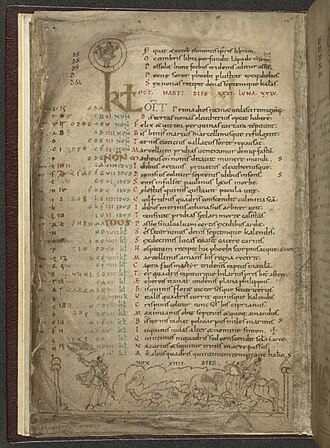
The calendar page for October; note the "Oct. habst dies XXXI" source ↗

The Julius Work Calendar is the earliest surviving calendar in England. It was written on parchment at Canterbury Cathedral in around 1020, and is a valuable primary source of Anglo-Saxon history. After the dissolution of the monasteries it was salvaged by Sir Robert Cotton and kept in the Cotton Library; the "Julius" in its name is a reference to where it was stored in Cotton's library. Since 2000 it has been stored in the British Museum, catalogued as Cotton MS Julius A VI. It is written in Medieval Latin.

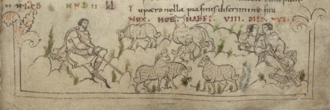
The calendar is illustrated; this footer image for the month of May shows shepherds tending sheep. A lamb is suckling at a ewe, and the other sheep are probably wethers kept for shearing their wool. source ↗
References

References

  • Lacey, Robert; Danziger, Danny (1999). The Year 1000: What Life was Like at the Turn of the First Millennium. Little, Brown and Company. ISBN 0-316-55840-0.
External links