John F. Clark | |
|---|---|
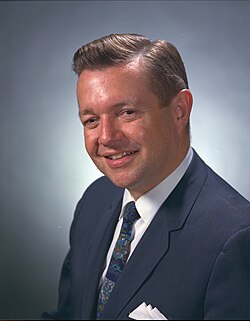 Portrait in 1966 | |
| Born | (1920-12-12)December 12, 1920 Reading, Pennsylvania, U.S. |
| Alma mater | Lehigh University (BS) George Washington University (MS) University of Maryland (PhD) |
| Years active | 1942–1976 |
| Awards |  NASA Distinguished Service Medal NASA Distinguished Service Medal |
John F. Clark (born December 12, 1920)1 was an American electrical engineer, physicist and atmospheric scientist who served as the second director of NASA's Goddard Space Flight Center from 1966 to 1976. He oversaw NASA's astronomy and planetary science programs as chairman of the steering committee from 1962 to 1965.
Clark was a member of the Apollo 13 Review Board, convened in 1970 to investigate the oxygen tank explosion that nearly cost the lives of the mission's three-man crew.2 He was awarded the NASA Distinguished Service Medal, NASA's highest award, in 1969.3
Early life
Clark was born in Reading, Pennsylvania in 1920. He earned a Bachelor of Science in electrical engineering with honors from Lehigh University in 1942 and a Master of Science in mathematics from George Washington University in 1946.4 He received a doctorate in physics from the University of Maryland, College Park in 1956.5
Career
After graduating from Lehigh, Clark joined the United States Naval Research Laboratory (NRL) as an electronics engineer. He briefly took on an assistant professorship in electrical engineering at Lehigh in 1947 but returned to the NRL in 1948 to study atmospheric electricity. He became head of the program responsible for using sounding rockets to study phenomena in the atmosphere. Clark was considered an authority on atmospheric physics, particularly regarding the ionosphere.6
In 1958, he moved to NASA's Office of Space Sciences and Applications (OSSA) and was appointed director of the geophysics and astronomy programs three years later.78 He was appointed the director of science at OSSA in 19639 and was chairman of the Space Science Steering Committee until 1965.1011 He oversaw funding for an observatory on Mauna Kea, later named after the Dutch astronomer Gerard Kuiper.12

Clark became acting director of Goddard Space Flight Center in July 1965 and was appointed its second director on May 5, 1966, succeeding Harry J. Goett.13 He served for more than a decade, retiring from NASA on July 1, 1976.14
After the explosion of the oxygen tank on Apollo 13, Clark was part of the Apollo 13 Review Board.15
In 1974, Clark accepted the Collier Trophy on behalf of NASA, jointly with Daniel J. Fink of General Electric, for the Landsat program, for "proving in 1974 the value of U.S. space technology in the management of the Earth's resources and environment for the benefit of all mankind".1617
He was a member of the American Association of Physics Teachers, American Geophysical Union, Scientific Research Society of America, and Philosophical Society of Washington.18 He was awarded the NASA Exceptional Service Medal, NASA Outstanding Leadership Medal, and the NASA Distinguished Service Medal, NASA's highest award.
Personal life
He and his wife had two children. They lived in Silver Spring, Maryland, outside of Washington, D.C. Clark held four patents in electronic circuits.1
References
References
- Astronautics, United States Congress House Science and (1970). The Apollo 13 Accident, Hearings...91-2. June 16, 1970. U.S. Government Printing Office. p. 113. Retrieved April 22, 2026.
- "Historic Personnel: Center Directors - NASA". NASA. Retrieved April 22, 2026.
- Astronautics, United States Congress House Committee on Science and (1970). Hearings, Reports and Prints of the House Committee on Science and Astronautics. U.S. Government Printing Office. p. 114. Retrieved April 22, 2026.
- Center, Goddard Space Flight (1965). Goddard: A Year in Review at Goddard Space Flight Center, National Aeronautics and Space Administration. The Center. p. 34. Retrieved April 22, 2026.
- "Dr. John F. Clark". NASA. Retrieved April 22, 2026.
- Subcommittee, United States Congress Senate Committee on Aeronautical and Space Sciences NASA Authorization (1959). NASA Authorization for Fiscal Year 1960: Hearings Before the NASA Authorization Subcommittee of the Committee on Aeronautical and Space Sciences, United States Senate, Eighty-sixth Congress, First Session, on S. 1582 [and H.R. 7007], a Bill to Authorize Appropriations to the National Aeronautics and Space Administration for Salaries and Expenses, Research and Development, Construction and Equipment, and for Other Purposes. U.S. Government Printing Office. p. 140. Retrieved April 22, 2026.
- Administration, Estados Unidos National Aeronautics and Space (1965). NASA University Program Review Conference. NASA. p. 225. Retrieved April 22, 2026.
- Clark, John F.; Haggerty, James J.; Woodburn, John H. (January 1, 1961). "Spacecraft" (PDF). Science Advisory Board. Retrieved April 22, 2026.
- Bergaust, Erik (1964). The Next Fifty Years in Space. Macmillan. p. 56. Retrieved April 22, 2026.
- Wells, Helen T.; Whiteley, Susan H.; Karegeannes, Carrie E. (1976). Origins of NASA Names. Scientific and Technical Information Office, Nat. Aeronautics and Space Administration. pp. 36–37.
- Clark, John F. (May 1, 1972). "Space Simulation". Proceedings of the Sixth Space Simulation Symposium. Retrieved April 22, 2026.
- "Letter to Mr. Akiyama from John F. Clark (Director of Sciences, Office of Space Science & Applications) August 26, 1964". hilo.hawaii.edu. University of Hawaii at Hilo. Retrieved April 22, 2026.
- NASA Activities. National Aeronautics and Space Administration. 1976. p. 22. Retrieved April 22, 2026.
- Fitzgibbons, Ryan; Nune, Swarupa (April 29, 2019). "Goddard at 60". NASA Goddard Space Flight Center. Retrieved April 22, 2026.
- "The Hard-won Triumph of the Apollo 13 Mission - 45 Years Later - NASA". NASA. May 3, 2023. Retrieved April 22, 2026.
- Mack, Pamela E. "LANDSAT and the Rise of Earth Resources Monotoring". www.nasa.gov. NASA. Retrieved April 22, 2026.
- Robie, Bill (1993). For the Greatest Achievement: A History of the Aero Club of America and the National Aeronautic Association. Washington, D.C.: Smithsonian Institution Press. p. 235.
- Collins, Martin; Collins, Martin J.; Fries, Sylvia Doughty (February 17, 1991). SPACEFARING NATION. Smithsonian. p. 142. ISBN 978-0-87474-907-6. Retrieved April 22, 2026.