| Jharrā | |
|---|---|
| Classification | Subcaste of Chhetri |
| Religions | Hinduism |
| Languages | Nepali, Sanskrit |
| Country | Nepal, India |
| Family names | Basnet/Basnyat, Bista/Bisht, Bohara, Budhathoki, Chauhan, Karki, Katuwal, Khadka, Kunwar, Mahat, Rawal, Ranabhat, Raut, Thapa. |
| Feudal title | Kaji Sa'ab, Dewan sahib, Mukhtiyar, Chautariya (चौतरिया) etc. All the titles being different administrative posts. |
| Victory weapon | Khukuri |
| Notable members | Thapa (,Basnyat family, Kunwar family, Thapa dynasty Family of Amar Singh Thapa |
| Subdivisions | Bahuthariya Ekthariya |
| Related groups | Thakuri, Bahun |
| Historical grouping | Tagadhari castes |
| Reservation (Education) | No (Forward Caste) |
| Reservation (Employment) | No |
| Reservation (Other) | No |
| Kingdom (original) | Khasa Kingdom |
| Kingdom (other) | Gorkha Kingdom, Jumla Kingdom |
Jharra Chhetri (/ˈʒərrɑː/) are the subgroup of the Chhetri caste of the Khas ethnic group. Jharra Chhetri wear the six threaded Janai (sacred thread). They are historically Indo Aryan people. Communities of Jharras include Basnet/Basnyat, Thapa, Karki, Kunwar, Khadka, Katuwal, Rawat, and Bisht.
Etymology and background
"Chhetri" is a direct derivative1 or a Nepalese vernacular of the Sanskrit word Kshatriya.2
Chhetris along with Brahmins are considered among the twice born castes called Tagadhari in Nepal and they wear the sacred thread called the Yagnopavita.3 Chhetris are considered among the Pahadi caste groups and they speak Nepali language as their mother tongue which is highly influenced by Sanskrit.3
Culture and traditions
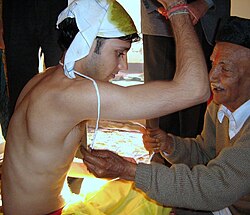
The children born from the union of a Chhetri man and his married Chhetri wife, only accomplished by a proper Brahmā vivāha are considered "Jharrā" (meaning: 'pure') while those children born from the union of a Hill Brahmin man and a Chhetri woman are considered "Thimā" (meaning: 'hybrid').4
A Jharrā boy would be given a six threaded Janai (sacred thread) at his Hindu passage of rite Bartaman ceremony while a Thimā boy would be given only a three threaded Janai (sacred thread).4 A Thimā son would inherit a sixth of the ancestral property compared to that of the Jharrā son.4
Notable people
- Bhimsen Thapa
- Abhiman Singh Basnet
- Dilli Jung Thapa
- Amar Singh Thapa
- Bhakti Thapa
- Bal Narsingh Kunwar
- Swarup Singh Karki
- Balbhadra Kunwar
- Queen Tripurasundari of Nepal
- Abhiman Singh Basnet
- Mathabarsingh Thapa
- Pyar Jung Thapa
- Purna Chandra Thapa
- Surya Bahadur Thapa
- Rookmangud Katawal
- Yogi Naraharinath
References
References
- Burghart 1984, p. 119.
- Gurung 1996, p. 31.
- Adhikary 1997, p. 19.
- Bennett 1978, p. 135.
Books
- Adhikary, Surya Mani (1997). The Khasa Kingdom: A trans-Himalayan empire of the middle age. Nirala Publications. p. 210. ISBN 8185693501.
- Bennett, Lynn (1978). "Maiti-Ghar: The Dual Role of High Caste Women". In James F. Fisher (ed.). Himalayan Anthropology: The Indo-Tibetan Interface. Walter de Gruyter. ISBN 978-90-279-7700-7.
- Bista, Dor Bahadur (1 January 1972). People of Nepal. Kathmandu: Ratna Pustak Bhandar.
- Burghart, Richard (1984). "The Formation of the Concept of Nation-State in Nepal". The Journal of Asian Studies. 44 (1): 101–125. doi:10.2307/2056748. JSTOR 2056748.
- Gurung, Harka B. (1996). Faces of Nepal. Himal Books. ISBN 9789993343509.
- Pahari, Anup (1995), The Origins, Growth and Dissolution of Feudalism in Nepal: A Contribution to the Debate on Feudalism in Non-European Societies, vol. 4, University of Wisconsin--Madison
- Sharma Upreti, Nayantara (1979). A Study of the Family Support System: Child Bearing and Child Rearing Rituals in Kathmandu, Nepal. University of Wisconsin--Madison. ISBN 9788173041143.
- Subba, Tanka Bahadur (1989). Dynamics of a hill society: Nepalis in Darjeeling and Sikkim Himalayas. Mittal Publications. ISBN 9788173041143.
- Iijima, Shigeru (1977). Changing Aspects of Modern Nepal: Relating to the Ecology, Agriculture, and Her People. Institute for the Study of Languages and Cultures of Asia and Africa.