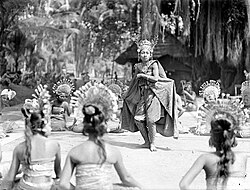
 Performance of janger dance | |
| Native name | ᬚᬗᬾᬃ (Balinese) Tari Janger (Indonesian) |
|---|---|
| Instrument(s) | Gamelan, Kendhang |
| Inventor | Balinese and Osing |
| Origin | Indonesia |
Janger (Balinese: ᬚᬗᬾᬃ) is a traditional Balinese and Osing dance drama performance originated from the Indonesian island of Bali,1 and commonly performed by Balinese in Bali as well as Osing people in the easternmost region of Java. The term roughly translates to '"infatuation," with a connotation of someone who is madly in love" 2:97
History
Janger is a social dance created in the 1920s, though its exact date of origin is unknown3:17, 161 I Madé Kredek claims it 'originated in the village of Menyali, North Bali and the songs featured in it were those of the horse drivers in the area.'2:101
Performance
Janger is a 'flirtatious youth group dance'4:92 which begins with a tableau vivant and a welcoming song.3:161 This is followed by 12 male dancers (kecak) who perform an elaborate routine. When finished, they sit in two rows of six facing each other, and then, a female group (janger) enters the area, sings a traditional folk song,3:161 and performs a slower dance with an 'emphasis on fluid, undulating, arm movements'.2:100 When finished, they form two lines of six, with the male dancers 'forming a boundary around the playing area.'3:161 This opening is followed by a drama, which usually concerns some sort of domestic theme.3:162
Gallery
-
 Janger dancers
 -
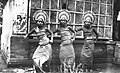 Janger performance
 -
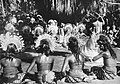 Janger performance, back view
References
References
- Kartika Dewi Suardana (2012). Dances of Bali. PT. Phoenix Communications. ISBN 978-60-297-9711-4.
- Bandem, Deboer; Bandem, I. Made; DeBoer, Fredrik Eugene (1995). Balinese Dance in Transition: Kaja and Kelod. Oxford University Press. ISBN 978-967-65-3071-4.
- Connick, Rob (2011). Rethinking Artaud's Theoretical and Practical Works (Thesis). Bowling Green State University. Archived from the original on 2020-06-30. Retrieved 2020-06-28.
- Sedana, I Nyoman; Foley, Kathy (2016-02-05). "Traditional Indonesian Theatre". In Liu, Siyuan (ed.). Routledge Handbook of Asian Theatre. Routledge. ISBN 978-1-317-27886-3.