James B. Hartle | |
|---|---|
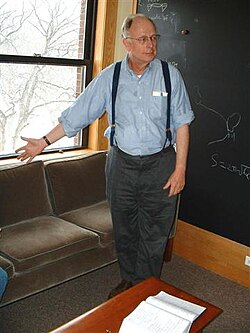 Hartle in 2007 | |
| Born | James Burkett Hartle (1939-08-17)August 17, 1939 Baltimore, Maryland, U.S. |
| Died | May 17, 2023(2023-05-17) (aged 83) Zurich, Switzerland |
| Alma mater |
|
| Known for | |
| Scientific career | |
| Fields |
|
| Institutions |
|
| Murray Gell-Mann | |
James Burkett Hartle (August 17, 1939 – May 17, 2023) was an American theoretical physicist known for his work in general relativity, astrophysics, and interpreting quantum mechanics. He was one of the pioneers of quantum cosmology. He joined the faculty of the University of California, Santa Barbara in 1966, and was a member of the external faculty of the Santa Fe Institute.
Early life and education
Hartle was born on August 17, 1939, in Baltimore, Maryland, to Anna Elizabeth Burkett and Charles James Hartle, who worked for IBM. His father's job required the family to relocated multiple times while Hartle was growing up. He attended public schools in Ohio and Connecticut, as well as the Gilman School in Baltimore.1 There, Hartle became interested in physics thanks to his teacher, Bill Potter. He began as an engineering major upon matriculation at Princeton University, but switched to physics due to the influence of John Archibald Wheeler.2
Hartle earned his AB at Princeton in 1960 and his Ph.D. in particle physics under Murray Gell-Mann in 1964 at the California Institute of Technology (Caltech). Afterwards, he briefly taught at Princeton before accepting a position at the University of California, Santa Barbara.2
Work
With Dieter Brill in 1964, he discovered the Brill–Hartle geon, an approximate solution realizing Wheeler's suggestion of a hypothetical phenomenon in which a gravitational wave packet is confined to a compact region of spacetime by the gravitational attraction of its own field energy.3
Hartle then turned his attention towards astrophysics.1 Starting in 1967, Hartle worked with Kip Thorne on the physics of rotating compact objects, such as neutron stars, including the influence of the coupling of their multipole moments to the spacetime curvature of nearby objects, as described by general relativity.24 They discovered the Hartle–Thorne metric, an approximate solution which describes the exterior of a slowly and rigidly rotating, stationary and axially symmetric body.5
Funded by an award from the Sloan Foundation, Hartle spent a year at the Institute for Theoretical Astronomy at the University of Cambridge, where he met Stephen Hawking, with whom he became a long-time collaborator.1 In 1976, Hartle and Hawking utilized path integrals to show that black holes must emit radiation (later dubbed Hawking radiation),6 the same conclusion Hawking himself had reached two years earlier.78: 74 Their work on the thermodynamics of black holes led to the development of the Euclidean approach to quantum gravity.1 In 1983, Hartle and Hawking proposed the no-boundary wave function for the Universe.98: 129 Their aim was to explain the initial conditions of the Big Bang model of cosmology.1 Hartle considered this to be his greatest contribution to the subject.1
In later decades, Hartle collaborated with Gell-Mann and others to develop an alternative to the standard Copenhagen interpretation of quantum mechanics, more general and appropriate to quantum cosmology, based on the notion of consistent histories.10
Hartle published his textbook on general relativity, Gravity: An Introduction to Einstein's General Relativity, in 2003.11 Reviewers have praised the book for its lucid explanations and focus on physical insight rather than mathematical details.21213 Only requires familiarity with calculus and differential equations, making the book suitable for junior or senior undergraduates in physics.1314 He explained his vision for teaching general relativity to undergraduates in a 2006 article.15
Hartle was a founder of the Kavli Institute for Theoretical Physics at UC Santa Barbara and served as its director from 1995 to 1997.1610
He was elected to the American Philosophical Society in 2016.17 He was also a Fellow of the American Physical Society (APS), a Guggenheim Fellow, and was elected to the National Academy of Sciences. He received the 2009 Einstein Prize from the APS for his "broad range of fundamental contributions to relativistic stars, quantum fields in curved spacetime, and especially quantum cosmology."2
Personal life
Hartle married Mary Jo Wheeler, a niece of John Archibald Wheeler, in 1984.2
Hartle was diagnosed with Alzheimer's disease in 2022.2 He died in Zurich, Switzerland on May 17, 2023, at the age of 83.101
References
References
- "Jim Hartle Obituary". Department of Physics, University of California, Santa Barbara. May 30, 2023. Archived from the original on June 4, 2023. Retrieved May 31, 2023.
- Garisto, Dan (June 15, 2023). "Jim Hartle, 1939-2023". APS News. American Physical Society. Retrieved August 10, 2023.
- Brill, Dieter; Hartle, James (1964). "Method of the Self-Consistent Field in General Relativity and its Application to the Gravitational Geon". Physical Reviews. 135 (1B): B271–B278. Bibcode:1964PhRv..135..271B. doi:10.1103/PhysRev.135.B271.
- Hartle, James; Thorne, Kip S. (1985). "Laws of motion and precession for black holes and other bodies" (PDF). Physical Review D. 31 (8): 1815–1837. Bibcode:1985PhRvD..31.1815T. doi:10.1103/PhysRevD.31.1815. PMID 9955908.
- Hartle, James B.; Thorne, Kip S. (September 1968). "Slowly Rotating Relativistic Stars. II. Models for Neutron Stars and Supermassive Stars". The Astrophysical Journal. 153: 807. Bibcode:1968ApJ...153..807H. doi:10.1086/149707.
- Hartle, James B.; Hawking, Stephen W. (April 15, 1976). "Path-Integral Derivation of Black Hole Radiance". Physical Review D. 13 (2188). doi:10.1103/PhysRevD.13.2188.
- Hawking, Stephen (March 1, 1974). "Black Hole Explosions?". Nature. 248 (5443): 30–31. Bibcode:1974Natur.248...30H. doi:10.1038/248030a0. S2CID 4290107.
- Ferguson, Kitty (2012). Stephen Hawking: An Unfettered Mind. Palgrave MacMillan. ISBN 978-0-230-34060-2.
- Hartle, James B.; Hawking, Stephen W. (December 15, 1983). "Wave Function of the Universe". Physical Review D. 28 (2960). doi:10.1103/PhysRevD.28.2960.
- "In Memoriam: James Hartle". Santa Fe Institute. June 2, 2023. Archived from the original on August 7, 2023. Retrieved August 21, 2023.
- Hartle, James B. (2003). Gravity: an Introduction to Einstein's General Relativity. San Francisco: Addison–Wesley. ISBN 0-8053-8662-9.
- Poisson, Eric (2005). "Book Review: Gravity: An Introduction to Einstein's General Relativity". Classical and Quantum Gravity. 22 (20). doi:10.1088/0264-9381/22/20/B01.
- Finley, Daniel (April 1, 2018). "A List of Technical Books on General Relativity". Department of Physics and Astronomy, University of New Mexico. Archived from the original on March 20, 2024. Retrieved December 23, 2025.
- Traschen, Jennie (2005). "Book Review: Gravity: An Introduction to Einstein's General Relativity". Physics Today. 58 (1): 52–4. doi:10.1063/1.1881902.
- Hartle, James (2006). "General relativity in the undergraduate curriculum". American Journal of Physics. 74: 14–21. arXiv:gr-qc/0506075. doi:10.1119/1.2110581.
- "2009 Einstein Prize Recipient". American Physical Society (APS). Retrieved August 21, 2023.
- "APS Member History". search.amphilsoc.org. Retrieved February 18, 2021.
External links
External links
- James Hartle homepage Archived July 25, 2011, at the Wayback Machine
- Faculty profile
- "The Future of Gravity" – April 2000 online lecture (RealAudio plus slides)
- "Spacetime Quantum Mechanics" online RealAudio lecture
- "The Classical Behavior of Quantum Universes" online RealAudio lecture
- James Hartle at the Mathematics Genealogy Project
- "The Quantum Universe: Essays on Quantum Mechanics, Quantum Cosmology, and Physics in General" book (World Scientific, 2021)