| Ixiolite | |
|---|---|
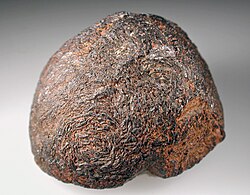 Ixiolite found in Mozambique | |
| General | |
| Category | Oxide minerals |
| Formula | (Ta,Nb,Sn,Mn,Fe)4O81 or (Ta,Mn,Nb)O22 |
| IMA symbol | Ix3 |
| Strunz classification | 4.DB.25 |
| Crystal system | Orthorhombic, some varieties might be monoclinic41 |
| Crystal class | Dipyramidal (mmm) H-M symbol: (2/m 2/m 2/m) |
| Space group | Pbcn2 |
| Unit cell | a = 4.785, b = 5.758 c = 5.16 [Å]; Z = 42 |
| Identification | |
| Color | Steel-grey, black |
| Crystal habit | Irregular granular or inclusions, also as prismatic crystals; some varieties might be pseudoorthorhombic |
| Twinning | Uncommon on {013} |
| Fracture | Irregular/ uneven, sub-conchoidal |
| Tenacity | Brittle |
| Mohs scale hardness | 6 - 6+1⁄2 |
| Luster | Sub-metallic |
| Diaphaneity | Opaque |
| Specific gravity | 7.03 - 7.23 |
| References | 1562 |
Ixiolite is an accessory oxide mineral found in granitic pegmatites. It is an oxide with the general chemical formula (Ta,Nb,Sn,Mn,Fe)4O8 or (Ta,Mn,Nb)O2.
Structure
Ixiolite was originally reported as crystallizing in the monoclinic crystal system.5 Detailed studies of the scandium, tin and titanium rich varieties indicate that they form crystals in the orthorhombic system whereas tungsten ixiolite is monoclinic.4
Discovery and occurrence
It was first described in 1857 for an occurrence at Skogsböle, Kimito Island, Finland. The name is for Ixion, the Greek mythological character related to Tantalus, as the mineral contains tantalum.1
Ixiolite is typically associated with feldspar, tapiolite, cassiterite, microlite, and rutile.5
Substitution and varieties
Trace elements include zirconium, hafnium, titanium and tungsten.5
As with other tantalum and niobium bearing minerals considerable substitution and a number of varieties exist. Substitutions in the formula are common and the varieties stannian ixiolite (tin), titanian ixiolite (titanium) and wolframian ixiolite (tungsten) have been reported.4
Scandium is present in many ixiolite sample with percentages up to 4.0 percent Sc2O3, but usually less than one percent scandium oxide. High scandium ixiolites, containing from 4 to 19% scandium oxide are typically also rich in tin and titanium.4
Economic importance
Ixiolite together with microlite, tantalite, tapiolite, wodginite are the most important minerals mined for the element tantalum. Ixiolite contains about 69 % tantalum oxide (Ta2O5) and is a common constituent of coltan ore.7
Further reading
Further reading
- Grice JD, Černý P, Ferguson RB (1972). "The Tanco pegmatite at Bernic Lake, Manitoba. II. Wodginite, tantalite, pseudo-ixiolite and related minerals" (PDF). The Canadian Mineralogist. 11: 609–642.
- Grice JD, Ferguson RB, Hawthorne FC (1976). "The crystal structures of tantalite, ixiolite and wodginite from Bernic Lake, Manitoba I. Tantalite and ixiolite" (PDF). The Canadian Mineralogist. 14: 540–549.
- The crystal structures of tantalite, ixiolite and wodginite from Bernic Lake, Manitoba; II, Wodginite
References
References
- Mindat.org - Ixiolite
- https://www.mineralienatlas.de/lexikon/index.php/MineralData?mineral=Ixiolite Mineralienatlas
- Warr, L.N. (2021). "IMA–CNMNC approved mineral symbols". Mineralogical Magazine. 85 (3): 291–320. Bibcode:2021MinM...85..291W. doi:10.1180/mgm.2021.43. S2CID 235729616.
- Wise, M.A.; Černý, P.; Falster, A.U. (1998). "Scandium substitution in columbite-group minerals and ixiolite" (PDF). Canadian Mineralogist. 36: 673–680.
- "Ixiolite" (PDF). Handbook of Mineralogy. Mineralogical Society of America. Archived from the original (PDF) on 10 October 2012. Retrieved 20 February 2013.
- Ixiolite data on Webmineral
- "Niobium-Tantalum". bgs.ac.uk. Retrieved 2 March 2013.