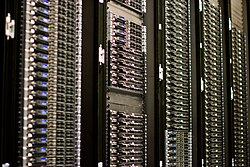
Information technology infrastructure is defined broadly as a set of information technology (IT) components that are the foundation of an IT service; typically these include physical components (computer and networking hardware and facilities), but also various software and network components.12
According to the ITIL Foundation Course Glossary, IT infrastructure can also be defined as “all of the hardware, software, networks, facilities, etc., that are required to develop, test, deliver, monitor, control or support IT services."3 IT infrastructure hardware includes mainframe computers, end-user devices like personal computers (PCs), laptops and tablets, and networking hardware like firewalls and routers. The software components include operating systems (OS), database management systems (DBMS), and virtualization software.4
Overview
IT infrastructure contributes to and drives business functions. Leaders and managers within the IT field are responsible for ensuring that both physical hardware and software networks and resources are working optimally. IT infrastructure is the foundation of an organization's technology systems, and is thereby integral to its success.5 All organizations that rely on technology can benefit from having robust, interconnected IT infrastructure.
With the current speed that technology changes and the competitive nature of businesses, IT leaders have to ensure that their IT infrastructure is designed such that changes can be made quickly and without impacting business continuity.6 While traditionally companies used to typically rely on physical data centers or colocation facilities to support their IT infrastructure, cloud hosting has become more popular as it is easier to manage and scale.
IT infrastructure can be managed by the company itself, or it can be outsourced to another company that has consulting expertise in developing robust IT infrastructure.7 With advances in online outreach availability, it has become easier for end users to access technology. As a result, IT infrastructures have become more complex, and therefore it is harder for managers to oversee the end to end operations. In order to mitigate this issue, strong IT infrastructures require employees with varying skill sets. The fields of IT management and IT service management rely on IT infrastructure, and the ITIL framework was developed as a set of best practices with regard to IT infrastructure. The ITIL framework assists companies in being responsive to technological market demands. Technology may be thought of as an innovative product which can incur high production costs. However, the ITIL framework helps address these issues and allows the company to be more cost effective which helps IT managers to keep the IT Infrastructure functioning.8
Background
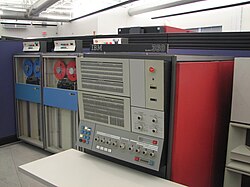
The history of IT infrastructure began in the mid-1950s, when mainframe computers were invented by IBM and other technology companies. They are designed to be able to process huge amounts of data at very quick speeds, and are still being used to this day by many companies, banks, and government agencies.9 By the 1960s, the IBM System/360 mainframe became the standard in the mainframe computer market. It was the first mainframe computer to introduce compatibility across systems, making it possible for applications created on one computer to operate on another.
Even though IT infrastructure has existed for 60 years, there have been significant advancements in technology in the past 20 years. By the 2000s, companies began moving to cloud computing, turning IT infrastructure virtual. This changed how organizations used information technology resources. Instead of being bound by the limitations of hardware IT, companies now only needed an internet connection to access IT services. 10
Components of IT infrastructure
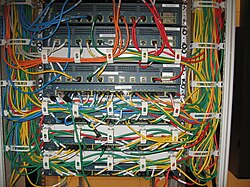
The primary components of IT infrastructure are the physical systems such as hardware, storage, any kind of routers/switches and the building itself, in addition to networks and software.11 In addition to these components, “IT infrastructure security” is necessary to keep the network and its devices safe and maintain the integrity of the overall infrastructure of the organization.12
IT infrastructure consists of three layers. The physical layer serves as the fundamental layer for hardware. The second and third layers (data link and network), are essential for communication to and from hardware devices. Without this, networking is not possible, and thus the internet itself would not be possible.13 Fiber optics play a crucial role in a network infrastructure. They serve as the primary means for connecting network equipment and establishing connections between buildings.14
Skills
In the field of IT infrastructure, key skills include technical abilities such as cloud, network, and data administration skills, and soft abilities such as collaboration and communication skills.1516
Future
As data storage and management becomes more digitized, IT infrastructure is moving towards the cloud. Infrastructure-as-a-service (IaaS) provides the ability to host on a server and is a platform for cloud computing.17
See also
See also
References
References
- techopedia.com: IT Infrastructure Quote: "...IT infrastructure refers to the composite hardware, software, network resources and services required for the existence, operation and management of an enterprise IT environment...", backup
- gartner.com: IT Infrastructure Quote: "...IT infrastructure is the system of hardware, software, facilities and service components that support the delivery of business systems and IT-enabled processes...", backup
- "ITIL® V3 Foundation Course Glossary" (PDF). Archived (PDF) from the original on 2021-08-12. Retrieved 2019-12-02.
- "What Is IT Infrastructure? | IBM". www.ibm.com. 2025-07-10. Retrieved 2026-03-05.
- "What is IT Infrastructure?". www.ecpi.edu. Archived from the original on 2021-05-06. Retrieved 2019-11-28.
- "Beginner's Guide to IT Infrastructure Management". Smartsheet. Archived from the original on 2019-11-17. Retrieved 2019-11-28.
- "What is infrastructure (IT infrastructure)? - Definition from WhatIs.com". SearchDataCenter. Archived from the original on 2019-11-18. Retrieved 2019-11-28.
- "What is ITIL 4? ITIL 4 Framework & Processes Explained". BMC Blogs. Retrieved 2019-11-28.
- Laudon, Kenneth C.; Laudon, Jane P. (2021). Essentials of management information systems (Fourteenth ed.). Hoboken: Pearson Education, Inc. ISBN 978-0-13-650081-0.
- Zardi, Hedia; Karamti, Walid; Alwehaid, Thuraya; Almisned, Shahad; Alsalloum, Wajd (2025-10-22). "The Evolution of Cloud Computing Architectures: A Comparative Analysis of Traditional Virtualization and Containerization Technologies". International Journal of Cloud Applications and Computing (in Ndonga). 15 (1): 1–15. doi:10.4018/IJCAC.391348. ISSN 2156-1834.
- "What is IT Infrastructure?". www.ecpi.edu. Archived from the original on 2021-05-06. Retrieved 2019-11-28.
- "What is infrastructure (IT infrastructure)? - Definition from WhatIs.com". SearchDataCenter. Archived from the original on 2019-11-18. Retrieved 2019-11-28.
- "What is the OSI Model?". Archived from the original on 2019-11-20. Retrieved 2019-12-02.
- Barbut, Cornel (June 2018). "Fiber Optic Deployments in Romania between Metropolitan Fiber Optic Networks and Indoor Fiber Optic Infrastructure". 2018 10th International Conference on Electronics, Computers and Artificial Intelligence (ECAI). IEEE. pp. 1–3. doi:10.1109/ECAI.2018.8679021. ISBN 978-1-5386-4901-5.
- "10 IT Infrastructure Skills You Should Master". InformationWeek. Archived from the original on 2019-11-28. Retrieved 2019-11-28.
- "What is IT Infrastructure?". www.ecpi.edu. Archived from the original on 2021-05-06. Retrieved 2019-11-28.
- "What is infrastructure (IT infrastructure)? - Definition from WhatIs.com". SearchDataCenter. Archived from the original on 2019-11-18. Retrieved 2019-11-28.
Sources
Sources
- Simon, Errol (1996). Distributed information systems: from client/server to distributed multimedia. McGraw-Hill. ISBN 9780077090760.
- Laan, Sjaak (2011). IT Infrastructure Architecture: Infrastructure Building Blocks and Concepts. Lulu Press. ISBN 9781447881285.
- van der Veen, Annelies; van Bon, Jan (2007). Foundations of ITIL V3. Van Haren Publishing. ISBN 978-90-8753-057-0.
- Rouse, Margaret (2017). "A DevOps primer: Start, improve and extend your DevOps teams", "TechTarget Search Data Center". Retrieved 28 September 2019.
- Laudon, Kenneth C., and Jane P. Laudon. Essentials of MIS. 14th ed., Pearson, 2020.
- Hedia Zardi, Walid Karamti, Thuraya Alwehaid, Shahad Almisned, Wajd Alsalloum, The Evolution of Cloud Computing Architectures:,International Journal of Cloud Applications and Computing,Volume 15, Issue 1,2025,ISSN 2156-1834,https://doi.org/10.4018/IJCAC.391348.