 | |
 | |
| Names | |
|---|---|
| Preferred IUPAC name
2H-Isoindole1 | |
| Identifiers | |
| |
3D model (JSmol)
|
|
| ChEBI | |
| ChemSpider |
|
PubChem CID
|
|
| UNII | |
CompTox Dashboard (EPA)
|
|
| |
| |
| Properties | |
| C8H7N | |
| Molar mass | 117.15 g/mol |
Except where otherwise noted, data are given for materials in their standard state (at 25 °C [77 °F], 100 kPa).
| |


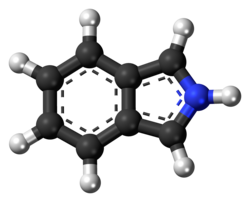
Isoindole is a heterocyclic compound consisting of a benzene ring fused with pyrrole along the carbon-carbon bond furthest from its nitrogen atom.2 The compound is an isomer of indole. Isoindoline is a hydrogenated form of isoindole. The parent compound is rarely encountered in the literature, but its derivatives (notably phthalocyanine dyes) are of significant utility and commercial value.3 Several alkaloids containing this ring system have been isolated from plants.4
Synthesis
The parent isoindole was prepared by flash vacuum pyrolysis of N-(methoxycarbonyloxy)isoindoline.5

N-Substituted isoindoles, which are more stable than the parent compound, can be prepared by dehydration of isoindoline-N-oxides. Other starting materials, including o-xylylene dibromide (o-C6H4(CH2Br)2), may be used in their synthesis.
Structure and tautomerism of 2-H-isoindoles
Unlike indole, isoindoles exhibit noticeable alternation in the C-C bond lengths, which is consistent with their description as pyrrole derivatives fused to a butadiene.
In solutions, the 2H-isoindole tautomer predominates. It resembles a pyrrole more than a simple imine.6 The degree to which the 2H predominates depends on the solvent and on the arrangement of substituents (for isoindole derivatives).7
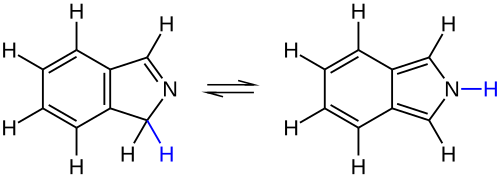
2H-Isoindole (right) is the predominant tautomer relative to 1H-isoindole (left) source ↗
N-Substituted isoindoles do not tautomerize.
Isoindole-1,3-diones and related derivatives
The commercially important phthalimide is an isoindole-1,3-dione with two carbonyl groups attached to the heterocyclic ring.8
- Illustrative Isoindoline Derivatives
-
 Pigment yellow 139, a common high performance pigment.
 -
 Pigment yellow 185, a common high performance pigment.
 -
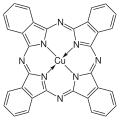 Copper phthalocyanine, one of the most pervasive synthetic pigments.
See also
See also
- 1,3-Disubstituted Isoindolines.
- Isoindene with nitrogen replaced by a methylene group.
References
References
- International Union of Pure and Applied Chemistry (2014). Nomenclature of Organic Chemistry: IUPAC Recommendations and Preferred Names 2013. The Royal Society of Chemistry. p. 213. doi:10.1039/9781849733069. ISBN 978-0-85404-182-4.
- Gilchrist, T. L. (1987). Heterocyclic Chemistry. Longman. ISBN 0-582-01422-0.
- Heugebaert, Thomas S. A.; Roman, Bart I.; Stevens, Christian V. "Synthesis of isoindoles and related iso-condensed heteroaromatic pyrroles" Chemical Society Reviews 2012, volume 41, pp. 5626-5640. doi:10.1039/c2cs35093a
- See for example: Zhang, X.; Ye, W.; Zhao, S.; Che, C. T. (2004). "Isoquinoline and isoindole alkaloids from Menispermum dauricum". Phytochemistry. 65 (7): 929–932. doi:10.1016/j.phytochem.2003.12.004. PMID 15081297.
- R. Bonnett and R. F. C. Brown "Isoindole" J. Chem. Soc., Chem. Commun., 1972, 393-395. doi:10.1039/C39720000393
- Alan R. Katritzky; Christopher A. Ramsden; J. Joule; Viktor V. Zhdankin (2010). Handbook of Heterocyclic Chemistry. Elsevier. p. 133.
- John A. Joule; Keith Mills (2010). Heterocyclic Chemistry. John Wiley & Sons. p. 447.
- Radtke, Volker; Erk, Peter; Sens, Benno (2009). "Isoindoline pigments". In Faulkner, Edwin B.; Schwartz, Russell J. (eds.). High Performance Pigments (2nd ed.). Wiley-VCH. pp. 221–241. doi:10.1002/9783527626915.ch14. ISBN 978-3-527-62691-5.