| Iris tuberosa | |
|---|---|
| |
Scientific classification 
| |
| Kingdom: | Plantae |
| Clade: | Embryophytes |
| Clade: | Tracheophytes |
| Clade: | Spermatophytes |
| Clade: | Angiosperms |
| Clade: | Monocots |
| Order: | Asparagales |
| Family: | Iridaceae |
| Genus: | Iris |
| Subgenus: | Iris subg. Hermodactyloides |
| Section: | Iris sect. Reticulatae |
| Species: | I. tuberosa
|
| Binomial name | |
| Iris tuberosa | |
| Synonyms123 | |
|
Synonyms of Iris tuberosa
Synonyms of Iris tuberosa var. tuberosa
Synonyms of Iris tuberosa var. longifolia (Sweet) ined.
| |
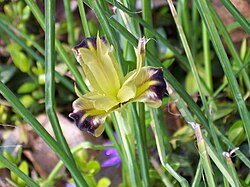
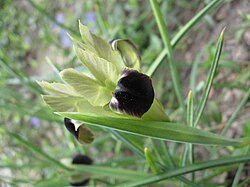
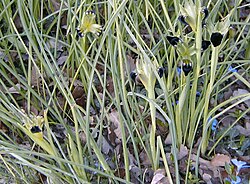
Iris tuberosa (formerly Hermodactylus tuberosus) is a species of tuberous flowering plant of the genus Iris, with the common names snake's-head,4 snake's-head iris,5 widow iris, black iris, or velvet flower-de-luce.
Distribution
A native of the Mediterranean region, it is found in the northern Mediterranean littoral and western Europe.6
It can be found in Albania, France, Greece, and Italy.7
Cultivation
It is grown from tubers planted in the autumn. It grows best in full sun to partial shade, and requires well-drained soil. It can naturalise in grassy areas but grows well in rock gardens or containers.8 It is a common ornamental garden plant, flowering in early spring. It is rather tender in the UK.9
Taxonomic history
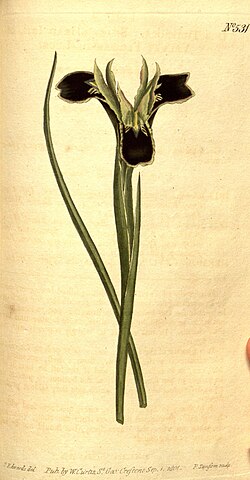
After being split off from the genus Iris in the nineteenth century into a separate genus,10 Hermodactylus, it has most recently been returned to the genus Iris,1112 following molecular studies at Kew.13 According to the proposed molecular classification of irises of Tillie, Chase and Hall,13 this species is now best seen as a member of the subgenus Hermodactyloides, the reticulate-bulbed bulbous irises.
References
References
- GBIF: Hermodactylus tuberosus
- "Iris tuberosa var. longifolia (Sweet) ined". Plants of the World Online. Royal Botanic Gardens, Kew. Retrieved 12 May 2022.
- "Iris tuberosa var. tuberosa". Plants of the World Online. Royal Botanic Gardens, Kew. Retrieved 12 May 2022.
- Thomas Ignatius M. Forster (1828)Circle of the seasons, and perpetual key to the calendar and almanack, p. 162, at Google Books
- BSBI List 2007 (xls). Botanical Society of Britain and Ireland. Archived from the original (xls) on 2015-06-26. Retrieved 2014-10-17.
- "Plants Profile - Hermodactylus tuberosus (L.) Salisb. (Iridaceae) - Bellavedova - Widow Iris". luirig.altervista.org. Retrieved 2021-09-24.
- "Iris tuberosa L. | Plants of the World Online | Kew Science". Plants of the World Online. Retrieved 2021-09-24.
- Paghat's Garden Paghat's Garden: Snake's-head or Widow Iris
- Caledonian Horticultural Society, Edinburgh Memoirs, Volume 3 (1823), p. 251, at Google Books
- David Joyce: The Genus Iris
- Pacific Bulb Society
- "Is It Clear, My Friend?". Royal Botanic Gardens, Kew: World Checklist of Selected Plant Families. Retrieved 3 Sep 2011.
- Tillie N, Chase MW, Hall T. 2002 Molecular studies in the genus Iris L.: a preliminary study. Ann. Bot. n.s. (Italy) 1. (2): 105–112 (2001)
Bibliography
Bibliography
- Telegraph: How to grow Hermodactylus
- Manning, John; Goldblatt, Peter (2008). The Iris Family: Natural History & Classification. Portland, Oregon: Timber Press. pp. 204–207. ISBN 978-0-88192-897-6.
- Goldblatt, P., (1990) Phylogeny and classification of Iridaceae. Ann. Missouri Bot. Gard. 77:607-627.
- Reeves, G., Chase, M.W., Goldblatt, P., Rudall, P., Fay, M.F., Cox, A.V., LeJeune, B., & Souza-Chies, T., (2001). Molecular systematics of Iridaceae: Evidence from four plastid DNA regions. Am. J. Bot. 88:2074-2087.
- Iridaceae: in L. Watson and M.J. Dallwitz (1992 onwards). The families of flowering plants: descriptions, illustrations, identification, information retrieval Archived 2007-10-12 at the Wayback Machine