| Iris notha | |
|---|---|
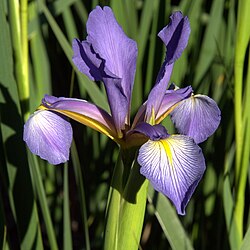
| |
Scientific classification 
| |
| Kingdom: | Plantae |
| Clade: | Embryophytes |
| Clade: | Tracheophytes |
| Clade: | Spermatophytes |
| Clade: | Angiosperms |
| Clade: | Monocots |
| Order: | Asparagales |
| Family: | Iridaceae |
| Genus: | Iris |
| Subgenus: | Iris subg. Limniris |
| Section: | Iris sect. Limniris |
| Series: | Iris ser. Spuriae |
| Species: | I. notha
|
| Binomial name | |
| Iris notha | |
| Synonyms2 | |
| |
Iris notha is a species in the genus Iris, it is also in the subgenus Limniris and series Spuriae. It is a rhizomatous perennial with deep blue or violet flowers from the Caucasus region. It is cultivated as an ornamental plant in temperate regions. It was once Iris spuria subsp. notha, and can often be found under that name. It has the common name of fake iris or mimic iris in Russia.
Description
It has a stout, thick rhizome,34 that is between 8–20 mm thick.56 The roots are sometimes described as adventitious (in an unusual place).4
It has linear, smooth, acuminate (tapering to a long point) 65–95 cm (26–37 in) long and 6–18 mm wide leaves.347 The leaves can be as long or longer than the peduncle.5
It has un-branched erect, stem, growing up to 30–90 cm (12–35 in) tall.8910
It has dark green, linear, lanceolate, acuminate, spathes (leaves of the flower bud).311
It has unequal pedicels (stem of a single flower).3
The stems hold 3–5 terminal (top of stem) flowers,4812 between May and July.3713
It has un-fragranced,5 flowers that are up to 15 cm (6 in) in diameter,3 that are violet-blue,81012 and bright blue.7910
It has 2 pairs of petals, 3 large sepals (outer petals), known as the 'falls' and 3 inner, smaller petals (or tepals, known as the 'standards'.14 The falls are deflexed, elliptic or ovate and narrowed at the claw (section near the stem).347 It has a yellow central stripe (or blaze).8912 The standards are erect, oblong and narrowed at the stem.37
It has a 20mm long perianth tube.34
It has slightly recurved, style branches,3 that are in the same shades of colour as the petals.
After the iris has flowered, it produces a seed capsule in August.13 It is 6 angled, has a beak-like appendage,3 and woolly-ribbed.4
Inside the capsule, are light brown, rugose (wrinkled), semi-circular and flattened seeds.345
Genetics
As most irises are diploid, having two sets of chromosomes. This can be used to identify hybrids and classification of groupings.14 It has a chromosome count: 2n=38. It has been counted several times, 38 in 1969 by O.I. Zakharyeva and L.M. Makushenko, 44 in 1970 by AK Sharma and 42 in 1978 by V Karihaloo.15
Taxonomy
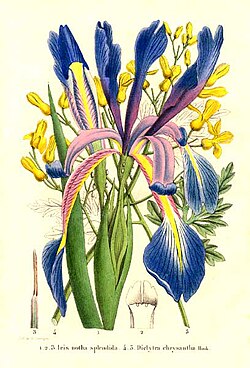
It has the common names of fake iris,51316 and mimic iris.1
The Latin specific epithet notha refers to the former name of the city of Ararat in Armenia.3
It was published as Iris notha by Friedrich August Marschall von Bieberstein in 'Flora Taurico Caucasica. Vol.3 page45 in 1819.37
It was the originally published and described by Bieberstein in 'Centuria Plantarum Rariorum Rossiae Meridionalis' (Cent. Pl. Ross. Merid.) Vol.3 page77 in 1843.2
It was also published by Boiss. in Flora Orientalis (Fl. Or.) Vol.5 page128 in 1884.7
It was then published as Iris spuria subsp. notha (M. Bieb.) Aschers. & Graebn. in Synops. Mitteleur Flora. Vol.3 page496 in 1905.717 Then by B. Mathew in his book Iris page118 in 1981.7
It was then published as Iris notha by Köhlein in his book Iris page 169 in 1987.7
It was verified as Iris spuria subsp. notha (M.Bieb.) Asch. & Graebn. by United States Department of Agriculture Agricultural Research Service on 9 January 2003.17
Iris spuria subsp. notha is currently in February 2015, an accepted name by the RHS.18
Distribution and habitat
Iris notha is native of temperate regions of Asia.17
Range
It is found in the Caucasus378 (both North6117 and South,7 Caucasus). Within the Russian Federation, it is found on the hills in the Stavropol Krai,11 Dagestan,41319 Krasnodar Krai,4131 Chechnya and Ingushetia,4613 Kabardino-Balkaria,10 and North Ossetia.131
One reference (Köhlein) refers to Kashmir.7
Habitat
Iris notha grows on steppe meadows,616 on the southern slopes of the dry scrub lands, in woodlands519 and on the slopes of the hills and foothills, and valleys.41019
It grows at altitudes around 3,000 m (9,840 ft) above sea level.6
Conservation
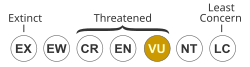
This is a scarce species with a fragmented population.1
Since 1986, it has been listed in the Red Data Book (the Soviet version of the IUCN Red List), within several republics (such as Kalmykia, Krasnodar, Stavropol and the Azov region).131 It is located in the ecological-recreational region of Kavkazskie Mineralnye Vody, which is under special protection.1
It is threatened due to the flowers being picked for bouquets and uncontrolled livestock grazing.6
Cultivation
It is hardy to H2.9 It winters without shelter in various places within Russia.1620
It was introduced to Britain in 1820.12
It was first grown in the St. Petersburg Imperial Botanical Garden in 1841.16
It was cultivated in many botanical gardens of the USSR,19 including, Moscow, Syktyvkar, Michurinsk, Samara, Stavropol, Nalchik, Dnepropetrovsk, Uzhgorod and Leningrad.1620
It is suitable to be grown in parks in dry conditions.20 It is tolerant of acid soils.6
Propagation
It can also be propagated by division or by seed growing.413
References
References
- Mikheev, A. (2014). "Iris spuria subsp. notha". IUCN Red List of Threatened Species. 2014 e.T200243A2643789. doi:10.2305/IUCN.UK.2014-1.RLTS.T200243A2643789.en. Retrieved 14 February 2015.
- "Iris notha M.Bieb. is an accepted name". theplantlist.org (The Plant List). 23 March 2013. Retrieved 14 January 2015.
- Komarov, V.L. (1935). "Akademiya Nauk SSSR" [FLORA of the U.S.S.R.]. Retrieved 9 October 2014.
- "Lat. Iris". agbina.com. Archived from the original on 14 March 2019. Retrieved 17 February 2015.
- Bend, Samara (2007). "COLLECTION IRIS natural flora, Introduced in the Botanical Garden Samara State University" (PDF). Научные Сообщения. 16 (3(21)): 518–531. Retrieved 14 February 2015 – via ssc.smr.ru (Samara State University).
- "Iris spuria subsp. notha in the Red Data Book of the Chechen Republic". oopt.aari.ru. Retrieved 14 February 2015.
- "Pakistan V. 202". efloras.org (Flora of Pakistan). Retrieved 12 February 2015.
- Cassidy, George E.; Linnegar, Sidney (1987). Growing Irises (Revised ed.). Bromley: Christopher Helm. p. 141. ISBN 0-88192-089-4.
- Stuart Max Walters, ed. (2011). The European Garden Flora Flowering Plants: A Manual for the Identification. Cambridge University Press. p. 348. ISBN 978-0-521-24859-4.
- "Chapter II iris clump and other (part3)". irisbotanique.over-blog.com. Retrieved 17 February 2015.
- "Spuria iris". flowerlib.ru. Retrieved 12 February 2015.
- "Iris spuria L. subsp. notha (Bieb.) Asch. & Grabn". hortuscamden.com. Retrieved 14 February 2015.
- Shmaraeva, A.N.; Shishlova, J.N.; Fedyaeva, V.V. (December 2014). "Fake iris (Iris notha Bieb.) In the Azov district of Rostov region". Living and Biokosnye System. 8 (10). Retrieved 14 February 2015.
- Austin, Claire (2005). Irises: A Gardener's Encyclopedia. Timber Press, Incorporated. ISBN 978-0881927306. OL 8176432M.
- "6 chromosome counts in Iris notha M. Bieb". ccdb.tau.ac.il. Retrieved 14 February 2015.
- "The exhibition "Iris Russia"". flower-iris.ru. Retrieved 14 February 2015.
- "Iris spuria subsp. notha". Germplasm Resources Information Network. Agricultural Research Service, United States Department of Agriculture. Retrieved 14 February 2015.
- "Iris spuria subsp. notha". www.rhs.org.uk. Retrieved 14 February 2015.
- Rodionenko, G. I. "Iris (Iris) fake (Iris notha)". calc.ru. Retrieved 14 February 2015.
- "Iris (Iris) fake (Iris notha)". derevnyaonline.ru. Retrieved 17 February 2015.
Sources
Sources
- Czerepanov, S. K. 1995. Vascular plants of Russia and adjacent states (the former USSR). [= I. notha M. Bieb.].
- Komarov, V. L. et al., eds. 1934–1964. Flora SSSR.
- Mathew, B. 1981. The Iris. 118.
- Nasir, E. & S. I. Ali, eds. 1970–. Flora of [West] Pakistan.
- Tutin, T. G. et al., eds. 1964–1980. Flora europaea. [mentions].
External links
External links
- many photos of Iris notha
- Data related to Iris willmottiana at Wikispecies