| Ips cembrae | |
|---|---|

| |
Scientific classification 
| |
| Kingdom: | Animalia |
| Phylum: | Arthropoda |
| Clade: | Pancrustacea |
| Class: | Insecta |
| Order: | Coleoptera |
| Suborder: | Polyphaga |
| Infraorder: | Cucujiformia |
| Superfamily: | Curculionoidea |
| Family: | Curculionidae |
| Genus: | Ips |
| Species: | I. cembrae
|
| Binomial name | |
| Ips cembrae Heer 1836
| |
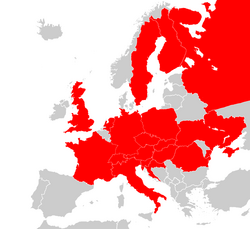
Ips cembrae, known generally as larch bark beetle or eight-toothed larch bark beetle, is a species of typical bark beetle in the family Curculionidae. Its habitat is Euro-Siberian, ranging from sea level to sub-alpine.2 It was first recorded in Great Britain in 1955.3 Populations were said to be found in Japan and China, but further research determined that those were actually Ips subelongatus.4
The insect measures around 5 mm and has a dark brown to black colour. The species is considered hard to distinguish visually from Ips typographus.4
As a pest
Ips cembrae is native to most of its habitat and is considered less of a pest risk than Ips typographus.1 The beetle mainly affects the European larch, Larix decidua, especially during periods of drought.35 Besides damage from digging tunnels, the beetle also spreads fungi between trees.
Parasites
The species can be infected by several nematodes: Contortylenchus, Parasitylenchus, Cryptaphelenchus, and Parasitorhabditis endoparasites, Micoletzkya under the wings as phoretic parasites. Laimaphelenchus and Bursaphelenchus are found in the frass.6
References
References
- EPPO/CABI 1997. "Ips typographus". In: Quarantine pests for Europe, 2nd edn. Ed. by Smith, I.M.; McNamara, D.G.; Scott, P.R.; Holderness, M. CABI, Wallingford.
- Grodski, Wojciech. "Ips cembrae Heer (Col.: Curculionidae, Scolytinae) in young larch stands–a new problem in Poland." Forstschutz Aktuell 44 (2008): 8-9.
- Crooke, Myles; Bevan, D. (1957). "Note on the First British Occurrence of Ips Cembrae Heer (Col. Scolytidae)". Forestry: An International Journal of Forest Research. 30: 21–28. doi:10.1093/oxfordjournals.forestry.a063092.
- Jeger, Michael; Bragard, Claude; Caffier, David; Candresse, Thierry; Chatzivassiliou, Elisavet; Dehnen-Schmutz, Katharina; Gilioli, Gianni; Jaques Miret, Josep Anton; MacLeod, Alan; Navajas Navarro, Maria; Niere, Björn; Parnell, Stephen; Potting, Roel; Rafoss, Trond; Rossi, Vittorio; Urek, Gregor; Van Bruggen, Ariena; Van Der Werf, Wopke; West, Jonathan; Winter, Stephan; Kertész, Virág; Aukhojee, Mitesha; Grégoire, Jean-Claude; Grégoire, J. C. (2017). "Pest categorisation of Ips cembrae". EFSA Journal. 15 (11): e05039. doi:10.2903/j.efsa.2017.5039. PMC 7009832. PMID 32625339.
- Hougardy, Evelyne, and J-C. Grégoire. "Biological differences reflect host preference in two parasitoids attacking the bark beetle Ips typographus (Coleoptera: Scolytidae) in Belgium." Bulletin of entomological research 94.4 (2004): 341-347.
- Grucmanová, Š., Holuša, J., Čermák, V., & Nermuť, J. (2015). Nematodes associated with Ips cembrae (Coleoptera: Curculionidae): comparison of generations, sexes and sampling methods. Journal of Applied Entomology, 140(5), 395–403. doi:10.1111/jen.12269
Further reading
Further reading
- Crooke, Myles, and D. Bevan. "Note on the first British occurrence of Ips cembrae Heer (Col. Scolytidae)." Forestry 30.1 (1957): 21–28.
- "Ips cembrae and Ips subelongatus". EPPO Bulletin. 35 (3): 445–449. 2005. doi:10.1111/j.1365-2338.2005.00880.x.