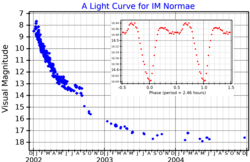
 A visual band light curve for IM Normae. The main plot shows the decline from the 2002 eruption, and the inset plot shows the periodic variation seen when the nova is in its quiescent state. Adapted from Schaefer (2010)1 | |
| Observation data Epoch J2000 Equinox ICRS | |
|---|---|
| Constellation | Norma |
| Right ascension | 15h 39m 26.465s2 |
| Declination | −52° 19′ 17.99″ |
| Characteristics | |
| Spectral type | white dwarf + ? |
| Variable type | eclipsing recurrent nova (NR+E) |
| Astrometry | |
| Parallax (π) | 0.9946±0.4149 mas3 |
| Distance | approx. 3,000 ly (approx. 1,000 pc) |
| Absolute magnitude (MV) | −4.44 |
| Details | |
| White dwarf | |
| Mass | 1.215 M☉ |
| Other designations | |
| AAVSO 1532-52, Nova Normae 19202 | |
| Database references | |
| SIMBAD | data |
IM Normae (IM Nor) is a recurrent nova in the constellation Norma, one of only ten known in the Milky Way. It has been observed to erupt in 1920 and 2002, reaching magnitude 8.5 from a baseline of 18.3. It was poorly monitored after the first eruption, so it is possible that it erupted in between these dates.1
The 1920 outburst was discovered by Ida Elizabeth Woods when she examined a Harvard Observatory photographic plate taken by the Bruce telescope in Arequipa, Peru, on July 7th of that year.6
At minimum, IM Normae shows brightness variations of about 0.3 magnitudes. These consist of 0.2 magnitude dips that are interpreted as partial eclipses of the accretion disk, and continuous variations caused by one side of the secondary star being heated by the white dwarf and therefore brighter than the other face. The orbital period is 2.462 hours.7
References
References
- Schaefer, Bradley E. (2010). "Comprehensive Photometric Histories of All Known Galactic Recurrent Novae". The Astrophysical Journal Supplement. 187 (2): 275–373. arXiv:0912.4426. Bibcode:2010ApJS..187..275S. doi:10.1088/0067-0049/187/2/275. S2CID 119294221.
- "V* IM Nor". SIMBAD. Centre de données astronomiques de Strasbourg. Retrieved 26 April 2015.
- Brown, A. G. A.; et al. (Gaia collaboration) (August 2018). "Gaia Data Release 2: Summary of the contents and survey properties". Astronomy & Astrophysics. 616. A1. arXiv:1804.09365. Bibcode:2018A&A...616A...1G. doi:10.1051/0004-6361/201833051. Gaia DR2 record for this source at VizieR.
- Schaefer, Bradley E. (2018). "The distances to Novae as seen by Gaia". Monthly Notices of the Royal Astronomical Society. 481 (3): 3033–3051. arXiv:1809.00180. Bibcode:2018MNRAS.481.3033S. doi:10.1093/mnras/sty2388. S2CID 118925493.
- Shara, Michael M.; Prialnik, Dina; Hillman, Yael; Kovetz, Attay (2018). "The Masses and Accretion Rates of White Dwarfs in Classical and Recurrent Novae". The Astrophysical Journal. 860 (2): 110. arXiv:1804.06880. Bibcode:2018ApJ...860..110S. doi:10.3847/1538-4357/aabfbd. S2CID 55851634.
- Bailey, S. I. (29 November 1920). "Variable Stars". Harvard College Observatory Bulletin. 734. Bibcode:1920BHarO.734....1W. Retrieved 8 October 2024.
- Woudt, P. A.; Warner, B. (2003). "High-speed photometry of the recurrent nova IM Normae". Monthly Notices of the Royal Astronomical Society. 343 (1): 313–314. arXiv:astro-ph/0304002. Bibcode:2003MNRAS.343..313W. doi:10.1046/j.1365-8711.2003.06666.x. S2CID 17271577.