| The Illusive Man | |
|---|---|
| Mass Effect character | |
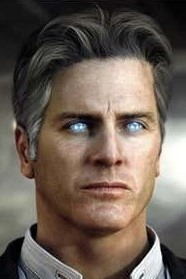 The Illusive Man, as shown in the Mass Effect 2 Codex. | |
First appearance | Mass Effect: Ascension (2008) |
| First game | Mass Effect 2 (2010) |
Last appearance | Mass Effect: Foundation (2014) |
| Voiced by | Martin Sheen |
| In-universe information | |
| Full name | Jack Harper |
| Affiliation | Cerberus (Mass Effect 2, Mass Effect 3) The Reapers (Mass Effect 3) |
The Illusive Man is a character in BioWare's Mass Effect francise. Initially presented in the tie-in novel Mass Effect: Ascension, the Illusive Man makes his first video game appearance in Mass Effect 2, where he is depicted as the leader of Cerberus, a pro-human organization with the goal of advancing humanity's role in the galaxy. The character returns in Mass Effect 3, where he implants himself with a set alien technology that ends up controlling him and making him aid the Reapers, the game's main antagonistic force. The Illusive Man is voiced by American voice actor Martin Sheen.
The Illusive Man was designed as a morally gray character with few signs of aging, a set of inhuman eyes, and a futuristic open suit designed to give an impression of authority. At one point in the development of Mass Effect 3, a Reaper-controlled Illusive Man was intended to become the game's final boss. In the Mass Effect universe, the Illusive Man is depicted as a "human nationalist" who only communicates with his subordinates via hologram. The character makes an appearance in several Mass Effect comic series and novels. The Mass Effect: Evolution comic series reveals the character's origin story as Jack Harper, who worked to defend humanity during an ongoing conflict against the turians known as the First Contact War.
During Donald Trump's 2016 presidential campaign, a propaganda video appropriating audio excerpts from Martin Sheen's performance of the Illusive Man, was shared on Trump's social media before being taken down for copyright infringement. The Illusive Man has been received well, with his appearance in Mass Effect 2 earning multiple accolades, with IGN naming him best character of 2010. Martin Sheen's performance was also received positively, earning a nomination for best male performance at the 2010 Spike Video Game Awards. His appearance in Mass Effect 3 and his relationship with the protagonist of the game, Commander Shepard has been the subject of scholarly analysis.
Concept and design
Visual design
In designing the Illusive Man, the Mass Effect 2 art team made the early decision to create his face by utilizing a catalog model as a base. Even though the Illusive Man was designed to be a smoker and a hard drinker in his fifties, the art team decided that he would not show any signs of age due to in-universe medical advancements.1 His eyes were designed to make him appear slightly inhuman, although a later in-universe explanation would be given in the comic series Mass Effect: Evolution.12 To create his suit, the art team intended to design an garment that, while futuristic, did not ground itself to any particular decade's fashion and combined "an impeccable futuristic style" and "the casual swagger of a charming billionaire". It was decided that the Illusive Man's suit should be open, to give the impression he could do whatever he pleased.13 Producer Adrien Cho described the Illusive Man's design as "almost perfect" and "very symmetrical".4
During the early stages of development on Mass Effect 3, the Illusive Man was envisioned as the final boss fight of the game, which would see him being turned into a Reaper-controlled creature. This idea was ultimately discarded for various reasons, one being that the design team wanted to give the players "the satisfaction of fighting a character they know", with his final design implying that the Illusive Man's biggest weapon was his intelligence and not his strength.1 In an interview with Eurogamer, producer Michael Gamble said the decision to discard the Illusive Man's boss fight was to make Mass Effect 3 separate from other games with similar endings.5 For his final appearance, the art team made several facial concepts to establish the level of indoctrination, a process that turns organic individuals into brainwashed, Reaper-controlled cyborgs to aid them in their goals, which the Illusive Man would be subject to. Some of those designs referenced the appearance of the main villain of the first Mass Effect video game, Saren Arterius.1
For his main setting, his chamber, the art team created very few concept art pieces. This chamber was designed to be mostly empty so that the Illusive Man's location remained unknown, with concepts depicting the Illusive Man staring at a dying star to create the illusion that he was in control of his surroundings. The room was envisioned to exclude any phones or monitors, instead featuring the Illusive Man surrounded by holograms that showed his connection to a vast amount of information. Early concepts for this observation room in Mass Effect 3 featured the Sun visible in the background either changing colors or during an eclipse. For the final design in the mission Priority: Cerberus Headquarters, the art team decided to make the dying star a hologram.1
Narrative design and voice acting

The Illusive Man's narrative creation was the result of a mash-up of several ideas. The name "Illusive" came from a proposed name for Dragon Age: Origins' Eclipse game engine. The engine was at one point meant to be called "Illusive", inspired by the use of the word "elusive" in a phrase by Obi-Wan Kenobi in The Phantom Menace, but with the "E" swapped for an "I" to evoke "illusion". As a character he was created by combining CNN reporter Anderson Cooper's ability to be at multiple places without looking tired with the idea of a character encompassing the worst of humanity. Another major influence in his narrative design came from Graem Bauer, Jack Bauer's brother in 24, a clandestine figure who worked behind the scenes.6 Mass Effect 3's lead writer Mac Walters explained that the Illusive Man was conceived as a morally gray character that the player would not know much about.78 Walters noted that the narrative team made the decision not to reveal much about the character's present, but remained open to exploring his past through additional content.8 Producer Adrien Cho described the Illusive Man as "a shadowy puppetmaster", characterizing him as "a womanizer" that encompassed both the best and worst traits of humanity embodied in a single individual, serving as a foil to Commander Shepard.4
For his appearance in the comic series Mass Effect: Evolution, Walters stated the writing team wanted to explore the Illusive Man's identity and background, expressing special interest in how he came to hold the influence he holds in Mass Effect 2 and the justifications behind his ideology. John Jackson Miller, who penned the script for Mass Effect: Evolution, Invasion, and Redemption, personally viewed him as a searcher that saw a "darker side to some of the great things humanity's discovered", the object of his search.8
For the Illusive Man's voice acting in both Mass Effect 2 and Mass Effect 3, BioWare cast American actor Martin Sheen.9 According to former Mass Effect lead producer Casey Hudson, Sheen was really invested in his role. Hudson further stated that during the recording, the development team had to explain to Sheen that he had to do multiple takes of each line so that they could fit in with the different conversation options that players have in dialogue. The thought of someone talking back to the Illusive Man confounded Sheen, who stated that the player "wouldn't say that".1011 In an interview with Joshua Lucht of Action News, Sheen said he would suck on a pen to simulate smoking when recording lines.12
Appearances
Throughout his appearances in the Mass Effect universe, the Illusive Man is depicted as a "human nationalist" and the leader of Cerberus, a pro-human organization dedicated to advancing humanity's role in the galaxy. In almost all his appearances, the Illusive Man almost exclusively communicates via hologram with his subordinates.113
In Mass Effect novels
Mass Effect: Ascension
The Illusive Man was first introduced in the tie-in novel Mass Effect: Ascension. After watching Saren's defeat at the hands of Commander Shepard in the news, the Illusive Man is portrayed as believing the time for humanity to assert its dominance over the rest of the species has come. The role of the Illusive Man in the novel revolves around the Ascension project in Grissom Academy, an ongoing initiative by humanity to expand their capacity to utilize biotics, a form of telekinesis that allows people to manipulate objects and forces using only their mind in the Mass Effect universe. To advance his political agenda, the Illusive Man tasks his operative Paul Grayson with retrieving his adoptive daughter Gillian from the academy so that Cerberus could personally train her. However, his plan is undermined when Grayson sides with Ascension Project doctor Kahlee Sanders to protect his daughter, ultimately betraying the Illusive Man.1415
Mass Effect: Retribution
Mass Effect: Retribution follows the Illusive Man's attempts to study the effects of the technology of the Reapers, a sentient machine race dedicated to wiping out all advanced intelligent life, when installed on people. The Illusive Man orders the kidnapping of Paul Grayson to be used as a test subject for Reaper technology implantation in a Cerberus base. After the escape of a Reaper-controlled Grayson from the base following a Turian attack orchestrated by Kahlee Sanders and human military officer Captain Anderson, the leader of Cerberus sends Kai Leng to oversee Grayson's assassination.1415
Mass Effect: Deception
In Mass Effect: Deception, the Illusive Man orders Kai Leng to retrieve Paul Grayson's body from the Citadel Council, while also being targeted by an organization known as the Biotic Underground.16
In Mass Effect video games
Mass Effect 2
Mass Effect 2, a 2010 action role-playing video game, marked the Illusive Man's first in-game appearance. The player character and protagonist, Commander Shepard, is recalled to life by the Illusive Man's Cerberus after being killed by an unknown ship at the beginning of the game. The Illusive Man debriefs and tells Shepard about how human colonists have begun to be mysteriously abducted and needs Shepard to investigate the matter.17 The game depicts the Illusive Man as a solitary person sitting in a chamber separate from all other characters, commanding others remotely utilizing a hologram.1819 The Illusive Man's Cerberus then tasks Shepard with building a team with whom to stop the colonist abductions.20
Over the course of the game, the Illusive Man's Cerberus tasks Shepard with a series of missions that reveal that the Collectors, a mysterious and reclusive race of insect-like humanoids, are behind the abductions and the attack that killed Commander Shepard.20 The Illusive Man also sends Shepard to the Collector Ship, which turned out to be a trap, one that the Illusive Man new about.21 At the end of the game, the Illusive Man sends Shepard to the Collector's base, where Shepard fights a Collector-created human Reaper. Once the mission is finished, the Illusive Man contacts Shepard, arguing that the technology encountered in the base could be used against the Reapers. It is then that Shepard has to decide whether to keep the base while killing the Collectors only or destroying the base in its entirety, ultimately severing their connection with Cerberus.2214
The Illusive Man also plays an important role in party member or "squadmate" Jack's backstory. His political organization had been responsible of physically torturing and nearly murdering Jack when she was a kid to enhance her biotic abilities. However, when questioned, the Illusive Man denies any culpability, stating that the facility where Jack was being kept had gone rogue.19
Mass Effect 3
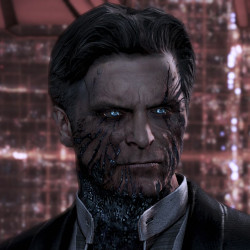
The character returns in the sequel to Mass Effect 2, Mass Effect 3. Throughout the game, the Illusive Man commands Cerberus to attack a series of locations, including the planet Sur'Kesh, homeworld of the salarians, and the Citadel, a massive space station and megastructure that serves as the center of galactic politics.2324 He makes another appearance on the asari home planet, Thessia, where he tries to convince Shepard that controlling the Reapers is the best solution. Shepard refuses and suggests that the Illusive Man is indoctrinated. In response, the Illusive Man commands the assassin Kai Leng to steal vital information necessary to combat the Reapers.25 Throughout the game, the Illusive Man is portrayed as a firm believer that technological augmentation is the key to securing human dominance within the galaxy, and actively seeks to harness the advanced technology of the Reapers to elevate humanity's position and power. This leads the Illusive Man to conduct experiments with Reaper nanotechnology, ultimately implanting himself with it and becoming indoctrinated.26
Toward the end of the game, the Illusive Man discloses to the Reapers the galaxy's ongoing efforts to locate the Catalyst, the final component necessary to complete the Crucible, a large-scale weapon theorized to be capable of destroying the Reapers. This allows the Reapers to take control of the Catalyst, which is revealed to be the Citadel.27 During the final mission aboard the Citadel, the Illusive Man encounters Shepard as well as Admiral Anderson, who is fatally shot. The Illusive Man subsequently once again attempts to convince Shepard that the Crucible can be used to control the Reapers. Shepard can then either shoot the Illusive Man or convince him to shoot himself.2728
Other appearances
The 2011 Mass Effect: Evolution comic mini series discusses the origins of the Illusive Man, revealing his true identity as Jack Harper. Set during the First Contact War between humanity and the Turians, the series follows a young Harper leading a small volunteer unit disrupting turian operations. While fighting on the world of Shanxi, Harper and turian general Desolas Arterius, brother of Saren Arterius who serves as the primary antagonist of the first Mass Effect, encounter an ancient Reaper device. This device converts Ben Hislop, one of the members of Harper's team, into a zombie-like monster and leaves Harper with synthetic blue irises. Desolas, believing the artifact to be a source of perfect soldiers, leads Harper and his brother Saren to a similar device on the Turian homeworld of Palaven. Recognizing the danger of the devices, Harper and Saren ally to stop Desolas, resulting in the deaths of Desolas and the remainder of Harper's squad. In the aftermath, Harper creates a manifesto for Cerberus and adopts the identity of the Illusive Man.214
The Illusive Man makes several appearances in multiple other Mass Effect comics. In the fourth section of the comic series Mass Effect: Homeworlds, the Illusive Man contacts Liara T'Soni to exchange information regarding the Reapers.14 The Illusive Man also makes an appearance in the comic series Mass Effect: Invasion, which sees him involved in a conflict with Aria T'Loak, the leader of Omega, a massive space station built in the crust of a metallic asteroid that makes an appearance in Mass Effect 2 and the Mass Effect 3: Omega downloadable content.29
Reception and analysis
Donald Trump propaganda video
In April 2016, a propaganda video promoted on various social media channels attracted media attention for its appropriation of audio assets from Mass Effect 2, which included the voice performance of the Illusive Man by Martin Sheen, in an ostensible show of support for the 2016 presidential campaign of Donald Trump.30 The original video, which was uploaded on YouTube and had stylistic similarities to a promotional trailer for Mass Effect 2, was liked and shared on Donald Trump's Twitter and Instagram accounts shortly before it was taken down due to copyright infringement claims by publisher EA, with an issued statement condemning the use of their intellectual property for political campaigns, though the video was still briefly visible on Trump's Twitter account before it was permanently removed.3132 Former BioWare staff member Manveer Heir, who had worked on the video game series, expressed bemusement over the propaganda video and said that he "love[s] the idea that Trump may think he's the Illusive Man, who is verifiably the bad guy in the game."30 Sheen himself was a vocal critic of Trump throughout his tenure as US President.3334
Reception
The Illusive Man was received well, and gained accolades for his appearance in Mass Effect 2. IGN called him the best PC character of 2010: "[a]n enigma, a crusader, an agent of calm in a vortex of chaos".18 In a vote for by Game Informer for their top 30 favorite characters of the 2000s decade, the Illusive Man placed 27th.35 Giant Bomb's 2010 Game of the Year listed the Illusive Man as the character with which they would most like to party, describing him as someone who prioritizes results over ethical considerations. Giant Bomb staff praised his "singular vision" and "strong personality".36 Game Informer's Joe Juba listed the Illusive Man's appearance in Mass Effect: Retribution as a reason to read the book.37 Dan Ryckert, also writing for Game Informer, felt that Bruce Greenwood would best suit the character in the forthcoming Mass Effect film.38 When comparing Mass Effect to previous works that may have inspired the series, IGN's Christopher Monfette compared the character to the Smoking Man from The X-Files.39 In his list of best video game villains, Sam Loveridge of GamesRadar+ praised his moral sense, highlighting that the Illusive Man was one of the few antagonists who did not underestimate the strength that good characters could have. Loveridge also underlined the Illusive Man's willingness to take risks, citing his decision to resurrect Commander Shepard at the beginning of Mass Effect 2 despite knowing the chances of Shepard turning against him were high.40 In an article written for The Escapist, Elijah Beahm regarded his backstory in Mass Effect: Evolution positively, arguing that the comic captures the Illusive Man's most iconic traits. Beahm further described the Illusive Man as one of the few characters truly central to "the Mass Effect mythos".2
Martin Sheen was praised for his voice acting. Sheen was nominated for best male performance at the 2010 Spike Video Game Awards.4142 Seth Schiesel from the New York Times singled out Sheen's performance as an example of BioWare's superbly evocative and believable voice acting and direction, alluding to the perceived similarities between the Illusive Man and Sheen's character Captain Benjamin L. Willard from the film Apocalypse Now as "a wonderful, delicious riff".43 David Houghton, writing for GamesRadar+, said Sheen's involvement is an instance of "[w]hen celebrity voice-acting goes very right".44 When reviewing Mass Effect 2, IGN's Erik Brudvig called Sheen's performance a "high point" in the game's cast.45 Similarly, Gameplanet's Aylon Herbet called him a "show-stealing personality".46
Tom Francis of PC Gamer criticized how the player was forced to work with the Illusive Man and Cerberus in Mass Effect 2, saying that it was an interesting idea if an option, but "it's just frustrating" if the player was forced to do it.47 Nic Vargus, writing for GamesRadar, felt similarly and called it "one of the biggest narrative stretches in Mass Effect".48
Analysis
The role played by the Illusive Man in Mass Effect 3 and his relationship with Commander Shepard has been the subject of scholar analysis. The Illusive Man's technological augmentations in the game were analyzed in a book published by Bloomsbury Publishing, arguing that his cybernetic implants function as a visual marker of moral corruption. They further argue that his augmented appearance positions him within a broader pattern in the Mass Effect trilogy in which visible cybernetic modification signals evil, similarly to how Shepard's physical appearance changes when the player makes renegade choices.26 In an article published by Oxford Academic, Craig Hayden argued that the confrontation between Shepard and the Illusive Man in Mass Effect 3 represents two competing political models in tension: Shepard's inclusive, coalition-based approach against the Illusive Man's exclusionary approach. For Hayden, their conflict mirrors the trilogy's overarching tension between organic and machine life, and raises questions about whether the boundary conditions of identity are essential or contingent.49
References
References
- Hudson, Casey; Watts, Derek (February 2, 2012). The Art of the Mass Effect Universe. Dark Horse Comics. ISBN 978-1-59582-768-5.
- Beahm, Elijah (August 27, 2021). "The Secret Origins of the Illusive Man". TheEscapist. Archived from the original on March 18, 2026. Retrieved June 4, 2026.
- ME2 Digital Artbook
- "Mass Effect 2 – Adrien Cho Video Interview". IGN. December 18, 2009. Retrieved July 6, 2013.
- Phillips, Tom (December 12, 2012). "BioWare: Mass Effect 4 due "late 2014 to mid-2015"". Eurogamer. Archived from the original on September 10, 2021. Retrieved March 17, 2013.
- Gelinas, Ben (2020). BioWare: Stories and Secrets from 25 Years of Game Development. Dark Horse Comics. ISBN 9781506718798.
- Narcisse, Evan (January 27, 2012). "How BioWare Writes A Mass Effect Game". Kotaku. Archived from the original on May 3, 2012. Retrieved March 16, 2013.
- George, Richard (July 15, 2010). "SDCC 10: Mass Effect: The Origin of the Illusive Man". IGN. Retrieved March 16, 2013.
- Ryckert, Dan (January 31, 2012). "BioWare Announces Voice Cast For Mass Effect 3". Game Informer. Archived from the original on July 10, 2013. Retrieved March 17, 2013.
- Crecente, Brian (January 14, 2010). "Martin Sheen Dares You To Talk Back To Him (In Mass Effect 2)". Kotaku. Archived from the original on March 28, 2010. Retrieved March 16, 2010.
- Nunneley, Stephany (January 14, 2010). "Martin Sheen really got into playing "The Man" in ME2, says BioWare". VG247. Archived from the original on September 8, 2015. Retrieved March 16, 2013.
- Sheen, Martin (September 10, 2011). "Martin Sheen Confirms His Return As The Illusive Man For "Mass Effect 3"" (Interview). Interviewed by Lucht, Joshua. Archived from the original on January 13, 2012. Retrieved March 17, 2013.
- BioWare. Mass Effect 2.
Codex – Cerberus: The Illusive Man: The reclusive tycoon calling himself the Illusive Man is a human nationalist focused on advancing human interests, whatever the cost to non-humans. The Citadel Council regards him as a fanatic posing a serious threat to galactic security.
- Blomquist, Gregory Carl William (2023). "The Ludic Nature of Transmedia Storytelling in Mass Effect". University of Alberta. Retrieved April 18, 2026.
- Lowry, Brendan (January 17, 2018). "The 8 best Mass Effect books you can't miss". Windows Central. Archived from the original on March 29, 2020. Retrieved May 28, 2026.
- Dietz, William C. (January 31, 2012). Mass Effect: Deception. Del Rey Books. ISBN 978-0345520739.
- Shoemaker, Brad (December 17, 2009). "Mass Effect 2: The Truth About The First 90 Minutes". Giant Bomb. Archived from the original on July 2, 2025. Retrieved July 10, 2026.
- "Best Character (PC)". IGN. Archived from the original on June 5, 2012. Retrieved March 16, 2013.
- Winter, Jerome (2023). Bioware's Mass Effect. Palgrave Macmillan. ISBN 978-3-031-18878-7.
- "Mass Effect 2 – Freedom's Progress Colony". Prima Games. June 7, 2010. Archived from the original on December 2, 2024. Retrieved July 10, 2026.
- BioWare. Mass Effect 2. Level/area: Collector Ship (mission).
- Neltz, András (April 12, 2013). "The Most Defining Decisions You Have To Make In Mass Effect". Kotaku. Archived from the original on June 12, 2018. Retrieved June 5, 2026.
- Augustine, Josh (June 10, 2011). "E3 2011: Mass Effect 3 hands-on". PC Gamer. Archived from the original on June 11, 2026. Retrieved June 11, 2026.
- BioWare. Mass Effect 3. Level/area: Priority:The Citadel 2.
- BioWare. Mass Effect 3. Level/area: Priority:Thessia.
- Empey, Julia A.; Kilbourn, Russel J.A. (eds.). Feminist Posthumanism in Contemporary Science Fiction Film and Media: From Annihilation to High Life and Beyond. Bloomsbury Publishing. ISBN 9781501398407.
- Hamilton, Kirk. "A Beginner's Guide To The World Of Mass Effect". Kotaku. Archived from the original on June 12, 2018. Retrieved June 6, 2026.
- Plunkett, Luke (March 12, 2012). "Why Mass Effect 3's Ending Was So Damn Terrible". Kotaku. Archived from the original on May 18, 2025. Retrieved June 6, 2026.
- Cobbett, Richard (March 2, 2012). "Mass Effect: The Stories So Far". Eurogamer. Retrieved July 10, 2026.
- Kyle Orland (April 5, 2016). "EA trumps Trump ad, takes down supporter's retweeted Mass Effect video". Ars Technica. Archived from the original on May 17, 2021. Retrieved May 16, 2021.
- Donovan Slack (April 3, 2016). "Trump promotes perhaps the most over-the-top campaign video in American history". USA Today. Archived from the original on February 5, 2021. Retrieved May 16, 2021.
- Phillips, Tom (April 5, 2016). "EA lambasts Donald Trump for using Mass Effect audio in campaign ad". Eurogamer. Archived from the original on September 5, 2021. Retrieved May 16, 2021.
- Rosanna Greenstreet (March 18, 2017). "Martin Sheen: 'Which living person do I most despise? Yellow Hair'". The Guardian. Archived from the original on May 17, 2021. Retrieved May 16, 2021.
- Melinda Henneberger (October 28, 2020). "'West Wing' star Martin Sheen: Donald Trump gets away with more than any TV president could". USA Today. Archived from the original on May 17, 2021. Retrieved May 16, 2021.
- Vore, Bryan (December 3, 2010). "Readers' Top 30 Characters Results Revealed". Game Informer. Archived from the original on May 25, 2015. Retrieved March 16, 2010.
- "Giant Bomb's Game of the Year 2010: Day Four". Giant Bomb. December 30, 2010. Archived from the original on November 21, 2014. Retrieved March 16, 2013.
- Juba, Joe (July 27, 2010). "Five Reasons To Read Mass Effect Retribution". Game Informer. Archived from the original on November 27, 2013. Retrieved March 16, 2013.
- Ryckert, Dan (May 25, 2010). "Casting Call: Mass Effect". Game Informer. Archived from the original on May 5, 2013. Retrieved March 16, 2013.
- Monfette, Christopher (January 26, 2010). "Films That Inspired Mass Effect". IGN. Archived from the original on March 13, 2024. Retrieved March 17, 2013.
- "The best villains in video games". GamesRadar. February 10, 2018. Archived from the original on November 26, 2018. Retrieved March 20, 2020.
- Leahy, Brian (November 17, 2010). "Spike Video Game Awards Nominee List Released". Shacknews. Archived from the original on April 4, 2016. Retrieved March 16, 2013.
- "Spike TV Announces the "2010 "Video Game Awards"". IGN. November 17, 2010. Retrieved March 16, 2013.
- Seth Schiesel (February 2, 2010). "Dragging Out a Galaxy Rescue". New York Times. Archived from the original on October 10, 2020. Retrieved October 8, 2020.
- Houghton, David (March 26, 2010). "When celebrity voice-acting goes very right". GamesRadar. Archived from the original on March 4, 2016. Retrieved March 16, 2013.
- Brudvig, Erik (February 8, 2010). "Mass Effect 2 Review". IGN. Archived from the original on November 30, 2017. Retrieved March 17, 2013.
- Herbet, Aylon (January 27, 2010). "Mass Effect 2 review". Gameplanet. Archived from the original on March 17, 2013. Retrieved March 17, 2013.
- Francis, Tom (February 16, 2011). "15 things we want to see in Mass Effect 3". PC Gamer. Archived from the original on March 16, 2013. Retrieved March 19, 2013.
- Vargus, Nic (March 2, 2012). "Mass Effect 3 – 21 must-know facts about the Mass Effect universe". GamesRadar. Archived from the original on March 4, 2016. Retrieved March 26, 2013.
- Hayden, Craig (June 18, 2016). "The Procedural Rhetorics of Mass Effect: Video Games as Argumentation in International Relations". Oxford Academic. Retrieved June 4, 2026.
External links
External links
- The Illusive Man profile on the official Mass Effect 2 Website at the Wayback Machine (archived June 23, 2011)