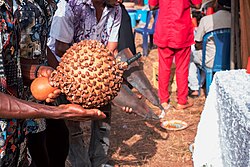
 A performer playing the ichaka at a community event in southeastern Nigeria | |
| Other names | Ichake, Ishaka, Ukwusa, Osha |
|---|---|
| Classification | Idiophone, rattle |
| Hornbostel–Sachs classification | 112.13 (Vessel rattles) |
| Developed | Igboland, southeastern Nigeria |
| Related instruments | |
| Shekere, Axatse, Afuxê | |
The ichaka (also spelled ichake or ishaka;1 also known as ukwusa or osha in some dialects) is a gourd rattle of the Igbo people of southeastern Nigeria. It consists of a dried gourd covered with a net of beads on the outside. When shaken or tapped, the beads strike the gourd surface and produce a dry rattling sound. The instrument is classified as an idiophone.
The ichaka originates among the Igbo people of southeastern Nigeria. Beaded gourd rattles of similar construction are found elsewhere in West Africa, including the shekere among the Yoruba people and the axatse among the Ewe of Ghana, though these developed independently within their respective cultural traditions.
Etymology
The word ichaka is generally considered onomatopoeic. The name varies considerably across Igbo-speaking areas. In parts of Anambra State and Imo State, the form ichake is more common. Ukwusa is found in some northern Igbo communities, while osha is documented in certain areas. Ishaka appears in some published sources on West African instruments.2
Lo-Bamijoko (1987) records osha as one alternate name for the instrument alongside ichaka in his classification of Igbo musical instruments.3
Construction
The body of the ichaka is a dried gourd or calabash. A net of beads is woven tightly around the exterior of the gourd. The neck of the gourd serves as a handle.
The beads are traditionally made from seeds or dried berries. Contemporary instruments may use glass or plastic beads. Instrument size varies depending on the maker and intended use.
A second construction type exists in which dried seeds or small pebbles are placed inside the hollow gourd cavity rather than outside. This produces sound by a different mechanism, more similar to a maraca, though both forms are referred to as ichaka in some communities.4
Playing
The instrument is held by the gourd neck and shaken in rhythmic patterns. Players also tap the gourd body with the free hand to produce sharper accents, or tilt the instrument slowly to create a softer sustained sound.
In ensemble contexts, the ichaka provides rhythmic texture rather than melodic content. In Egwu Ogene ensembles, the ichaka player typically reduces volume during quieter sections and plays more fully during louder passages, in coordination with the igba drummer.5
Use in Igbo music
Lo-Bamijoko (1987) lists the ichaka among the core instruments of Igbo musical culture alongside the ogene (iron bell), ekwe (wooden slit drum), igba (cylindrical drum), udu (clay pot drum), and ọjà (wooden flute).6
The instrument appears in Egwu Ogene, the ogene ensemble tradition of northern Igboland, and in Ekpili, a folk genre of southeastern Igboland in which it is played alongside the ubo (thumb piano). Okeke (2014) identifies the ichaka as one of several Igbo traditional instruments used as non-verbal communication devices in cultural ceremonies.7
In Igbo highlife, the blending of the ichaka with guitar became part of the genre's characteristic sound from the mid-twentieth century onward.8
Ceremonial contexts
The ichaka is played at naming ceremonies, second burial celebrations (ọnọ), masquerade festivals, the New Yam Festival (Iri ji), and chieftaincy installations. It accompanies masquerade appearances at community festivals. Lo-Bamijoko notes it is also played recreationally and is accessible to children learning percussion.9
Related instruments
| Instrument | People | Region |
|---|---|---|
| Ichaka | Igbo | Southeastern Nigeria |
| Shekere | Yoruba | Southwestern Nigeria, West Africa |
| Axatse | Ewe | Ghana, Togo |
| Afuxê | Afro-Brazilian | Brazil |
References
References
- O'Halloran, Kate (1997). Hands-on Culture of West Africa. J. Weston Walch. p. 13.
- O'Halloran, Kate (1997). Hands-on Culture of West Africa. J. Weston Walch. p. 13.
- Lo-Bamijoko, J. N. (1987). "Classification of Igbo Musical Instruments, Nigeria". African Music. 6 (4): 19–41. doi:10.21504/amj.v6i4.1259.
- Lo-Bamijoko, J. N. (1987). "Classification of Igbo Musical Instruments, Nigeria". African Music. 6 (4): 19–41. doi:10.21504/amj.v6i4.1259.
- "Ogene and Oja: Talking instruments of a playful Igbo crew". Garland Magazine. Retrieved 2026-06-05.
- Lo-Bamijoko, J. N. (1987). "Classification of Igbo Musical Instruments, Nigeria". African Music. 6 (4): 19–41. doi:10.21504/amj.v6i4.1259.
- Okeke, Chukwuma Onyebuchi (2014). "Semantic Content of Igbo Traditional Non-Verbal Modes of Communication". International Journal of Linguistics and Literature.
- "The pioneers of Nigeria's Igbo highlife music". Global Voices. Retrieved 2026-06-05.
- Lo-Bamijoko, J. N. (1987). "Classification of Igbo Musical Instruments, Nigeria". African Music. 6 (4): 19–41. doi:10.21504/amj.v6i4.1259.