| Emission nebula | |
|---|---|
| Planetary nebula | |
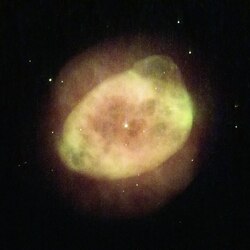 As seen by Hubble | |
| Observation data: J2000.0 epoch | |
| Right ascension | 03h 10m 19.3017s1 |
| Declination | +61° 19′ 00.914″1 |
| Distance | 5,190 ± 500 ly (1,592 ± 153 pc)2 ly |
| Constellation | Cassiopeia |
| Designations | IRAS 03062+6107, 2MASS J03101930+6119009, ARO 86, Hb 1, VV 9, RL 67, Lan 496, NSV 1056, GSC2 N3130331357821 |
IC 289 is a planetary nebula in the constellation Cassiopeia.3 It was discovered by Lewis Swift in early September 1888. It lies close to the 10th magnitude star BD +60° 0631. N.J. Martin described IC 289 as "A nice, faint round planet like planetary nebula. The uniform oval disc shows some irregularity in brightness but is not obviously brighter at the edge."
The central star of the planetary nebula is an O-type star with a spectral type of O(H).4
References
References
- "IC 289". SIMBAD. Centre de données astronomiques de Strasbourg. Retrieved 2020-02-18.
- Brown, A. G. A.; et al. (Gaia collaboration) (August 2018). "Gaia Data Release 2: Summary of the contents and survey properties". Astronomy & Astrophysics. 616. A1. arXiv:1804.09365. Bibcode:2018A&A...616A...1G. doi:10.1051/0004-6361/201833051.
- IC 289
- González-Santamaría, I.; Manteiga, M.; Manchado, A.; Ulla, A.; Dafonte, C.; López Varela, P. (2021). "Planetary nebulae in Gaia EDR3: Central star identification, properties, and binarity". Astronomy & Astrophysics. 656: A51. arXiv:2109.12114. Bibcode:2021A&A...656A..51G. doi:10.1051/0004-6361/202141916. S2CID 237940344.
External links
External links
- Media related to IC 289 at Wikimedia Commons
- http://www.noao.edu/outreach/aop/observers/ic289.html Archived 2011-09-10 at the Wayback Machine