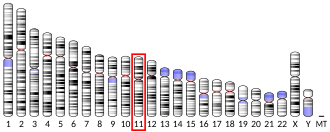
Hydrolethalus syndrome protein 1 is a protein that in humans is encoded by the HYLS1 gene.56
Function
Hyls1 is incorporated into centrioles as they are formed but is not required for centriole assembly. However Hyls1 is required for the formation of cilia.7
Clinical significance
Mutations in this gene are associated with hydrolethalus syndrome.6
References
References
- GRCh38: Ensembl release 89: ENSG00000198331 – Ensembl, May 2017
- GRCm38: Ensembl release 89: ENSMUSG00000050555 – Ensembl, May 2017
- "Human PubMed Reference:". National Center for Biotechnology Information, U.S. National Library of Medicine.
- "Mouse PubMed Reference:". National Center for Biotechnology Information, U.S. National Library of Medicine.
- "Entrez Gene: hydrolethalus syndrome 1".
- Mee L, Honkala H, Kopra O, Vesa J, Finnilä S, Visapää I, Sang TK, Jackson GR, Salonen R, Kestilä M, Peltonen L (June 2005). "Hydrolethalus syndrome is caused by a missense mutation in a novel gene HYLS1". Hum. Mol. Genet. 14 (11): 1475–88. doi:10.1093/hmg/ddi157. PMID 15843405.
- Dammermann A, Pemble H, Mitchell BJ, McLeod I, Yates JR, Kintner C, Desai AB, Oegema K (September 2009). "The hydrolethalus syndrome protein HYLS-1 links core centriole structure to cilia formation". Genes Dev. 23 (17): 2046–59. doi:10.1101/gad.1810409. PMC 2751977. PMID 19656802.
Further reading
Further reading
- Stelzl U, Worm U, Lalowski M, et al. (2005). "A human protein-protein interaction network: a resource for annotating the proteome". Cell. 122 (6): 957–68. doi:10.1016/j.cell.2005.08.029. hdl:11858/00-001M-0000-0010-8592-0. PMID 16169070. S2CID 8235923.
- Rose JE, Behm FM, Drgon T, et al. (2010). "Personalized smoking cessation: interactions between nicotine dose, dependence and quit-success genotype score". Mol. Med. 16 (7–8): 247–53. doi:10.2119/molmed.2009.00159. PMC 2896464. PMID 20379614.
- Visapää I, Salonen R, Varilo T, et al. (1999). "Assignment of the locus for hydrolethalus syndrome to a highly restricted region on 11q23-25". Am. J. Hum. Genet. 65 (4): 1086–95. doi:10.1086/302603. PMC 1288242. PMID 10486328.
- Ota T, Suzuki Y, Nishikawa T, et al. (2004). "Complete sequencing and characterization of 21,243 full-length human cDNAs". Nat. Genet. 36 (1): 40–5. doi:10.1038/ng1285. PMID 14702039.
- Bonaldo MF, Lennon G, Soares MB (1996). "Normalization and subtraction: two approaches to facilitate gene discovery". Genome Res. 6 (9): 791–806. doi:10.1101/gr.6.9.791. PMID 8889548.
- Strausberg RL, Feingold EA, Grouse LH, et al. (2002). "Generation and initial analysis of more than 15,000 full-length human and mouse cDNA sequences". Proc. Natl. Acad. Sci. U.S.A. 99 (26): 16899–903. Bibcode:2002PNAS...9916899M. doi:10.1073/pnas.242603899. PMC 139241. PMID 12477932.
- Paetau A, Honkala H, Salonen R, et al. (2008). "Hydrolethalus syndrome: neuropathology of 21 cases confirmed by HYLS1 gene mutation analysis". J. Neuropathol. Exp. Neurol. 67 (8): 750–62. doi:10.1097/NEN.0b013e318180ec2e. PMID 18648327. S2CID 12872658.