| Hydrohalite | |
|---|---|
| General | |
| Category | Halide mineral |
| Formula | NaCl·2H2O |
| IMA symbol | Hhl1 |
| Strunz classification | 3.BA.05 |
| Dana classification | 9.1.2.1 |
| Crystal system | Monoclinic |
| Crystal class | Prismatic (2/m) (same H-M symbol) |
| Space group | P21/c |
| Identification | |
| Colour | Colourless or white |
| Diaphaneity | Transparent |
Hydrohalite is a halide mineral that occurs in saturated halite brines at cold temperatures (below 0.1 °C) and is the most common form of hydrated sodium chloride. It was first described in 1847 from an occurrence in Dürrnberg, Austria.
Physical properties
Hydrohalite has a high nucleation energy, it decomposes at 0.1°C, giving a salty brine and solid halite.
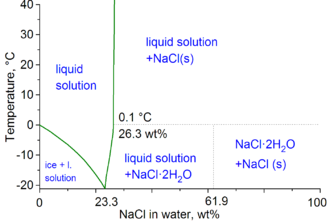
The cryohydric point of hydrohalite is at −21.2 °C (−6.2 °F), solutions will normally need to be supercooled for crystals to form. Above this temperature, liquid water saturated with salt can exist in equilibrium with hydrohalite. Unlike halite, hydrohalite has a strong positive temperature coefficient of solubility.2 Under pressure, hydrohalite is stable between 7,900 and 11,600 atmospheres pressure. The decomposition point increases at the rate of 0.007K per atmosphere (for 1–1000 atmospheres),2 reaching a maximum decomposition temperature is at 25.8°C around 9400 atmospheres. The decomposition temperature reduces again at higher pressures.2
Occurrence
The type locality is the Hallein Salt Mine in Austria.3
Ceres
Hydrohalite was discovered on Ceres by Dawn,4 suggesting an early ocean, possibly surviving as a relict ocean.
References
References
- Warr, L.N. (2021). "IMA–CNMNC approved mineral symbols". Mineralogical Magazine. 85 (3): 291–320. Bibcode:2021MinM...85..291W. doi:10.1180/mgm.2021.43. S2CID 235729616.
- Braitsch, O. (1971). "The Stability Conditions of Salt Minerals". Salt Deposits Their Origin and Composition. Springer. pp. 42–44. doi:10.1007/978-3-642-65083-3_2. ISBN 978-3-642-65085-7.
- Page Hydrohalite: Mineral information, data and localities on "mindat.org". Hudson Institute of Mineralogy. Retrieved 2025-04-01.
- De Sanctis, M.C., Ammannito, E., Raponi, A. et al. Fresh emplacement of hydrated sodium chloride on Ceres from ascending salty fluids. Nat Astron 4, 786–793 (2020). https://doi.org/10.1038/s41550-020-1138-8