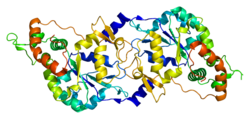
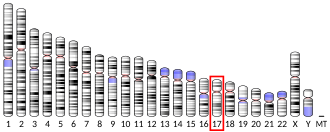
Heparan sulfate glucosamine 3-O-sulfotransferase 3B1 is an enzyme that in humans is encoded by the HS3ST3B1 gene.56
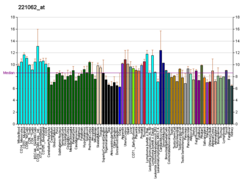
Heparan sulfate biosynthetic enzymes are key components in generating myriad distinct heparan sulfate fine structures that carry out multiple biologic activities. The enzyme encoded by this gene is a member of the heparan sulfate biosynthetic enzyme family. It is a type II integral membrane protein and possesses heparan sulfate glucosaminyl 3-O-sulfotransferase activity ( HS3ST3A1). The Sulfotransferase domain of this enzyme is highly similar to the same domain of heparan sulfate D-glucosaminyl 3-O-sulfotransferase 3A1 and these two enzymes sulfate an identical disaccharide. This gene is widely expressed, with the most abundant expression in liver and placenta.6
References
References
- GRCh38: Ensembl release 89: ENSG00000125430 – Ensembl, May 2017
- GRCm38: Ensembl release 89: ENSMUSG00000070407 – Ensembl, May 2017
- "Human PubMed Reference:". National Center for Biotechnology Information, U.S. National Library of Medicine.
- "Mouse PubMed Reference:". National Center for Biotechnology Information, U.S. National Library of Medicine.
- Shworak NW, Liu J, Petros LM, Zhang L, Kobayashi M, Copeland NG, Jenkins NA, Rosenberg RD (Mar 1999). "Multiple isoforms of heparan sulfate D-glucosaminyl 3-O-sulfotransferase. Isolation, characterization, and expression of human cdnas and identification of distinct genomic loci". J Biol Chem. 274 (8): 5170–84. doi:10.1074/jbc.274.8.5170. PMID 9988767.
- "Entrez Gene: HS3ST3B1 heparan sulfate (glucosamine) 3-O-sulfotransferase 3B1".
Further reading
Further reading
- Razi N, Lindahl U (1995). "Biosynthesis of heparin/heparan sulfate. The D-glucosaminyl 3-O-sulfotransferase reaction: target and inhibitor saccharides". J. Biol. Chem. 270 (19): 11267–75. doi:10.1074/jbc.270.19.11267. PMID 7744762.
- Liu J, Shworak NW, Sinaÿ P, et al. (1999). "Expression of heparan sulfate D-glucosaminyl 3-O-sulfotransferase isoforms reveals novel substrate specificities". J. Biol. Chem. 274 (8): 5185–92. doi:10.1074/jbc.274.8.5185. PMID 9988768.
- Shukla D, Liu J, Blaiklock P, et al. (1999). "A novel role for 3-O-sulfated heparan sulfate in herpes simplex virus 1 entry". Cell. 99 (1): 13–22. doi:10.1016/S0092-8674(00)80058-6. PMID 10520990. S2CID 14139940.
- Salehi LB, Mangino M, De Serio S, et al. (2002). "Assignment of a locus for autosomal dominant idiopathic scoliosis (IS) to human chromosome 17p11". Hum. Genet. 111 (4–5): 401–4. doi:10.1007/s00439-002-0785-4. PMID 12384783. S2CID 29912776.
- Strausberg RL, Feingold EA, Grouse LH, et al. (2003). "Generation and initial analysis of more than 15,000 full-length human and mouse cDNA sequences". Proc. Natl. Acad. Sci. U.S.A. 99 (26): 16899–903. Bibcode:2002PNAS...9916899M. doi:10.1073/pnas.242603899. PMC 139241. PMID 12477932.
- Ota T, Suzuki Y, Nishikawa T, et al. (2004). "Complete sequencing and characterization of 21,243 full-length human cDNAs". Nat. Genet. 36 (1): 40–5. doi:10.1038/ng1285. PMID 14702039.
- Moon AF, Edavettal SC, Krahn JM, et al. (2004). "Structural analysis of the sulfotransferase (3-o-sulfotransferase isoform 3) involved in the biosynthesis of an entry receptor for herpes simplex virus 1". J. Biol. Chem. 279 (43): 45185–93. doi:10.1074/jbc.M405013200. PMC 4114238. PMID 15304505.
- Gerhard DS, Wagner L, Feingold EA, et al. (2004). "The Status, Quality, and Expansion of the NIH Full-Length cDNA Project: The Mammalian Gene Collection (MGC)". Genome Res. 14 (10B): 2121–7. doi:10.1101/gr.2596504. PMC 528928. PMID 15489334.