 | |||
| Manufacturer | Hughes Aircraft Company | ||
|---|---|---|---|
| Specifications | |||
| Spacecraft type | Satellite | ||
| Launch mass | 560–574 kg (1,235–1,265 lb)4 | ||
| Dry mass | 146 kg (322 lb) | ||
| Payload capacity | 54 kg (119 lb) | ||
| Power | 300 watts | ||
| Design life | 7 years123 | ||
| Dimensions | |||
| Length | 3.3 m (11 ft) | ||
| Diameter | 1.8 m (5.9 ft) | ||
| Production | |||
| Status | Retired | ||
| Launched | 8 | ||
| Operational | 0 | ||
| Retired | 8 | ||
| Maiden launch | 10 November 1972 | ||
| Last launch | 20 August 1979 | ||
| |||
In 1970, Hughes Aircraft Company (HAC) Space and Communications Group offered the first standardized satellite: the HS 333 design.5 A spinning satellite, it was based on previous one-design satellites like Intelsat I. HAC built eight of these 300 watt, 12 channel single antenna satellites between 1970 and 1977.6
Design
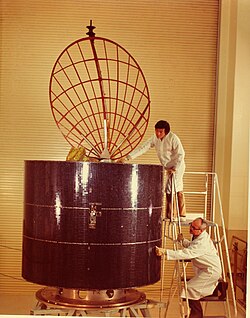
The early satellites were designed with cylindrical bodies to maximize the size of the satellite that could fit inside of the rocket's nose cone or fairing which was also round. The early design satellites also relied on spinning at about 30 rpm for stability in orbit. The spinning satellite is a gyroscope.
Several parallel decks, including the top and bottom, were used to mount the propulsion, attitude control, communication, Telemetry & Command (T&C), and power equipment. The upper deck or top of the satellite contained the payload antenna and the T&C antenna.
The outer surface of the cylindrical body was covered with solar cells to generate power for operating the satellite's electrical equipment. Batteries provide power during an eclipse when the satellite is in the shadow of the Earth. The batteries are recharged by excess power from the solar array.
The HS 333 was 1.8 m (6 ft) in diameter and nominally 3.3 m (11 ft) high. The solar array and batteries provided sufficient power over the satellite's 7-year design life to power the 190 W payload and 233 W spacecraft equipment. The payload contributed 54 kg (119 lb) of the HS 333's 146 kg (542 lb) dry mass.
Satellites
Eight HS-333 satellites were launched from 1972 to 1979:
| Satellite | Operator | Launch date (UTC) |
Carrier rocket7 | Mass | Longitude | Retirement | Remarks |
|---|---|---|---|---|---|---|---|
| Anik A14 |  Telesat Canada1 Telesat Canada1
|
10 November 1972 01:14:037 |
Delta 19141 | 560 kg (1,230 lb)1 | 104°W8 114°W |
15 July 1982 | |
| Anik A24 | Telesat Canada1
|
20 April 1973 23:47:037 |
Delta 19141 | 560 kg (1,230 lb)1 | 109°W9 | 6 October 1982 | |
| Westar 14 |  Western Union3 Western Union3
|
13 April 1974 23:33:037 |
Delta 29143 | 574 kg (1,265 lb)3 | 99°W10 | April 1983 | |
| Westar 24 | Western Union3
|
10 October 1974 23:53:007 |
Delta 29143 | 574 kg (1,265 lb)3 | 125°W11 | ||
| Anik A34 | Telesat Canada1
|
7 May 1975 23:35:267 |
Delta 29141 | 560 kg (1,230 lb)1 | 104°W12 115°W |
21 November 1984 | |
| Palapa A14 |  Perumtel2 Perumtel2
|
8 July 1976 23:317 |
Delta 29142 | 574 kg (1,265 lb)2 | 83°E13 | 198513 | |
| Palapa A24 | Perumtel2
|
10 March 1977 23:167 |
Delta 29142 | 574 kg (1,265 lb)2 | 77°E14 | 198814 | |
| Westar 34 | Western Union3
|
20 August 1979 00:207 |
Delta 29143 | 574 kg (1,265 lb)3 | 91°W15 |
References
References
- G. D. Krebs. "Anik A 1, 2, 3". Gunter's Space Page. Retrieved 4 July 2012.
- G. D. Krebs. "Palapa A 1, 2". Gunter's Space Page. Retrieved 4 July 2012.
- G. D. Krebs. "Westar 1, 2, 3". Gunter's Space Page. Retrieved 4 July 2012.
- G. D. Krebs. "Hughes: HS-333 / HS-356". Gunter's Space Page. Retrieved 4 July 2012.
- I. Chechile (2023). Space Technology: A Short Introduction. Springer. pp. 8–9. ISBN 978-3-031-34817-4.
- Hughes Aircraft Corporation, Space and Communications Group, SBS F6 Prime sales brochure, 1985
- J. McDowell. "Launch Log". Jonathan's Space Page (TXT). Retrieved 4 July 2012.
- "Anik A1". The Satellite Encyclopedia. Retrieved 13 April 2025.
- "Anik A2". The Satellite Encyclopedia. Retrieved 13 April 2025.
- "Westar 1". The Satellite Encyclopedia. Retrieved 13 April 2025.
- "Westar 2". The Satellite Encyclopedia. Retrieved 13 April 2025.
- "Anik A3". The Satellite Encyclopedia. Retrieved 13 April 2025.
- "Palapa A1". The Satellite Encyclopedia. Retrieved 13 April 2025.
- "Palapa A2". The Satellite Encyclopedia. Retrieved 13 April 2025.
- "Westar 3". The Satellite Encyclopedia. Retrieved 13 April 2025.