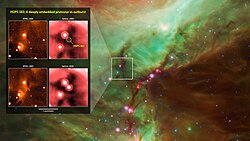
 Infrared images from instruments at Kitt Peak National Observatory (left) and NASA's Spitzer Space Telescope document the outburst of HOPS 383, a young protostar in the Orion star-formation complex. The background is a wide view of the region taken from a Spitzer four-color infrared mosaic. | |
| Observation data Epoch J2000.0 Equinox J2000.0 | |
|---|---|
| Constellation | Orion1 |
| Right ascension | 05h 35m 29.81s |
| Declination | −04° 59′ 51.1″ |
| Characteristics | |
| Evolutionary stage | Class 0 protostar |
| Astrometry | |
| Distance | 1,400 ly (420 pc) |
| Other designations | |
| HOPS 383 | |
| Database references | |
| SIMBAD | data |
HOPS 383 is a Class 0 protostar. It is the first Class 0 protostar discovered to have had an outburst,2 and as of 2020, the youngest protostar known to have had an outburst.2 The outburst, discovered by the Herschel Orion Protostar Survey (HOPS) team, was first reported in February 2015 in The Astrophysical Journal Letters.3
Observations
Outburst
HOPS 383 had an outburst between 2004 and 2006 (a "dramatic mid-infrared brightening"); the increase in magnitude was detectable at the 24 μm (35 times increase) and 4.5 μm, and was also detectable at the submillimetre.4: 2 After 6 years, observations showed no signs of fading.4: 1
X-Ray
The Chandra X-Ray Observatory detected an X-ray flare from HOPS 383 in December 2017.5 This was the first detection of X-rays from a Class 0 protostar that will evolve into a sun-like star.5 The flare lasted 3 hours and 20 minutes.6 It significantly impacted the previously-thought timeline for when such events occur in the evolution of a protostar. Furthermore, it has improved astronomers' understanding of the Sun's earlier evolutionary stages.
References
References
- Roman, Nancy G. (1987). "Identification of a constellation from a position". Publications of the Astronomical Society of the Pacific. 99 (617): 695. Bibcode:1987PASP...99..695R. doi:10.1086/132034. Constellation record for this object at VizieR.
- "NASA satellites catch 'growth spurt' from newborn protostar". Science Daily. 24 March 2015.
- McKinney, Donna (2015-02-25). "NRL Astrophysicist Explores Star Formation in Orion's Belt". United States Naval Research Laboratory. Retrieved 2022-06-24.
- Safron, Emily J.; Fischer, William J.; Megeath, S. Thomas; Furlan, Elise; Stutz, Amelia M.; Stanke, Thomas; Billot, Nicolas; Rebull, Luisa M.; Tobin, John J.; Ali, Babar; Allen, Lori E.; Booker, Joseph; Watson, Dan M.; Wilson, T. L. (2015-02-10). "Hops 383: An Outbursting Class 0 Protostar in Orion". The Astrophysical Journal Letters. 800 (1): L5. arXiv:1501.00492. Bibcode:2015ApJ...800L...5S. doi:10.1088/2041-8205/800/1/L5. hdl:1887/48742. ISSN 2041-8205. OSTI 22364255. S2CID 45127705.
- "Chandra :: Photo Album :: HOPS 383 :: June 18, 2020". chandra.harvard.edu. Retrieved 2021-12-29.
- "Chandra Press Room :: X-rays From a Newborn Star Hint at Our Sun's Earliest Days :: 18 June 2020". chandra.harvard.edu. Retrieved 2021-12-30.