| Hoplapoderini | |
|---|---|
| |
Scientific classification 
| |
| Kingdom: | Animalia |
| Phylum: | Arthropoda |
| Clade: | Pancrustacea |
| Class: | Insecta |
| Order: | Coleoptera |
| Suborder: | Polyphaga |
| Infraorder: | Cucujiformia |
| Superfamily: | Curculionoidea |
| Family: | Attelabidae |
| Subfamily: | Apoderinae |
| Tribe: | Hoplapoderini |
| Subtribes1 | |
| |
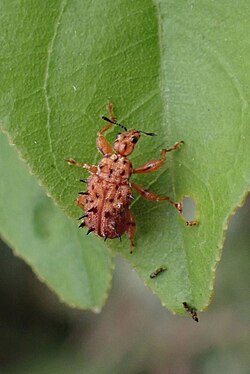
Hoplapoderini is a tribe of weevils of the subfamily Apoderinae. They are characterized by a strongly constricted head with a distinctively arched crown.2 The head shape is common to both males and females. They are distributed from Japan to the Indomalayan archipelago, as well as throughout Madagascar and Africa. Their lower body tends to be characterized by spots, pustules, bumps, or spines. Spines are particularly ubiquitous in those species found in Madagascar.
Genera
The genera of Hoplapoderini are:3
- Agomadaranus
- Archiparapoderus
- Echinapoderus
- Homapoderus
- Hoplapoderus
- Isapoderus
- Parapoderus
- Paratomapoderus
- Paroplapoderus
- Phymatapoderus
- Pseudapoderus
- Rhamnapoderus
- Strigapoderopsis
- Tomapoderus
References
References
- Bouchard, Patrice; Bousquet, Yves; Davies, Anthony E.; Cai, Chenyang (2024). "On the nomenclatural status of type genera in Coleoptera (Insecta)". ZooKeys (1194). doi:10.3897/zookeys.1194.106440. PMC 10955229. PMID 38523865.
- Eduard Voß (April 1939). "Bemerkenswerte interkontinentale Zusammenhänge in den Unterfamilien Rhynchifinae, Äffelabinae und Äpoderinae". In K. Jordan; E. M. Hering (eds.). VII. Internationaler Kongress für Entomologie (in German). Vol. 1. p. 448.
- "Tribe Hoplapoderini". iNaturalist. Retrieved 2025-09-26.