| Associated cuisine | Korean cuisine |
|---|---|
| Main ingredients | Skate |
| Korean name | |
| Hangul | 홍어무침 |
| RR | hongeo muchim |
| MR | hongŏ much'im |
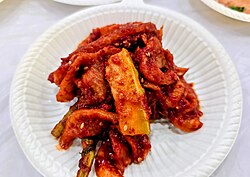
Hongeo muchim (Korean: 홍어무침; lit. 'skate mixed dish') is a spicy chilled salad in Korean cuisine made primarily from fermented skate (hongeo) and various mixed vegetables, dressed in a pungent, spicy, and sour gochujang (Korean chili paste) sauce. It is a variant of Korean hoe-muchim (raw fish salad) and is a specialty of Korea's Jeolla Province region.1
Significance
Hongeo muchim holds a significant place in the regional cuisine of Jeolla Province, often served as a main dish or a strong banchan.2 In parts of the Jeolla and Chungcheong regions, hongeo muchim is traditionally served at certain funeral meals alongside dishes such as yukgaejang; local sources describe this practice as customary in some communities.34 Vendors in urban food markets commonly sell hongeo muchim, which indicates the dish’s circulation beyond its regional origins.5
Unlike hongeo-hoe (fermented raw skate), which is simply sliced and consumed with dipping sauces, hongeo muchim is a mixed dish where the skate is tossed with a variety of fresh ingredients and a complex dressing.6
The dish has a distinctive ammonia-like aroma attributed in sources to compounds produced during the skate's fermentation; reactions to this aroma vary among consumers. The aroma is a characteristic feature of fermented skate and affects its reception outside regions where it is commonly consumed.7
Some vendors use ray (ganjaemi) as a substitute for skate for cost or availability considerations.89
Preparation
The main ingredients of Hongeo muchim include:
- Skate (hongeo): Raw or lightly fermented skate fish slices are used. Some prefer to use less-fermented skate, making the muchim a milder, more approachable dish compared to highly fermented Hongeo-hoe.
- Spicy dressing (yangnyeomjang): A sauce based on gochujang, vinegar, garlic, ginger, soy sauce, and a sweetener such as sugar or rice syrup.
- Fresh vegetables: Commonly includes julienned Korean radish (mu or muchae), cucumber, and onion, which provide a crisp, fresh contrast.
- Aromatics: Korean parsley (minari) is a popular aromatic addition, and sesame oil and sesame seeds are used for garnish.
The skate is typically marinated in an acidic mixture, such as vinegar or makgeolli (Korean rice wine), a step described in recipe sources as intended to soften the texture of the flesh and bones.1011
The dish serves as a key ingredient for naengmyeon (cold noodles) in some areas. In the Seoul and Gyeonggi regions, hoe naengmyeon (raw fish cold noodles) typically refers to a spicy mixed noodle dish topped with hongeo muchim. Conversely, in the coastal areas of Gangwon Province, hoe naengmyeon is more often topped with dried pollock (bukeo or hwangtae) muchim instead.12
References
References
- "Wonjo Hongeo Main Store (원조홍어 본점)". VisitKorea. Korea Tourism Organization. Retrieved October 20, 2025.
- "홍어회무침에 탁배기 한잔, 캬!". OhmyNews. 2008-12-23. Retrieved 2025-11-20.
- Kim, Sung-eun (2020-01-12). "'Altoran' recipes: Hong-eo muchim". Global Economic (in Korean). Retrieved 24 October 2025.
- "상례 음식" [Funeral food]. 디지털화순문화대전 (in Korean). 한국학중앙연구원. Retrieved 24 October 2025.
…제사상을 차리고 홍어 무침, 삼합 등을 올리기도 한다.
- "[서소문사진관]홍어 냄새 NO~ 젊은 손맛으로 대박난 이 집" [NO Smell of Dried Pollack~ This Restaurant Hits the Jackpot with Young Cooks]. JoongAng Ilbo. 2018-06-17. Retrieved 2025-11-20.
- "입맛 돋우는 칼칼함, 홍어무침 황금레시피" [Spicy, Hongeo muchim Golden Recipe to Increase Appetite]. Queen Magazine (in Korean). Retrieved October 20, 2025.
- Zhao, Chang-Cheng; Eun, Jong-Bang (2018-10-20). "Isolation and identification of hyper-ammonia-producing bacteria from commercial fermented skates (Raja kenojei)". Journal of Food Science and Technology. 55 (12): 5082–5090. doi:10.1007/s13197-018-3447-9. PMC 6233455. PMID 30483004.
- "Asia's stinkiest fish makes novice eaters gag". Taipei Times. Associated Press. 2014-04-14. Retrieved 24 October 2025.
- "South Koreans crave Asia's smelliest fish". TODAY (Singapore). Associated Press. 2014-04-14. Retrieved 24 October 2025.
- Latoch, Agnieszka; Czarniecka-Skubina, Ewa; Moczkowska-Wyrwisz, Małgorzata (2023-10-01). "Marinades Based on Natural Ingredients as a Way to Improve the Quality and Shelf Life of Meat: A Review". Foods. 12 (19): 3638. doi:10.3390/foods12193638. PMC 10572579. PMID 37835291.
- "[한국의 맛] 홍어무침" [Seasoned Hong-eo]. Asiae. 2021-04-16. Retrieved 2025-11-20.
- "인생 3대 도전음식 홍어... 알고 먹어야 진짜 樂이죠" [Hongeo, one of life's top 3 challenging foods... you only enjoy it when you know how to eat it]. iMBC News (in Korean). 15 February 2022. Retrieved October 20, 2025.