| Hickey | |
|---|---|
| Other names | Kiss mark, love bite, bug bite, love mark |
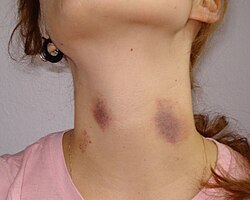 | |
| Hickeys on the neck | |
| Pronunciation | |
| Specialty | Dermatology |
| Duration | 3–14 days |
| Causes | Suction on skin |
A hickey, also known as love bite, is a bruise or bruise-like, dark red or purple mark caused by sucking or biting the skin of a person, usually their neck.1 While biting may be part of giving a hickey, sucking is sufficient to burst small superficial blood vessels under the skin to produce bruising. A hickey is sometimes used to mark someone as being the target of a partner's romantic affection or as belonging to them. While mostly considered safe, there have been some reports of serious medical complications as a result of receiving hickeys, such as strokes, vascular2 or nerve damage.3
History
In a looser definition, the fourth-century Hindu text Kama Sutra contains references to biting with relation to kissing.4
As a term, "Love bite" is first attested in 1749 in John Cleland's Memoirs of a Woman of Pleasure.5 The later term 'hickey', originally used in American English and still predominantly in that dialect, is of unclear etymology.6 Some sources suggests that it derives from the earlier meaning of "pimple, skin lesion" (c. 1915), itself perhaps a sense extension of "small gadget, device; any unspecified object" (1909).7
References
References
- "hickey". dictionary.cambridge.org. 2026-04-08. Retrieved 2026-04-14.
- Wu TY, Hsiao J, Wong EH. Love bites--an unusual cause of blunt internal carotid artery injury. N Z Med J. 2010 Nov 26;123(1326):112-5. PMID: 21326406.
- Carydakis C, de l'Isle-Boudon RB, Baulac M, Laplane D. Une cause inhabituelle de traumatisme du nerf spinal. La morsure amoureuse [An unusual cause of spinal nerve injury. A love bite]. Presse Med. 1985 May 18;14(20):1152. French. PMID: 3158985.
- Vatsyayana (1883). "Part II, Chapter V: On Biting". Kama Sutra. Translated by Burton, Richard Francis. p. 46. Archived from the original on 2025-07-02. Retrieved 2025-07-02.
- "love bite". Oxford English Dictionary (Online ed.). Oxford University Press. doi:10.1093/OED/38907269100. (Subscription or participating institution membership required.)
- "hickey". Oxford English Dictionary (Online ed.). Oxford University Press. (Subscription or participating institution membership required.)
- Harper, Douglas. "hickie". Online Etymology Dictionary. Retrieved 2025-07-02.