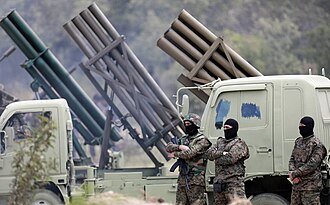
Hezbollah, a Lebanese Shia Islamist political party and militant group,12 has an exceptionally strong military wing, thought to be stronger than the Lebanese Army34 and equivalent to the armed strength of a medium-sized army.5a A hybrid force, the group maintains "robust conventional and unconventional military capabilities",7 and is generally considered to be the most powerful non-state actor in the world.89b711
Estimates vary widely, but as of October 2021, Hezbollah's leader Hassan Nasrallah claimed his organization has 100,000 trained fighters.12 In 2017, Janes assessed Hezbollah's strength at more than 20,000+ full-time fighters and approximately 20,000+ reservists.13c They are financed in part by Iran and trained by Iran's Islamic Revolutionary Guard Corps. Hezbollah's military budget is $700 million according to 2018 U.S. official estimates.16
Hezbollah's primary adversary is Israel, and to a large extent its military strength is based on rockets.17 Hezbollah's strategy against Israel uses rockets as offensive weaponry combined with light infantry and anti-armor units to defend their firing positions in southern Lebanon.18 Estimates of Hezbollah's total rocket count range from 40,00019 to 120,000,20 which is considerably more than most countries.
Hezbollah possesses limited numbers of anti-aircraft and anti-ship missiles, as well as thousands of anti-tank missiles.21 The group does not have manned aircraft, tanks, or armored vehicles in Lebanon, as they cannot counter Israeli air supremacy.522d
Hezbollah's tactical strengths are cover and concealment, direct fire, and preparation of fighting positions, while their weaknesses include maneuver warfare, small arms marksmanship,18 and air defenses.23 Though Hezbollah's light infantry and anti-tank squads are well-regarded,1724 Hezbollah as a whole is "quantitatively and qualitatively" weaker than the IDF.24
Sources generally agree that Hezbollah's strength in conventional warfare compares favorably to state militaries in the Arab world.25e A 2009 review concluded that Hezbollah was "a well-trained, well-armed, highly motivated, and highly evolved war-fighting machine"f and "the only Arab or Muslim entity to successfully face the Israelis in combat."1828
Hezbollah typically does not discuss their military operations.g Accurate and reliable information on their strengths and capabilities is often non-existent or classified.30 Hezbollah, Israel and others may have reasons to misstate the movement's capabilities. Estimates for Hezbollah's overall strength and manpower vary widely.h
Hezbollah's military capabilities were significantly diminished during the 2023-2024 conflict with Israel, referred to as the "Support War" or "Gaza Support War" in Arabic. Following a ceasefire in November 2024, Israel persisted with almost daily airstrikes in Lebanon, resulting in the deaths of 331 individuals, including at least 127 civilians, by November 2025. The death toll eventually exceeded 500, and Hezbollah breached the ceasefire by enhancing its military infrastructure and weapons.
Hezbollah used fiber optic drones in the 2026 Lebanon war as part of the Hezbollah–Israel conflict.
History
Formation

The Lebanese Civil War began in 1975. Three years later, the Palestine Liberation Organization occupied much southern Lebanon in an attempt to raise an army and destroy the state of Israel. Israel invaded in 1982 and shattered the PLO, but occupied southern Lebanon and created a Christian proxy militia, the South Lebanon Army (SLA), to hold the territory. A narrow strip of land running the length of the Israeli border was termed the "security zone." Lebanese Shia, driven by a desire to gather forces to fight the Israeli occupation of southern Lebanon, founded Hezbollah (the Party of God) in 1982, with the organization being named and reorganized in 1985.10

In 1982, hundreds of Islamic Revolutionary Guard Corps (IRGC) from Iran traveled to Lebanon's rugged Bekaa Valley and began training various Shiite groups, including Islamic Amal and the Dawa Party.32 The ongoing civil war and Israel's occupation of southern Lebanon created an environment for resistance against the Israeli forces. "The movement gained momentum quickly due to logistical, financial, and military support from both Syria and Iran"10 and engaged Israel in guerrilla warfare. The physical geography of southern Lebanon is green and hilly with deep valleys, which favored the defender and was ideal for Hezbollah's "classic" guerrilla warfare.31
Hezbollah's initial tactical choices involved human wave attacks, similar to those used by Iran in the Iran–Iraq War33 in which some Hezbollah elements participated,34 and terrorist tactics like kidnappings, aircraft hijackings, and mass-casualty suicide attacks to hurt Israel's resolve to fight.3526i Hezbollah engaged in short raids to harass and kill and did not try to hold territory.35 Although initially very successful,26 these choices imposed a heavy cost on Hezbollah in casualties and in public opinion.35
The Central Intelligence Agency (CIA) in 1985 said Hezbollah's command and control was "virtually non-existent" and described Hezbollah as not a hierarchy but defined by personal loyalties, personal rivalries, and family ties.36 At this time, operational decisions were inefficiently passed through multiple clerics and imams in Beirut, who were far from the front lines.35 Hezbollah had a military structure and separate responsibility for operations, logistics, communications, intelligence, training and recruitment.37 This lack of a hierarchy was similar to contemporary left-wing liberation movements.38
Tactics around 1985–1986 were mainly planting landmines, detonating IEDs and occasionally gathering bands of armed men to shoot at the Israelis.39 Hezbollah was not able to use sniping at this time.39 An IDF intelligence officer described Hezbollah in the mid-1980s as a "rag-tag group" that "failed every time".26 A 2014 review considers the group's tactical performance during this period poor and "very amateurish."35 The CIA says that prior to spring 1986, Hezbollah's attacks were more "undisciplined acts of desperation" rather than military actions.39

Growth
Despite these problems, Hezbollah continued to grow in size, and in 1986, the CIA considered its military strength comparable to Lebanon's major militias.40 The total membership of Hezbollah and closely affiliated groups grew from "several hundred" in 1983 to 2,000–3,000 in 198441 and to a few thousand in 1985.37 In mid-1986, Hezbollah massed 5,000 fighters for an event in the town of Baalbek in the Bekaa Valley.40 Hezbollah was numerically smaller than Amal in 1986, but trends were favoring Hezbollah.42
At this time, Hezbollah had many part-time fighters and very few full-time members,37 making it sensitive to casualties.35 Hezbollah's "skill in fighting the Israeli Army and Israel's proxy militia forces", as well as the corruption and inefficiency of Hezbollah's rival Amal, were critical in building credibility and public support.43 In south Lebanon, Amal was widely seen as "too moderate" and accommodating of Israel, leading many Shia to back Hezbollah.44
Hezbollah also received backing from pro-Hezbollah factions of Amal that had split from top Amal leadership.44 Assessments of Hezbollah's position at this time vary. The CIA assessed at the time that "Hezbollah’s policy of confronting Israel and its surrogates is working"40 and that Hezbollah held a "qualitative edge" in warfare over the SLA and Amal,39 while an independent review says that by 1987 Hezbollah's strategic position was deteriorating.33
On April 18, 1987, a Hezbollah human wave attack on a fortified SLA outpost failed and resulted in 24 dead, killing around 5% of Hezbollah's full-time fighters in a single day.33 As a consequence of this setback and others like it, Hezbollah was forced to change its strategy.33 Outgunned by the Israelis and outspent by richer Lebanese sects and political parties, Hezbollah was forced to learn fast and reappraise its tactics, strategy, and organization.26
Suicide attacks gave way to "sophisticated, coordinated, and timed attacks" and short, quick ambushes.45 In May 1987, Hezbollah began to coordinate infantry and artillery as combined arms, and "improved their capability to attack Israeli helicopters, and demonstrated improvements in extracting wounded from the battlefield."39 Hezbollah moved from squad-sized attacks around 1986 to platoon- and company-sized attacks by spring 1987, and launched a simultaneous attack on multiple targets in September 1987.39
Hezbollah's attacks in the late 1980s became better planned and developed in complexity, especially in involving supporting fire.39 Hezbollah removed most mid-level commanders in the late 1980s, delegating their authority to local commanders, which improved both operational performance and security.35 Hezbollah trimmed its ranks of loosely affiliated reservists and switched its tactics to IEDs, ambushes, and indirect fire.32 Originally, Hezbollah was just one of several militias fighting the Israelis, but by 1985 it was preeminent.46 By the late 1980s, it was clearly dominant.j
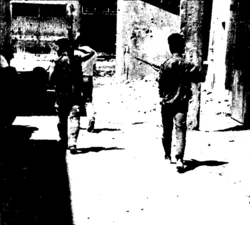
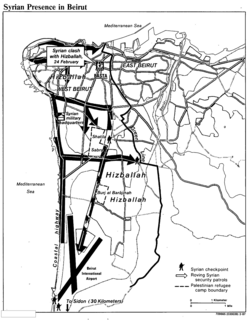
In May 1988, after years of rivalry and clashes, Hezbollah waged a brief but intense war with Amal for control of Beirut's southern suburbs,47 which at the time contained about one-quarter of Lebanon's population.40 As Amal was allied with Syria, Hezbollah clashed with the Syrian Army troops occupying Lebanon at that time. Hezbollah won in the streetfighting and escalated to targeted assassinations and encouraging defections, forcing Amal to seek Syrian mediation. Amal and Hezbollah have remained begrudging allies ever since.48
After Hezbollah prevailed militarily, they soon imposed harsh Sharia law on their territory, such as banning coffee and unveiled women, and lost the hearts and minds of their people.3233 Most Lebanese are not Shiite, and even most of Lebanon's Shiites do not want to live in an Islamic state.43 Support for Hezbollah is much higher than support for hardline Shiite religious rule.43
Faced with declining public support and collapsing tourism, Hezbollah was forced to abandon its rhetoric of an Islamic republic and entered Lebanese politics in 1992.3233 Later efforts by Hezbollah to create social institutions, rebuild homes destroyed by the fighting, and bring sewage, jobs, and electricity to Shiite areas were critical for building public support.33 In 1989, the Taif Accord ended the Lebanese Civil War, and allowed Hezbollah to intensify its military efforts against the IDF.31
1990s
Hezbollah improved rapidly in the early 1990s, progressing from losing five fighters for every Israeli soldier killed in 1990, to 1.5 in 1993, a ratio that roughly held till the end of the decade.49 Hezbollah ended human-wave attacks in 1990 and began conducting attacks with two units: an assault team and a fire support team with 81 mm mortars.50 Accumulating combat experience was critical to this improvement in tactical proficiency.35 By the early 1990s, Hezbollah attacks were "characterized by careful planning and well-practiced professionalism."51
Hezbollah in the early 1990s performed dedicated staff work, mirroring their Israeli adversaries.50 Improved intelligence and reconnaissance abilities were also major drivers of better overall fighting ability.3550 In 1992, Hassan Nasrallah took control of Hezbollah, and he is generally considered to have provided strong leadership.3152 During the late 1980s and early 1990s, Hezbollah refocused on quality over quantity, substantially improved training,35 and accumulated more weapons: by the early 1990s, they "had amassed a significant arsenal."26 Their small arms at this time included AK-47 and M16 rifles, Bangalore torpedoes, hand grenades, RPGs, and M40 recoilless rifles.35 Iran was largely responsible for this arms increase, and flew planeloads of weapons and ammo into Damascus every month.32 Hezbollah introduced full combat uniforms in the early 1990s and improved their small-unit tactics and field security.33
Throughout the 1990s, Hezbollah waged a cat-and-mouse of IEDs with the IDF, with Hezbollah developing increasingly sophisticated IEDs and the IDF countermeasures. Hezbollah may have used cell phone-detonated IEDs against the IDF as early as 1995.53 IEDs were the main source of Israeli casualties during the occupation period.33 IED attacks increased about 50% each year from 1995 until 2000.35 On September 29, 1992, Hezbollah launched its first coordinated attack on multiple outposts.32
In 1993, Hezbollah engaged in a seven day period of intensified fighting with Israel, which resulted in enormous damage to Lebanese infrastructure and civilians but little lasting military harm to either Hezbollah or Israel.54 The conflict saw the first major use of unguided Katyusha rockets fired onto IDF occupied Israeli areas by Hezbollah, a tactic used by the PLO a decade before and became a defining practice of Hezbollah in the future.33 Hezbollah used its first AT-3 Sagger anti-tank guided missile (ATGM) in September 1992 and used its first AT-4 Spigot missiles in 1997, the same year, Hezbollah acquired the powerful American TOW ATGM.32 The anti-tank weaponry used by Hezbollah steadily increased in quality over the duration of the insurgency.50 By 1998, Hezbollah had destroyed three Merkava Mk 3 main battle tanks with these missiles.55
Hezbollah started seriously developing anti-tank tactics in 1997, with a focus on being able to hit the same spot on a tank multiple times to defeat Israel's sophisticated reactive armor, a tactic that remains a part of Hezbollah's repertoire today.23 Although Hezbollah's ATGM weaponry at the time – and still today – remains far inferior to the IDF's Spike system, being able to destroy Merkava tanks was a psychological victory.35 Hezbollah improved in their ability to use mortars and artillery during this time.35
Not all of Hezbollah's weapons were as successful. Although Hezbollah acquired SA-7 'Grail' anti-aircraft missiles and first fired them in November 1991, they had almost no success attacking Israeli aircraft.32 Hezbollah's anti-aircraft abilities remain one of the group's largest weaknesses. Hezbollah fighters used "basic light infantry tactics" during this period,56 like IEDs, mortars, and small ambushes.57

Around 1995, a small group of fighters went to Bosnia to train Muslims in the civil war.58 This was probably Hezbollah's first expeditionary endeavor. Hezbollah continued to find suicide attacks morally acceptable, but phased their usage out because they were no longer tactically effective. Hezbollah launched just four suicide attacks in the 1990s.33 This is part of Hezbollah's long-term trend towards non-terrorism forms of violence.38
During the 1990s, Hezbollah particularly targeted Shiite conscripts in the SLA for defections, desertion, or intelligence. Along with Hezbollah's use of PSYOPS and propaganda warfare, this led to plummeting morale within the SLA.35 SLA morale, and even IDF morale, declined as the insurgency went on.35 Although the insurgency had sometimes seemed "tepid" in the early 1990s, the 1996 Operation Grapes of Wrath greatly increased the level of violence.35
Hezbollah and Israel engaged in a sixteen-day campaign marked by thousands of rocket and artillery strikes and intensified fighting. Hezbollah launched hundreds of rockets into Israel during the conflict, and their "rocket performance [had] improved particularly between 1993 and 1996."35 The campaign ended with the written April Understanding, which established well-understood "rules of the game" and allowed retaliation if either side crossed "red lines," particularly attacks on civilians.43 Since then, Hezbollah has followed typical strategic doctrine of escalation and deterrence.43

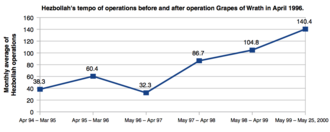

Fighting briefly lulled after the 1996 conflict as Hezbollah recovered from the fighting, but Hezbollah's logistics were "resilient," and Hezbollah dramatically escalated the level of violence thereafter.59 Hezbollah performed 100 attacks from 1985 to 1989 and 1,030 attacks in the six-year period from 1990 to 1995. It launched 4,928 attacks from 1996 to 2000,60 including at least 50 attacks per month for three years59 and over 1,500 attacks in 1999 alone.35k
After abandoning the tactic of frontal assaults on SLA and IDF outposts around 1987, Hezbollah resumed the practice a decade later with radically changed tactics. On 18 September 1997, Hezbollah attacked 25 outposts simultaneously and used ATGM teams to target reinforcements.35 By the end of the occupation, Hezbollah was using heavy weapons and engaging in hours-long firefights with the enemy.35 In October 1998, Hezbollah first deployed an explosively formed penetrator, a sophisticated and powerful IED that can penetrate almost any armor.61
Hezbollah considers 1998, 1999, and 2000 to be their most successful years of insurgency. In 1997 and 1998 combined Israeli and SLA casualties exceeded those of Hezbollah.33 A research paper by analyst Iver Gabrielson argues that by the late 1990s, Hezbollah had become a "tactically proficient" organization.35 By identifying and targeting Israel's weak point, casualties, Hezbollah was able to win a war of attrition.33 Amid escalating violence, poor morale, and intense political pressure at home, the war in Lebanon became too much for Israel. On May 24, 2000, the IDF departed southern Lebanon for the first time in 18 years, and the SLA militia immediately collapsed.33 Although Hassan Nasrallah had once promised to "slaughter" SLA members in their beds, there were no revenge killings.35
2000s
From 2000 to 2006, Hezbollah made a strategic choice to build a massive amount of military infrastructure in southern Lebanon, south of the Litani river. Hezbollah enormously increased the quantity and quality of their weaponry, acquiring anti-tank missiles like the AT-14 Kornet. Starting just before the Israeli withdrawal, Hezbollah built a significant military infrastructure in southern Lebanon.23l The IDF and independent observers knew that Hezbollah had built some infrastructure, but the scale was unanticipated.23
The interwar period was marked by limited, sporadic fighting and few casualties on either side: between 2001 and 2004, Hezbollah launched just 16 attacks.60 Hezbollah continued to study Israel and adopt to lessons learned, and the group spent a large amount of effort gathering information about Israel.35 Changing its strategy of high mobility, Hezbollah instead became relatively fixed with pre-built bunkers, stockpiles, and fighting positions.35 During this time, Hezbollah acquired its first UAVs from Iran and sent militants to Iraq to train "Special Groups" to wage guerrilla warfare against the Americans.

In 2006, Hezbollah ambushed an Israeli border patrol inside Israel, killing eight Israeli soldiers and taking prisoner two Israeli soldiers in an unsuccessful attempt to bargain for the release of incarcerated Hezbollah hostages. Israel responded with overwhelming force, sparking the 34-day 2006 Lebanon War. During the course of the war, Hezbollah was described as "an organized, well-trained and well-equipped force" and "fighting hard."62 In 2006 Hezbollah pursued an asymmetric, integrated standoff fires and area-denial strategy.63 Hezbollah launched rockets onto populated Israeli areas and cities while using light infantry, bunkers, and anti-tank teams to defend southern Lebanon and attack the IDF. Hezbollah focused on small self-sufficient units, based in villages, providing home-front attrition with a somewhat effective command-and-control structure and low mobility.57
In 2006, Hezbollah used a "Complex Web Defense." "This was characterized by mutually supporting defensive positions, interconnected with resilient, redundant communications, and sustained by stockpiled and hidden supplies. Fighters were often irregulars, but were well trained and very well equipped with top-of-the-line antitank and antipersonnel weapons. They were capable of executing flexible, prearranged plans and demonstrated agility at the lower tactical levels."64
Hezbollah was willing to fight from villages and other civilian areas, which while a violation of the laws of war, was tactically advantageous.31 The terrain and climate negated Israel's advantages in armored and maneuver warfare and tested infantry skills, where Hezbollah was strongest.31 Hezbollah's tactics, including light infantry, anti-tank weapons, and rocket fire onto Israel, were continuations of 1990s-era tactics.35
Hezbollah had become more conventional, transitioning from a guerrilla organization into a hybrid actor with the ability to absorb damage and sustain high-intensity fighting over time.35 The war ended by United Nations Security Council Resolution 1701 and an inconclusive outcome. Neither side achieved their objectives.46 Hezbollah claimed a "divine victory".65 Hezbollah identified their main shortcoming in the 2006 war as their lack of air defenses, which they considered a "serious problem" and their main task to address.23 Other identified weaknesses were marksmanship, small unit tactics, and the exposure of battlefield tactics, weapons depots, and fighting positions.23
The UN Security Council resolution that ended the war forced Hezbollah to abandon its dense network of underground bunkers and fortifications and cede southern Lebanon to the Lebanese Armed Forces UN peacekeepers, known as UNIFIL.23 Although Hezbollah's weaponry, operational security, and intelligence improved much between 2000 and 2006, there was arguably little improvement in Hezbollah's force structure or tactical ability.35 There is no academic consensus on whether the war was strategically beneficial for Hezbollah.35 Hezbollah's popularity in the Shia community, Lebanon as a whole, and the Middle East surged following the war.57
Post-2006

Following the 2006 war, Hezbollah undertook an after action review of their weaponry and tactics.23 Hezbollah rated the performance of their bunkers and camouflaged firing positions in fenced off "security pockets" in rural areas as worthwhile.23 Hezbollah's review found that the group's "village guard" reservists, almost entirely veterans from the insurgency, had performed well.23 Hezbollah fighters reportedly knew their local terrain intimately, understood their mission, and had absolute confidence in victory.23 The Islamic Revolutionary Guard Corps' Quds Force (IRGC-QF) also wrote a lessons-learned review for Hezbollah, who reportedly adopted a number of its recommendations.66m Following the war, the IRGC-QF increased transfers of materiel, funding, training, and intelligence sharing.67 There has been virtually no rocket fire onto northern Israel following the war, and Hezbollah disavows the few attacks that do happen.46
Since the 2006 war, Hezbollah has continued to substantially grow its weapons arsenal, manpower, and intelligence appatus. Hezbollah is widely used as the textbook definition of a hybrid actor, with conventional and unconventional warfare capabilities.6869 As a hybrid actor, Hezbollah's main weakness is its need to maintain civilian support to hide among the population, while causing great harm to civilians if war breaks out. This causes Hezbollah to have to justify its actions to maintain public support and to avoid war.70
Syrian Civil War
Since 2012, Hezbollah has engaged in a military deployment to Syria to fight for the Assad government in the ongoing civil war. In terms of both casualties and total manpower, this is Hezbollah's largest ever military operation.71 Hezbollah's involvement in Syria may weaken the group somewhat in the short term, but strengthen the group in the long term.17 Hezbollah relies on Assad for weaponry and as a conduit for arms, and would be threatened by the presence of Sunni militant groups on the Lebanese border.
Weeks after the first protests in early 2011, Hezbollah declared their support for Assad's government in Syria.72 Since Hezbollah uses the country's capable air defense networks to shield their logistics train, Hezbollah operatives were present even before protests turned violent.72 The group became involved militarily in 2012 as the government's position slipped and revealed their presence in 2013. For the first two years of the war, Hezbollah presence was limited to a covert advisory role, training, and security for important installations.57 The group operates largely, but not entirely, in an advisory capacity,72 training and providing some capabilities like IEDs, guerrilla warfare, and sniping.57 The group's military role gradually expanded as the government's position deteriorated.57 Following the 2006 war, Hezbollah engaged in its largest manpower buildup.
Hezbollah has probably deployed up to 4,000 fighters to Syria at any given time.73 Estimates vary widely, from about 1,500-8,000,2674 but sources agree this represents a meaningful component of Hezbollah's total manpower.75 Hezbollah uses short deployments in Syria, around a few weeks to a month.74 Although Hezbollah has deployed line infantry on several occasions, most of their involvement is as front-line advisors providing specialized military assistance like communications support, sniper fire, and special forces.72 The scope of Hezbollah's involvement in Syria, their largest ever military engagement, is such that they send not just fighters to the country but also support personnel and trainers.57

In Syria, Hezbollah conducts offensive and counter-insurgency operations, and fights side-by-side with Russian soldiers,7677 including Spetsnaz.78 Although some sources suggest that Russia and Hezbollah are cooperating closely, other sources say they have strategic differences and are not cooperating closely.79 The party's exposure to sophisticated Russian doctrine, EW capability, airpower, and combined arms could improve the party's capabilities, but also deter it by demonstrating the power of Israel.57
Hezbollah has specifically improved its command and control, working with other military organizations, and fighting in dense urban environments.80 The organization has improved its ability to operate with other Iranian-aligned forces and bettered its ability to conduct sustained operations outside of Lebanon in varied terrain.72 Hezbollah, which prepared for decades to fight Israel in southern Lebanon, instead had to fight militia forces as a large conventional force in unfamiliar terrain and in farmland and urban areas.81
Many sources note that the enemies Hezbollah faces in Syria are very dissimilar to the IDF,80 and that some of the equipment and knowledge Hezbollah gains will not be usable against Israel.7781 Participation in the war is said to have given Hezbollah a better understanding of conventional armed forces, airpower, and intelligence gathering.82 The war is Hezbollah's first offensive battlefield experience and the first time Hezbollah has coordinated hundreds of its own fighters.57
In 2013, Hezbollah planned and led the battle of al-Qusayr,72 which was considered an important victory for the government. The group by this point had a significant role in Syria83 and their performance in this battle is considered good. Later, the group would take heavier than expected casualties leading the Battle of Aleppo, and Iran reportedly replaced it with the Badr Organization.84 Despite this, Hezbollah remains the most capable and trusted Iranian-aligned group in Syria, and generally maintains control of most Shiite militias in Syria and Afghan and Pakistani foreign fighters.84 At the same time, some Hezbollah members see the war effort as mercenary work.84 When the group fights in Syria, they often take a command role, with the Syrian Army handling logistics and local intelligence.57 In 2017, Hezbollah paratroopers apparently jumped into the besieged garrison of Fu'ah and Kafriya.81
The war made Hezbollah much more independent from Syria: while Hezbollah was once a Syrian proxy, it now has its own areas of influence inside Syria.85 The group's position within Iranian-allied forces has been strengthened over the course of the war.57 Since Hezbollah intervened in Syria, it has taken on a conventional war and received heavy weaponry from the Assad government.86 Hezbollah has deployed about 4,000 to 8,000 fighters in Syria.86
Although the group has suffered heavily from the war, with over two thousand deaths,87 the war has served as a powerful recruiting drive among Shia youth and has resulted in the preservation, to date, of the Assad government.88 According to former Shin Bet chief Avi Dichter, Hezbollah's combat experience in Syria "has made [them] a better fighting force and more adept in conventional military warfare."89 Although Hezbollah's intervention in Syria has "strengthened and battle-hardened" the group,9074 it has also redirected resources away from Israel and reduced the group's standing among Lebanese Sunnis.88 The party's involvement in Syria may threaten its war readiness, although the party maintains strong support among Lebanese shias.57 A lack of established norms in Syria makes the party's relationship there with Israel more volatile.13
Hezbollah fighters are substantially better than soldiers from the Syrian Arab Army,919293 with one rebel commander describing Hezbollah as "the number one [government] fighters in Syria."82 Newsweek writes that Hezbollah as a whole is stronger than the Syrian government.25 A report from the Institute for the Study of War finds that Hezbollah soldiers are "often far better trained, disciplined, and experienced than their Syrian or Iraqi counterparts" and have substantially better morale.72
Hezbollah is considered more capable than the Syrian Arab Army, which has been plagued by defections and poor discipline.85 Their fighters are noted to stop SAA soldiers from looting and pillaging.85 Hezbollah arguably is playing for long-term influence in Syria.85 Fighters sometimes openly disrespect Syrian Army soldiers and rarely fly Syrian flags or pictures of Bashar al-Assad.85
Since the start of the civil war in Syria in 2011, Hezbollah has deployed a substantial amount of its manpower in the country, where Hezbollah engages in counterinsurgency and large scale operations. Most sources agree that this deployment has harmed Hezbollah's morale and public image, while improving Hezbollah's ability to conduct large-scale maneuvers and interoperability with allied forces. As of 2017, Hezbollah's military operations include thousands of fighters deployed to Syria to back the Assad government, about 250-500 fighters in Iraq training the Shiite-dominated Popular Mobilization Forces, and about 50 fighters in Yemen on a covert train-and-support mission for Houthi rebels.9471
Over the course of 35 years, Hezbollah evolved from "a relatively small group of revolution-oriented conspirators" into "arguably the most powerful and popular organization in Lebanon."43 Hezbollah changed from "a small cadre of militants" into a semi-military organization and a regional military actor.57 Professor Augustus Richard Norton says that the core reasons for Hezbollah's long-term success were its resistance to Israeli occupation, institution-building, anti-western worldview, piety, pragmatism, and Iranian support.43 Scholar Iver Gabrielson says the main reasons for Hezbollah's victory were its "pragmatism, social services and political participation."33 Andrew Exum says that Hezbollah won by combining kinetic (violent) and non-kinetic lines of operation.56 Over its history, Hezbollah has performed many different kinds of warfare, including insurgency, sub-state conflict, hybrid warfare, and counter-insurgency.35
Qualitatively, Hezbollah is described as ruthless and arrogant, willing to use physical force to effect political change, and prioritizing hard power.48 Hezbollah's strategy combines extremist rhetoric, tactical caution, and long-term risk taking.52 Arguably, its core source of strength is its effective, sustained violence.9548 A number of sources say that Hezbollah's fighting strength is the foundation upon which its political power, public support, and legitimacy lie. As one Hezbollah fighter said in 2017, "Either you are strong or you are weak, and if you are weak you get eaten. Now, Hezbollah is strong."96
Hezbollah–Israel conflict (2023–present)
Hezbollah's capabilities were severely weakened during the Hezbollah-Israel conflict (2023-2024), also known as the "Support War" or the "Gaza Support War" in Arabic.9798 Despite a ceasefire agreement reached in November 2024, Israel continued to launch airstrikes in Lebanon almost every day,99 killing 331 people (at least 127 of whom were civilians) by November 2025.100101 Later, the death toll surpassed 500.102 Hezbollah violated the cease-fire by strengthening its military infrastructure and armaments.103
Training
In general, Hezbollah runs most of their own training camps, with Iran's Islamic Revolutionary Guard Corps, particularly the Quds Force, playing an integral role. The IRGC runs training camps in Lebanon. Hezbollah fighters have traveled to Iran for more advanced training.104105 Hezbollah also runs many of its own camps, particularly for introductory training.106 Assessments of how much of Hezbollah's training takes place in Iran vary, but probably most training takes place in Lebanon.31 Hezbollah is widely reported to send members to Iran for more advanced training than can be delivered in Lebanon, but estimates of how many Hezbollah supporters have been to Iran for military training vary wildly, ranging from "hundreds" since 200623 to hundreds of thousands.34 In general, there is no expert consensus on the degree of IRGC involvement in arming and training Hezbollah.107
In terms of design, Hezbollah training camps are structured and inspired by Israeli training camps, which Hezbollah studies.108 Training camps are located in remote parts of Lebanon under Hezbollah control, and are protected by checkpoints staffed with uniformed guards.109 Facilities generally include firing ranges, assault courses and urban warfare sites, and sometimes driving tracks and IED ranges. The largest camp, located in the west Beqaa Valley, contains a mock-up Lebanese village and a main street.109 All members, including administrative clerics, have to graduate from a 45-day paramilitary course.106 This is hosted in Lebanon and teaches basic fighting skills. Full-time combatants eventually specialize in a field like explosives or ATGMs.57
Training includes long marches, weapons familiarity, reconnaissance and observation, and navigation skills.23 Fighters are reportedly well-trained in pre-sighting mortars, indirect fire,18 and using ATGMs, particularly TOW missiles, AT-3 Saggers, and Kornets.91 Fighters are known to be transported to training camps in blacked-out vans and have little knowledge of the identities of their instructors or comrades.110 Hezbollah's capabilities for sniping and light infantry are well-regarded,72 with members "highly skilled at reconnaissance and intelligence gathering in the field."106
Hezbollah snipers are often described as well-trained and "avoid conversations, behave arrogantly towards others, dress well and hate small talk." They are often college educated with studies in mathematics and are apparently required to take classes in a foreign language and creative writing.108 Hezbollah snipers later trained an Afghan Shiite sniper unit.111 Hezbollah is trained with American and Israeli military manuals that emphasize tactics of attrition, mobility, intelligence gathering and night-time maneuvering.112
Sources describe Hezbollah in peacetime as "careful, patient, [and] attuned to gathering intelligence" who perform staff work and long-term planning.113 Hezbollah's active duty fighters are regularly described as well-trained and disciplined.104114115
Hezbollah has passed on its "knowledge of military tactics and recruitment techniques" since the 1980s to a wide range of other organizations.116 Hezbollah has mostly trained fellow Shiite groups, such as Shia militias in Iraq, during and after the American occupation, and has reportedly trained Houthis, Syrians, and Iraqis in Lebanon and elsewhere.92 Iran's IRGC-QF likes working with Hezbollah because they are Arabic-speakers and provide a degree of separation to Iran. Hezbollah's training of Iraqi militants focused particularly on small arms, reconnaissance, small unit tactics, and communications, with a focus on effecting IED attacks, EFP usage, and kidnappings. Training included intelligence and sniper skills.117
To a more limited degree, Hezbollah has trained a wide range of general Islamic radicals, including fundamentalists in Tunisia, Algeria, Egypt, the Palestinian Territories, and the Gulfs states.116 There are questionable reports that Hezbollah has trained small numbers of Lebanese Army personnel as well.118 The party's training is well-regarded.119 In 2017, A Hezbollah commander claimed that 120,000 fighters had passed through Hezbollah's training camps.120 Estimates of Hezbollah's manpower vary widely. For example, in 2002 the US State Department said that Hezbollah had a few hundred operatives and a few thousand supporters.121
History

In 1984, training was centered in the Sheikh Abdullah Barracks in Lebanon, with fighters sleeping in the barracks at night and leaving during the day in fear of air raids.122 Following Israeli air raids on their training camps in the Bekaa valley in 1994, Hezbollah trained more furtively in the Bekaa Valley, with small tents and foxholes. The end of the 2006 war brought large manpower demands that required Hezbollah to expand its training facilities. Since then, Hezbollah has had fairly large and built-up training camps.10913
In the early 1980s, some Hezbollah fighters travelled to Iran and fought against the Iraqi Army in the Iran–Iraq War.34 In the 1990s, the IRGC trained Hezbollah in infiltration techniques, explosives, and intelligence operations to promote advanced guerrilla warfare.106 Top leaders, including Hassan Nasrallah, reportedly trained for several months in North Korea in the late 1980s.123
The number of full-time fighters and Iranian liaison officers apparently decreased in the early 2000s as Hezbollah wound down from the peak of the insurgency.124 Direct Iranian-led training camps in Lebanon apparently ended around 2006.124 Travel to Iran for training was wound-down in the 2010s as it was replaced by combat in Syria.57 Training in Iran provides the opportunity to train on larger-scale weapons than would be practical in Lebanon.57
Since 2006 and especially the group's involvement in the Syrian Civil War, Hezbollah has engaged in a massive manpower buildup. Some observers suggest it has decreased Hezbollah's quality,23 though Hezbollah fighters claim this is not the case.23 Since 2006, Hezbollah has built training camps in Lebanon focusing on urban warfare.72 Experienced fighters rotate from the front lines to instructor roles in training camps.106 Agents from Iran's Ministry of Intelligence train Hezbollah as well, and North Korean instructors possibly participated in the 1980s and 1990s.125
Training by the IRGC is described as serious and in-depth.126 The Syrian government was involved in Hezbollah's training for decades. Since the start of the Syrian Civil War, the pattern has reversed, and Hezbollah now "provides training, advice and extensive logistical support to the Government of Syria."127 In response to the high manpower demands of the Syrian Civil War, Hezbollah has reportedly shortened its background check and training governmentns for new recruits, though the quality remains high.57
Recruitment
Recruitment is a slow process taking months to years, with recruiters looking for pious, conservative, and disciplined individuals.32 Hezbollah's "internal security wing" cooperates with Iran's intelligence services to vet select recruits for more advanced training, with rigorous family background inspection.106 Promotion within the ranks comes from patient talent spotting of trusted and gifted individuals.106 Fighters are generally older and well-educated.35 One study found that Hezbollah combatants who were killed in action had more education than civilian peers.128 To an unusual degree for a non-state actor, Hezbollah members are specialized in fields like IEDs, artillery, engineering, and communications.26
Reservists
Hezbollah's manpower includes full-time fighters and loosely affiliated reservists, who may only occasionally fight for Hezbollah or be affiliated with other political parties.31 Hezbollah has no formal membership rolls.
Assessment of the group's reservists, also known as "village guards" or part-time fighters, varies widely. These men have employment outside Hezbollah and only take up arms for major military engagements32 or as part of a two-week per year "duty".57 Israeli sources call the group's reservists "relatively unskilled,"114 while Hezbollah describes them as just as combat effective as full-time fighters.23 One American think tank says they performed exceptionally in the 2006 war,31 while another calls them "less capable" than full-time fighters.57
The training of Hezbollah reservists is unclear. Andrew Exum says that they did not seem to have been trained by Iran,32 and some may have been former militia members.31 Analyst Nadav Pollak says that they were recruited from the al-Mahdi Scouts57 and multiple sources say that almost all were former militia members.3218 Some people described as Hezbollah reservists apparently spontaneously took up arms or were not formally affiliated with the party.31 Hezbollah reservists have been rotated through Syria on short-term deployments, along with the party's regular fighters and commanders.57
Supply

Hezbollah is supplied mostly by the states of Iran and Syria via land, air and sea.126 Hezbollah obtains some equipment from other markets, like Lebanon, North America, and Europe. The majority of Hezbollah's weaponry is acquired or built by Iran and then trucked into Lebanon from Syria.129
Iran provides the majority of Hezbollah's funding and weapons, flying them through Iraqi airspace to Syria.130 Syria supplies some advanced weaponry and permits Iran to use Damascus as a waypoint to supply Hezbollah.131 Iran flies most materiel into Damascus area airports and has it trucked overland to Hezbollah, with some material flown directly to Lebanese airports.132 Both Iran and Syria's support increased after the 2006 Lebanon War,7 with Iran's support increasing more.133 Hezbollah owes its unique military power to the logistical support of Iran.23 Hezbollah's purpose, in Iran's view, is to deter American or Israeli attacks on Iran's nuclear facilities.23
In the 1980s, Hezbollah was supplied cautiously and with "relatively small amounts of weapons."134 Logistical problems, the ongoing Iran-Iraq war, and Syrian wariness of Hezbollah limited the number of trainers and amount of supplies that could be delivered to Hezbollah at this time.34 Syria released a substantial amount of military supplies to Hezbollah in spring 1987, as Hezbollah focused especially on fighting the IDF in southern Lebanon.39 During his presidency, Hafez al-Assad allowed limited smuggling of small arms and anti-tank missiles to Hezbollah, with Bashar al-Assad greatly increasing the amount of Iranian and Syrian weaponry after he took power in 2000.130
Bashar al-Assad shifted Syria's relationship with Hezbollah from a vassal to a strategic partnership.135 Hezbollah also acquired weaponry from corrupt Syrian army officers, the Lebanese black market, the SLA, and defeated factions in the Lebanese Civil War.32 Arms increased substantially after the 2006 war, with Syria viewing the conflict as a victory, seeing Hezbollah as withstanding Israeli forces and inflicting significant casualties.136 Following the war, Iran is reported to have supplied SA-7, SA-14, SA-16, and Mithaq-1 MANPADS, BM-21 Grad, Fajr-3, Fajr-5, Falaq-1, and Falaq-2 rockets, and RAAD-T and RPG anti-tank weapons.67
Syria supplied 230 mm and Khaibar-1 rockets, and Kornet, Konkurs, Metis-M and RPG-29 anti-tank weapons.67 Armaments increased again after Israel bombed a suspected Syrian nuclear reactor in 2007, with Assad transferring guided M-600 missiles to Hezbollah in response.130 By 2009, weapons shipments were described as "frequent and large."126 Syrian supply of Hezbollah accelerated again in May 2011129n in response to the Syrian Civil War, with Syria transferring "warehouses" of weaponry to Lebanon to keep them out of rebel hands.130
Syria reportedly increased arms shipments to Hezbollah to induce them to fight on behalf of the government.137 Arms shipments from Iran increased at this time, with the Quds Force apparently concerned that the Assad government could fall and their window to supply Hezbollah could end.137 According to one observer, "there's so much stuff coming across the border...Hezbollah doesn't know where to put it."138o Claims of specific weapons should be treated with caution, however: there are claims that nearly every weapon in Syria has been transferred to Hezbollah.139

All, or almost all, of Iran's military aid to Hezbollah passes through Syria.13357 If Syria did not cooperate, Hezbollah's ability to acquire weaponry would decline dramatically.104 As Iran and Syria are Hezbollah's main patrons, most of Hezbollah's rockets, small arms, money, and ammunition transit through Syria.140 Syria has blocked Iranian trucks and planes from passing through its territory.13672 Sending supplies by sea from the Iranian port of Bandar Abbas to the Syrian port of Latakia has been used in the past,13072 but takes much longer and risks interdiction.136
Because Syria's once-capable air defense network shielded Syria from Israeli airstrikes, Hezbollah has for decades used western Syria as a logistics and supply hub.57 The area hosts Hezbollah training camps and weapons depots.57 Historically, Damascus International Airport was a major stopover point for Hezbollah fighters on their way to more advanced training in Iran.57
Hezbollah obtains some weaponry from black markets and possibly from the Lebanese military.114 Dual-use technology, including night vision goggles, laser rangefinders, GPS receivers, advanced aircraft-analysis and design software, stun guns, nitrogen laser cutters, naval equipment, and ultrasonic dog deterrents were purchased from private vendors in the United States and Canada in the early 2000s.106 Hezbollah is able to fight at night and has advanced night vision technology.141 Israel and some sources claim that Iran has established two underground weapons factories in Lebanon's mountainous Bekaa valley region, producing Fateh-110 missiles and many other weapons.142143 Construction reportedly began after 2012.143 Hezbollah and the IRGC have previously suggested that Hezbollah could build some of its own weaponry.143
Since the start of the civil war in Syria, Israel has launched airstrikes on "advanced" or "game-changing" weaponry in Syria it says is destined for Hezbollah. Reportedly, Israel has interdicted Fateh-110/M600 guided missiles, drones, anti-ship missiles, and air defense systems.144130 Most sources suggest the airstrikes have been effective but not perfect in stopping the flow of sophisticated weapons to Hezbollah.
During April 2025, a multinational investigation has uncovered a Hezbollah logistics network operating across Europe, involving Spain, France, Germany, and the United Kingdom. This network facilitated the procurement of drone components, enabling the assembly of potentially hundreds of explosive-laden drones. Authorities in Spain and Germany have arrested four individuals linked to this operation, with a suspect in France indicted for terrorist conspiracy. The components seized match those found in drones used by Hezbollah against Israel, highlighting the group's extensive international supply chain. The investigation underscores the challenges European security services face in disrupting such clandestine networks.145146
Military
Hezbollah is widely described as comparable to or stronger than the Lebanese Armed Forces in military power. Reasons cited are Hezbollah's better discipline,104 better experience,77 and better weaponry,13377 which give Hezbollah "clearly"147 better military and combat capacity than the LAF.104 Some say that the LAF suffers from mistrust and sectarian conflict, while Hezbollah does not.133 Hezbollah is described as more capable and dangerous than any Sunni extremist groups in Lebanon148 and more capable than UNIFIL.95
One study says that comparing Hezbollah to typical Arab militaries, the main differences are Hezbollah's proficiency in tactical maneuvering, ability to use its weapons with skill, and the autonomy and initiative given to Hezbollah's small units.31 As a senior U.S. official said, "Hezbollah is pretty damn good."137 For decades, there have been reports that Hezbollah is exhausted from fighting and on the brink of collapse. These reports do not seem to have been accurate.57
Hezbollah has not deployed suicide bombers against a military target since December 30, 1999, but may have been prepared to do so during the 2006 Lebanon War.114 Hezbollah was an outlier in its use of suicide bombings, as around 85% of Hezbollah suicide bombings attack military targets.149 Hezbollah has not launched terror attacks against American interests since the mid-1990s43 and has not attacked US interests in Lebanon since 1991.121
Light infantry
Hezbollah was founded as a light infantry force and it remains primarily composed of light infantry to this day.150

In 2006, Jane's assessed Hezbollah's guerrilla forces "to be amongst the most dedicated, motivated and highly trained" in the world.112 Voice of America reports that "Hezbollah fighters have been schooled from a young age to submit to strict military discipline and are nurtured in a culture of martyrdom, believing that God sanctions their struggles," adding that, "their military and ideological training is rigorous."151 Hezbollah forces in 2006 were "well trained, well led and suitably equipped" and conducted defense in depth.18 Reconnaissance work, planning, and intelligence gathering "meticulously" underpin Hezbollah's combat missions.106
Hezbollah's operations were marked by tactical agility, use of cover, advanced weapons, survival, complex operations, advanced training, and effective command and control.152 For larger operations, Hezbollah has sometimes demonstrated "task organized" forces, including an assault team, a breach element, and support team.31 They're not fighting like we thought they would," one soldier said. "They're fighting harder. They're good on their own ground."31 Hezbollah cells were flexible and able to rapidly combine into larger forces, or operate independently when cut off.141
Reportedly, southern Lebanon was divided up into 75 self-sustaining Hezbollah zones connected together as a network.153 When the IDF massed firepower and used combined arms, it was able to comfortably defeat Hezbollah, even in their strongpoints.31 The 2018 assessment by Israeli military leadership is that Hezbollah has a 45,000 man standing army, with many battle-tested fighters.154
In 2006, Hezbollah fighters "often participated in extended direct firefights with the IDF."18 Hezbollah would generally wait for Israel to enter a village before beginning combat, rather than engage in open territory.114 Fighters mostly wore Hezbollah uniforms, while a small number wore civilian clothes or IDF uniforms in combat.18155 Hezbollah fighters in the 1990s and 2000s mostly wore M81 woodland and olive drab camo, with fighters recently also wearing multicam.156 Hezbollah fighters conducted close-range, direct firefights with the IDF, and launched counterattacks with up to a platoon of men.18 Soldiers displayed tenacity and planned and executed complex ambushes.105
Close familiarity with their area of operations, widespread civilian support, and strong communication networks bolstered the fighters.114 Fighters rely on "superior mobility, fighting morale, and popular support" to counter Israel's technological advancement.132 Israeli Brigadier General Gal Hirsch described house-to-house fighting with Hezbollah as "a full-contact operation. I mean direct fighting between our soldiers face to face."104
In 2006, Hezbollah fighters were overwhelmingly clad in uniforms, and often had equipment used by state militaries like body armor, dog tags, and helmets.155 Hezbollah is strongest when defending its home territory of southern Lebanon,114 and had a "strategic advantage" here.157 One of Hezbollah's strongest attributes is its skill in cover and camouflage, which is sometimes described as good as Israel.46
Some Hezbollah units attempted to make incursions into Israel in 2006, but Israel repulsed all of the attacks.114 Many commentators expect Hezbollah to make a substantive effort to capture Israeli territory in a future war.158
During a speech on October 18, 2021, Hezbollah leader Hassan Nasrallah publicly claimed that the military structure of Hezbollah includes 100,000 trained Lebanese fighters.
Anti-armor

Hezbollah's anti-armor capabilities consist of ATGM teams with 5 or 6 fighters.21 The typical team had two highly trained operators, within Hezbollah called "tank snipers" or "Mirkava fighters," and two or three porters to move the heavy missiles.31159 Fighters are trained in anti-tank weapons, ambushes, and camouflage.108 Hezbollah apparently stole a combat simulator from Fouad Shehab Command and Staff College and uses it to train anti-tank teams.108 Reportedly, in the 2006 war, Hezbollah's most skilled anti-tank teams were held back in reserve in expectation of a major Israeli attack, and did not see combat.159
One of Hezbollah's common tactics was to wait under cover for an Israeli vehicle to pass by, then attack from the rear, where the armor is weakest.18 Fighters swarm Israeli tanks with dozens of cheap ATGMs to strip off reactive armor and active protection systems, then use a powerful missile like a Kornet, Toophan or RPG-29 to destroy the tank.9021
ATGM teams target individual soldiers and occupied buildings with missiles.113 They operate alongside infantry as part of combined arms.114 To avoid airstrikes and counter-fire, the teams rely heavily on mobility.114 Since 2006, Hezbollah seems to have made more of an effort to use recoilless rifles and cheap ATGMs in their swarming mix.6
In 2006, about 12–15% of Hezbollah's forces were part of ATGM teams.21 They successfully integrated ATGM teams with indirect fire, which gave Hezbollah the ability to reposition their forces and conduct more efficient ambushes.18 ATGM teams could engage Israel at a range of several kilometers, giving Hezbollah standoff capability.160 Anti-tank tactics had some success and were the main source of Israeli casualties, accounting for at least 50 deaths.23 In addition to using their weapons with skill, Hezbollah used a wide range of anti-tank missiles, which posed problems for the IDF.31
The New York Times reports that 20% of ATGM attacks on tanks caused casualties or penetrated armor.113 Israeli military reports suggest this number was higher, at 45%.132 Hezbollah fought battles of maneuver and attacked fortified Israeli positions.18 Hezbollah's strategic maneuvering capability is a main weakness, but Hezbollah's skills in tactical maneuvering are "proficient".31 Although the fighters were highly mobile within their areas of operation, strategically Hezbollah's defensive position was basically static.31
The IAF's overwhelming firepower and communication problems meant that retreating or attacking were rarely possible.31 Instead of retreating, Hezbollah members took off their uniforms and disappeared into the civilian population.31 Hezbollah conducted ambushes that separated Israeli infantry from armor units and inflicted more casualties per Arab fighter than any of Israel's previous opponents.18 However, ATGM teams had poor night-fighting capacity and were slow to regroup when retreating.21
Armored forces
In 2015 or 2016, Syria reportedly provided Hezbollah 75 T-55 and T-72 tanks to use in the country, as well as other armored vehicles.161162 These forces were confirmed in a 2016 parade held in al-Qusair, Syria.81163 Hezbollah operates T-55 tanks and artillery loaned from the Syrian Army164 and has an unidentified amount of BMP-1 infantry fighting vehicles. Hezbollah does not deploy armor in Lebanon against Israel, because the vehicles are dated and Hezbollah cannot counter Israel's absolute air superiority.104
Special forces
Hezbollah has trained special forces fighters since the 1990s, which are today part of the Radwan Unit. They have particular experience in raids and small unit tactics57 and according to Hezbollah perform "ambushes, assassinations, or operations that require deep infiltration."35 They are secretive but regarded as "surprisingly professional and able"104 and "tough guerillas who excel in the art of operating clandestinely."123 According to Israeli Lieutenant Colonel Roni Amir, "when an Israeli SOF team encountered [Hezbollah SOF] on one occasion during a firefight, the Israeli team members thought at first that they had somehow become commingled with a separate detachment of Israeli SEALs."104 Training lasts 90 days.23 They are described as "very disciplined" full-time fighters, and in the 1990s were based in Beirut.35
Hezbollah's SOF include Unit 1800, which provides training to militant groups in the Palestinian territories, Unit 910, which carries out "external operations" in Israel and abroad, and Unit 3800, which supports Iraqi Shiite militant groups, particularly in constructing IEDs.16572 Hezbollah SF participated in the Battle of Bint Jbeil166 and commanded the Battle of al-Qusayr.167 Hezbollah SF have been heavily involved in the Syria theater.57
Specialized Units
Unit 121 - Unit 121 is Hezbollah's covert assassination team reporting directly to the group's Secretary-General. The unit has allegedly conducted deadly car bombings targeting Lebanese military and political leaders and journalists, which may include former Lebanese Prime Minister Rafic Hariri, law enforcement officer Wissam Eid, military officials Wissam al-Hassan and François al-Hajj, diplomat Mohamad Chatah, and political activist Lokman Slim.168169170
Unit 133 - Unit 133 is a secret unit within Hezbollah with an aim to oversee the group's foreign operations and execute terror attacks in Israel, the West Bank, in Egypt and Jordan.171172
Unit 900 - Unit 900 is a specialized division within the Lebanese Shiite political and militant organization Hezbollah. It is believed to function as part of Hezbollah's internal security and counterintelligence structure, playing a key role in maintaining the organization's operational secrecy and internal discipline.173174175
Unit 910 - Unit 910 is a clandestine unit within Hezbollah, responsible for the organization's covert operations outside of Lebanon, including intelligence gathering, logistical support, and the establishment of sleeper cells.176177
Unit 3800 - Unit 3800 is a specialized unit within Hezbollah, established in 2003 at the request of Iran’s Quds Force, with the primary mission of supporting Iraqi Shiite militant groups, particularly during and after the U.S. invasion of Iraq. The unit is in charge of training and assisting Shiite militias in Iraq and Yemen. Operating under Hezbollah's Jihad Council, Unit 3800 plays a pivotal role in expanding Iran's influence through proxy warfare across the Middle East.178179180
Unit 127 - Unit 127 is the group's specialized aerial unit, responsible for the development, production, and operational deployment of unmanned aerial vehicles (UAVs).181182
Unit 7900 - Unit 7900 is Hezbollah's covert naval missile unit formation linked the secret "maritime file", designated to conduct sea based attacks under civilian cover against Israeli and international targets.183184185
Command structure

Hezbollah is structured like a normal military organization.104 It has a hierarchical structure and centralized planning and decentralized execution, as is typical,18 though it has a greater degree of compartmentalization than is normal.26 "Hezbollah's military wing is hierarchically organized, but operates in a cellular manner with good operational and communications security to avoid detection from Israeli sensors and aerial attack.186 Hezbollah has flexible tactics and they do not have a tall hierarchical chain of command, instead delegating more authority to local commanders.113 Autonomous infantry cells with "considerable independence," including choosing when to attack, comprise most of the organization's fighters.18
Hezbollah leader Hassan Nasrallah explained in a 2013 interview that during the 2006 war they had delegated "freedom of assessment" down to the village level, and that several villages had decided to stand and fight.35 On the other hand, the Hezbollah high command asserts "firm operational control" over its strategic missile force.18 The Hezbollah headquarters in Beirut maintains direct control over long range missiles, with control of short and possibly medium range missiles devolved to regional commanders.104 In the Lebanon war, the Hezbollah high command had enough top down control to completely stop or start rocket attacks.114
Hezbollah's concept of operations centered around continued short-range rocket attacks against Israel.11423 "Hezbollah proved to be a highly dedicated and professional fighting force... Hezbollah successfully embraced a new doctrine, transforming itself from a predominantly guerilla force into a formidable quasi-conventional fighting force."187 In general, little is known about Hezbollah's decision-making process.57 The party has made significant investments in its command-and-control infrastructure since 2006.6
A 2009 review described Hezbollah in summary as "capable of tactical actions that are much more complex than a typical non-state belligerent. They show sophistication and the clear ability to conduct major combat operations."18 Analysts widely consider the group an "exceptionally capable organization" and one of the world's most innovative armed non-state actors.49 Hezbollah is considered to be more capable than Palestinian groups in terms of training, discipline, and central command.29 In the 2006 war, Hezbollah was able to execute mission-type orders, which improved its combat effectiveness, but was still severely outmatched by the IDF in one-on-one fighting.188
In the 2006 war, fighters had the autonomy to operate without direct orders in case they got cut off.23 It appears that this was not necessary, as a chain of command was maintained throughout the war.23 Although Hezbollah's mission command enabled local leaders to take the initiative and be flexible, it also meant that Hezbollah units were not able to support each other in battle.3123 Hezbollah squads generally, but not always, comprised about seven to ten men. They had a great deal of autonomy and self-sufficiency, but also had a chain of command up to Beirut.31 Hezbollah's use of stockpiles, instead of a logistics train, and the "high degree of autonomy given to junior leaders" differentiate it from normal Arab armies.31
Hezbollah practices decentralized mission command where top leadership is responsible for long-term planning but not generally for tactics or operations.189 In 2006, Hezbollah's style of mission command and high autonomy resulted in the organization behaving on the battlefield similarly to the IDF.31 Hezbollah's command and control is effective but "low-tech". It is composed of wire, fiber optic, runners, signals, and the civilian communication network. Hezbollah rarely emits radio-electronic spectrum. Hezbollah is very pliant to Iranian interests, but does not seem to be controlled directly by Iran.124 Hezbollah is expanding from a powerful, localized asymmetrical actor into a regional military power.71
Hezbollah's militant operations are compartmentalized in a separate, "black-ops" sub-group called the "Islamic Jihad Organization" or the "External Operations Organization."26190
Geographic commands

Lebanon's Shiites live in three geographically discontiguous areas: the Bekaa Valley in eastern Lebanon, south Lebanon, and south Beirut.36 Hezbollah was formed in the Bekaa Valley and began challenging Amal for control of Beirut's poor and radicalized southern suburbs in the 1980s,36 attaining control there by 1990. As guerrilla warfare against Israel intensified, Hezbollah expanded into southern Lebanon, Amal's stronghold, and eventually attained military primacy there as well.
Following Israel's departure from Lebanon in 2000, Hezbollah is known to have restructured itself into territorial commands. There is disagreement over precisely what geographic commands they have. Many sources say that Hezbollah has three commands: south Lebanon, the Bekaa Valley, and the south Beirut area.60 Hezbollah military expert Nicholas Blanford says that the group has a Mediterranean command.191 Some IDF sources describe the party's Syrian operations as an "Eastern Command".57
Most of Hezbollah's training camps,192 along with logistics infrastructure, are located in the rugged Bekaa Valley in eastern Lebanon near the Syrian border.114 This command is possibly called the "Haidar Unit".57 Hezbollah operations in this area are particularly centered around the town of Baalbek.114
North of the Litani River, the Nabatieh Heights store Hezbollah's long-range rockets and provide defensive depth. These are apparently part of the Beirut command,32 which is headquartered in Dahieh, Beirut, and is responsible for command and control, intelligence, and propaganda.114
Hezbollah's operational core is located south of the Litani near the Israeli border, with large numbers of short range rockets, fighters, and fortifications.114 This group, known as the Nasr unit, conducts most of its fighting from villages, with fighting also occurring in the mountainous countryside.114 The small Mediterranean command, which some sources do not mention, possesses overseas frogmen, coastal surveillance, anti-ship missiles, and "naval assets".191
From 1982 to 1992, Hezbollah was headquartered in the Shayk Abdallah Barracks in the town of Baalbek in the Bekaa Valley.40193
Infrastructure


Hezbollah has built "broad, advanced, [and] comprehensive military infrastructure within densely populated areas of Lebanon."114 Because Hezbollah cannot challenge Israeli air superiority over Lebanon,194 Hezbollah is highly decentralized, with no critical infrastructure or centers of gravity.18 Hezbollah's infrastructure is essentially composed of two parts: a network of secret bunkers in rural terrain, used by heavily trained combatants like anti-tank teams, and fortified villages defended by local residents and reservists.6
Hezbollah tries to reduce its weapon signatures and to build hardened defensive positions to mitigate Israeli airstrikes.18 Some of Hezbollah's bunkers were located very close to UN observation posts or the Israeli border, and had running water, thick concrete, and weeks of supplies.23 The infrastructure was reportedly built primarily in 2003–2004 and was overseen by Hezbollah commander Fouad Shakar.123
In 2006, The IAF quickly destroyed all 17 of the group's border observation posts on the Blue Line.104 Israel demolished the group's well-guarded headquarters complex in southern Beirut, which included fifteen-story buildings, with airstrikes.104 This complex oversaw administration, logistics, manpower, and intelligence work.114 Consequently, Hezbollah has since grown more decentralized and moved more infrastructure underground.104 Hezbollah may have a central command center underneath the Iranian embassy in Beirut.18104195
In the 2006 war, Hezbollah "intelligently prepared the battlefield" and tailored their forces to the Israeli threat.188 The terrain of southern Lebanon is very favorable to the defender, and Hezbollah expanded upon this advantage by anticipating how the IDF would fight and building or acquiring the infrastructure needed to hinder the IDF.31 Just as Hezbollah built large amounts of bunkers, Hezbollah stored weapons and built infrastructure in civilian villages and towns.31 This enabled Hezbollah to fight from both urban and rural areas in southern Lebanon.
Shiite villages in southern Lebanon are uniformly fortified with headquarters and bunkers. Hezbollah tends to operate on the outskirts of Christian and Druze villages due to lower civilian support.114 Hezbollah "skillfully exploited urban terrain" and "held strong defense fortifications close to non-combatants."141 Hezbollah owns large amounts of real estate in southern Lebanon and offers discounted rent in return for civilians storing weaponry in their homes.196 They extensively use civilian homes and buildings as fighting locations, with the reasoning that "a house can be destroyed, the village can be destroyed, but not the homeland."114 Hezbollah stores weapons in mosques, schools, hospitals, and other protected locations.114
Nature reserves

Israel gave the name "nature reserves" to Hezbollah's vast network of underground bunkers, barracks, caches and firing positions located in sparsely inhabited rural terrain in southern Lebanon. Hezbollah combat engineers have built defensive firing positions and well-hidden strongpoints throughout southern Lebanon since 2000. Hezbollah bunkers are well-defended, with blast doors and security cameras, and are deeply buried to stymie Israeli airstrikes.18 These fortifications are well camouflaged, with launch sites particularly challenging to locate.104114
In some atypical cases, bunkers were discovered buried hundreds of feet underground, with several feet of concrete protection and enough food and living space to last for weeks without resupply.114 Some of Hezbollah's tunnels have been thousands of meters long. Israeli sources say that North Korean instructors traveled to Lebanon in 2004 and oversaw construction of Hezbollah's underground infrastructure.18 In 2013, a United States federal court found that North Korea gave Hezbollah "advanced weapons, expert advice and construction assistance" in building "a massive network of underground military installations, tunnels, bunkers, depots and storage facilities in southern Lebanon."197

Because Hezbollah's fortified sites and underground facilities are resistant to airstrikes, they cannot be neutralized without a ground response.114 Hezbollah can use its weapons caches and strongpoints to challenge Israeli ground forces. In 2006, distributed caches of necessities gave fighters sufficient provisions to fight, despite IAF interdiction of resupplies.114198 Hezbollah had about 500–600 weapons caches in 2006.1811431
Some Hezbollah units continued to fire rockets into Israel, even from behind IDF lines.31 Following the 2006 war, Hezbollah was forced to abandon its bunkers and "nature reserves" south of the Litani River.23 The 2006 war caused a change in the region of Hezbollah's military infrastructure. Prior to the war, Hezbollah was concentrated south of the Litani River. Following the 2006 war, Hezbollah's defensive apparatus is mostly north of it.6
Offensive tunnels
Several tunnels crossing from Lebanese territory to northern Israel were found by IDF in December 2018 as a result of Operation Northern Shield. UNIFIL subsequently confirmed their existence.199
Launch sites

Hezbollah has hundreds of launch sites for its rockets throughout southern Lebanon,18 an increase from 200 to 300 launch sites in 2006.104 Spare rockets and equipment are stored in civilian houses and bunkers.113 Most rockets are moved from storage to firing position by one team, and fired by another.104 Hezbollah rocket teams were given giving simple mission-type instructions to maintain rocket fire on Israel and often operated independently for the duration of the 2006 war.31p Tactically, Hezbollah managed to fire Katyusha rockets as regularly as they had planned, and their rocket teams were determined and had good logistics. However, the rockets failed to have a coercive strategic effect on Israel, and did not end the war.31
Hezbollah sappers have built large numbers of presurveyed and prepared launching positions for rockets to use in war.104 A skeleton crew quickly moves rockets into position and fires them singly or in bulk with minimal logistical support.114 Some rockets are hidden underground with pneumatic lifts to raise and fire them or launched from trucks.18 Although Israel can target the launch sites within minutes of a launch, the IDF in 2006 could generally not destroy launch sites before use, and therefore could not stop the rain of rocket attacks.104114198q
Communications

Hezbollah runs an "excellent, diverse, and hard-to-target"18 military communications network, which Hezbollah leader Hassan Nasrallah called "the group's most important weapon" in 2008.200

Hezbollah's wired communications network originally spanned from Beirut through the Beqaa Valley to the Israel-Lebanon border, but since 2006 has been expanded to cover most of Hezbollah's areas of operation, except for parts in north Lebanon.200201 Composed mostly of fibre-optic cables run alongside existing civilian Lebanese telecommunications infrastructure, the network also contains some copper wires and standalone lines.200 "Almost every facility and building" owned by Hezbollah connects to this network.200 In the 2006 war with Israel, the network resisted Israeli attempts to jam it,200 and Hezbollah maintained communications throughout the conflict.18
Hezbollah fighters mostly communicated using codewords on low-tech walkie-talkies, while command posts and bunkers were linked by the group's fiber optic network.23 Hezbollah relies heavily on cell phones to conduct its operations, both using existing Lebanese carriers and operating its own cellular networks. Limited numbers of high-ranking and critical personnel have satellite phones as a redundant measure.200 Hezbollah's communications network has greatly increased since 2006, and fiber optic cables links the homes of top commanders to bunkers and headquarters.23 Normal personnel have access only to the insecure copper wire network, which is supposed to be used only for casual conversations.23
Mines and IEDs
Hezbollah has a number of minefields, which are sometimes systemically integrated with firing positions to create ambushes and sometimes used as an area-denial weapon.18155 Hezbollah uses mines heavily to protect strongpoints from Israeli raids.202 Members store spare mines in civilian homes and warehouses.114 Hezbollah has mined most of the major roads in southern Lebanon in anticipation of an Israeli assault, while Israel tries to avoid these mines by taking backroads.31114
Although Hezbollah had a number of minefields, the IDF in 2006 was easily able to bypass all of them, and the party was rarely able to combine minefields into integrated barrier defenses.155 Landmines known to be used by Hezbollah include the M15 mine and the M18 Claymore mine.203
Improvised explosive devices, or IEDs, are a common element in Hezbollah's repertoire. In the past, Hezbollah members have buried hundreds of kilos of explosives in large pits to take out Israeli tanks.114
Weapons
Hezbollah has long been considered one of the best-armed non-state actors in the region or in the world,12995 and its arsenal of weapons has grown in quality and quantity57 for over three decades.26 Stratfor describes it as "the best-equipped non-state fighting force in the world" and a number of other sources make similar claims.204 Although well armed, Hezbollah is unable to prevent air attack, so the organization has historically refrained from acquiring large or expensive weapons systems. In general, Hezbollah has sufficient weaponry to try to fight Israel,35 and it possesses the weaponry "of modern high-intensity warfare."114 In the 2006 Lebanon War, the organization used many different weapons, and "Hezbollah trained on, maintained, and used all of its weapons systems in a skilled and disciplined manner."31
In general, it is publicly unknown what weapons Hezbollah has and in what quantity, and many claims made about their weapons are speculative.159 Hezbollah itself virtually never discusses their weaponry.205206
Iranian military theorists downplay the impact of advanced weaponry for Hezbollah, suggesting that human resources are more important for determining victory. Some independent analysts concur, suggesting that the group's skills, tactics, and organization are more important than the weaponry it possesses.35 Hezbollah's weaponry is only one component of their overall strength and should absolutely not be seen as indicative of their military strategy.207 Since 2006, Hezbollah's military procurement has focused on air defense systems and surface-to-surface rockets with increased range and accuracy.23 Hezbollah is widely expected to attempt to acquire a precision-strike capability in the future.208 In August 2019, Israeli drones reportedly destroyed a factory in Beirut responsible for developing long-range precision missiles for Hezbollah.209 Hezbollah is also attempting to develop capabilities and operational concepts to attack American forces "in areas where they have traditionally found sanctuary."210
Small arms
| Model | Type | Quantity | Acquired | Origin | Notes | |
|---|---|---|---|---|---|---|
| Browning Hi-Power | handgun | small amounts | various | Belgium | 110 | |
| Glock | handgun | small amounts | Austria | 110190 Possibly Glock 22 variant.211 | ||
| H&K MP5 | Submachine gun | rare | Germany | used in training190110 and by Nasrallah's bodyguards. | ||
| AK-47 | Assault rifle | common | various | USSR | Standard issue,212 in use since the 1980s.213 often equipped with GP-30 grenade launchers from Syria.214215 | |
| AKM | Assault rifle | common | USSR | esp. AKMS variant.215 | ||
| AK-74 | Assault rifle | common | USSR | Standard issue | ||
| M16 | Assault rifle | various | United States | Standard issue.212 Hezbollah uses American made rifles, Norinco CQs, and Iranian-made Sayyad 5.56 clones.156 In use since the 1980s. | ||
| FN FAL | Battle rifle | common | Belgium | Seen frequently | ||
| M4 | Assault rifle | uncommon | various | United States | Used in 2006 war35216217 | |
| AKS-74U | Carbine assault rifle | rare | USSR | 156218 | ||
| H&K G3 | battle rifle | West Germany | used in training.108215 | |||
| PK machine gun | General machine gun | common | USSR | Standard issue,212 often PKS variant190110 | ||
| shotguns | shotgun | common | various | 219 | ||
| Dragunov sniper rifle | sniper rifle | hundreds?220 | USSR | standard weapon for sniper units221 | ||
| Steyr SSG 69 | sniper rifle | Austria | Supposedly being replaced by S&T Motiv K14.215 | |||
| Steyr HS .50 | anti-material rifle | unclear222 | Iran | Austria | whether Hezbollah has OEM Austrian-made weapons or Iranian-made Sayyad-2 clones is unclear.221223 In use since at least 2012.224 | |
| Barrett M82 | anti-materiel rifle | very limited if any | United States | unconfirmed225 | ||
| DShK | heavy machine gun | USSR | 226 Mostly DShKM variant. | |||
| KPV | Heavy machine gun | USSR | ||||
| M2 Browning | Heavy machine gun | common | United States | standard weapon212 |

Hezbollah fighters are allowed to choose between the M16 and AK-47 rifles.212 Most fighters choose AK-47s.10831 Some fighters also carry M4 rifles.31 As an unconventional fighting force operating in a region where many different weapons have proliferated, it is not uncommon for Hezbollah fighters to use other small arms, such as RPK machine guns227 and FN MAG machine guns.228
Hezbollah owns vast quantities of firearms. In 2006, when Hezbollah had about 3,000 fighters, IDF intelligence estimated that Hezbollah had at least hundreds of thousands of rifles.159 Hezbollah agents have been repeatedly arrested in the United States for schemes to procure hundreds, thousands,229 or tens of thousands230 of M4 assault rifles. In addition, Hezbollah members have been arrested for trying to buy M200 sniper rifles and thousands of Glock handguns in the United States.231 In general, the group does not suffer from any significant shortages of infantry equipment.57
In the 1980s, Hezbollah fighters were equipped with the weapons of the Lebanese Civil War: the AK-47, M16, H&K G3, and FN FAL rifles.232233234235
Anti-tank
| Model | Type | Quantity | Acquired | Origin | Notes |
|---|---|---|---|---|---|
| RPG-7 | RPG | very common | various | USSR | standard issue,212 includes Iranian clones236 and Iranian made PG-7-AT "Nader" warheads. |
| M72 LAW | anti-tank rocket | Captured from Israel | United States | ||
| RPG-29 | RPG | Syria | USSR | 21237 First used in November 2005.65 | |
| RPG-30 | RPG | Syria | Russia | possession unconfirmed238239 | |
| Saegre 2 | ATGM | Iran | Iran | Iranian M47 Dragon clone,236 used in 2006 war240 | |
| AT-3 Sagger | ATGM | 500+241 | Iran | USSR | 242243 Most common Hezbollah ATGM.6531 First used in 1992.35 |
| Raad | ATGM | Iran | USSR | Iranian Malyutka clone.242241 Hezbollah has RAAD, SACLOS I-RAAD and SACLOS tandem-warhead I-RAAD-T variants.240124 | |
| 9K111 Fagot | ATGM | hundreds (2006 est.)244 | Iran and Syria | USSR | 242243 Acquired 1995, first use in 1997.35 |
| 9M113 Konkurs | ATGM | hundreds (2006 est.)244 | Iran and Syria | USSR | 21237242243 |
| Towsan-1 | ATGM | Iran | Iran | Iranian Konkurs clone24165 | |
| 9K115-2 Metis-M | ATGM | hundreds (2006 est.)244 | Syria | USSR | 21237242243 |
| 9M133 Kornet | ATGM | hundreds (2006 est.)244 | Syriar | Russia | 237242243 |
| BGM-71 TOW | ATGM | unknown244 | unknown | United States | from Iran,132 perhaps pre-revolution or Iran-Contra.245 Built in the 1970s,241 "unstable".246242 Used with night sights.65 Acquired 1997.35 |
| Toophan | ATGM | unknown244 | Iran | Iran | Iranian TOW clone242 acquired prior to 2002.247 Used in 2006 war and Syria. |
| MILAN | ATGM | few244 | Syria and black market240 | France | 242241 |
| M40 | Recoilless rifle | more than in 20066 | United States | about 30,000 rounds of ammunition in 2008248 Includes Iranian made clones. | |
| Type 56 recoilless rifle | recoilless rifle | not in service. | Lebanese Civil War | China | probably no longer in use |
| SPG-9 | recoilless rifle | more than in 20066 | USSR | ||
| B-10 recoilless rifle | recoilless rifle | Lebanese Civil War | USSR | East German BRG82 copy, probably no longer in use203 | |
| M67 recoilless rifle | recoilless rifle | not in service. | Lebanese Civil War | United States | probably no longer in use |

In general, Hezbollah has the most advanced and numerous anti-tank weaponry of any non-state actor, while having less advanced weapons than a normal nation state. Hezbollah is generally described as having relatively advanced anti-tank missiles and of using them with skill. Hezbollah's anti-tank weaponry is one of their defining attributes.31 Hezbollah's anti-tank weapons are among the most well-documented of their weaponry, but there is still disagreement over precisely which weapons are in their possession.
Hezbollah reportedly used 500 to over one thousand ATGMs in the 2006 war249 and has thousands in total.250 According to an American think tank, Hezbollah used its ATGMs with "tactical skill" and few technical errors.249 Hezbollah's use of anti-tank weaponry is often considered to be very successful, with Hezbollah using anti-tank weapons to "swarm" Israeli tanks, target massed infantry, and target buildings.249 Most Israeli casualties in the 2006 war were caused by anti-tank weapons. In addition to the quantities listed above, Hezbollah has received many unreported weapons shipments from Iran and Syria.248

Hezbollah captured a single working Israeli Spike-MR "Gill" ATGM and launcher in the 2006 war.251
Air defense
| Model | Type | Quantity | Acquired | Origin | Notes |
|---|---|---|---|---|---|
| AZP S-60 | Anti-aircraft gun | small numbers | Lebanon | USSR | acquired 2002 or earlier252 |
| ZU-23-2 | anti-aircraft gun | USSR | |||
| Type 55 35 mm gun | anti-aircraft gun | Lebanese Civil War | China | Probably no longer in use | |
| ZSU-23-4 | Self-propelled anti-aircraft weapon | unclear | USSR | 253156 | |
| ZPU | anti-aircraft gun | unclear | USSR | ZPU-1 and ZPU-2 variants254 | |
| KS-12A | Anti-aircraft gun | small numbers | Lebanese Civil War | USSR | Towed 85 mm WWII era anti-aircraft gun |
| KS-19 | Anti-aircraft gun | small numbers | Lebanese Civil War | USSR | truck-mounted and used as artillery |
| ZSU-57-2 | Self-propelled anti-aircraft gun | small numbers | USSR | ||
| SA-7 | MANPADS | unclears | Iran | USSR | 242241256237243 Acquired 1991.25732 Hezbollah has SA-7 and SA-7b variants.126 Range of SA-7 is 3200 m, and range of SA-7B is 4200 m. |
| SA-14 | MANPADS | few (2006 est.)244 | Iran | USSR | 242241237243 reportedly fired in combat.126 Range of SA-14 is 4100 m. |
| SA-16 | MANPADS | few (2006 est.)244 | Iran | USSR | 242256237258 Range of SA-16 is 5200 m. |
| QW-1 Vanguard | MANPADS | dozens | Syria | China | 242241237243 Range of QW-1 Vanguard is 5000 m. |
| Misagh-1 | MANPADS | Iran | Iran | Iranian QW-1 variant,18242237 supplied during or after 2006 war159 Range of Misagh-1 is 5000 m. |

Hezbollah's anti-aircraft guns are obsolete by decades and wholly ineffective against modern Israeli helicopters, so they are instead deployed as ground-attack artillery against Israel35 and insurgents in Syria.81 In terms of skill, Hezbollah's use of MANPADS in 2006 was less successful than Iraqi insurgents operating around the same time with similar equipment.35
During 18 years of insurgency, Hezbollah shot down only one Israeli helicopter.35 Israel continued to easily avoid Hezbollah's air defenses during the 2006 war. Drones and strike fighters flew at altitudes of 9,000 feet or above to keep out of range of Hezbollah's missiles, while rescue helicopters and close-air support avoided fire by flying nap-of-the-earth.104 Hezbollah only shot down one CH-53 transport helicopter,259 apparently with an anti-tank missile, which was considered very light losses for the IDF.104
Unconfirmed air defense systems
| Model | Type | Quantity | Acquired | Origin | Notes |
|---|---|---|---|---|---|
| SA-18 | MANPADS | USSR | 104242256243248 Rumored to have been in Hezbollah's arsenal since 2002.6 The IAF believed Hezbollah had SA-18s in 2006 but none were fired.15923 Possession still unconfirmed a decade later. Range of SA-18 is 5200 m. | ||
| Misagh-2 | MANPADS | Iran | Iran | 1922606 Iranian QW-18 variant, the QW-18 itself being a Chinese variant of the Russian/Soviet Igla. Range of Misagh-2 is 5000 m. | |
| SA-24 Grinch Strelets | vehicle-mounted launcher | Libya (via Iran) or Syria6 | Russia | possession not confirmed3223139 Not man portable.261 | |
| FIM-92 Stinger | MANPADS | Afghanistan (via Iran) | United States | from Afghanistan. Missiles arrived in the late 1990s but current possession is unclear242256262 Range of FIM-92 is 8000 m. Targeting is done by Infrared. | |
| SA-2 | Surface-to-air missile system | Syria | USSR | Hezbollah operatives have reported trained to use the system.95263 Almost certainly not in Hezbollah's possession.264 | |
| SA-8 | Surface-to-air missile system | a few if any159 | Syria | USSR | possession disputed23625623 Rumored to have been in Hezbollah's possession since 2006.35 In 2009, Hezbollah cadres reportedly trained on the system in Syria.6 |
| SA-17 | Surface-to-air missile system | Syria | USSR | Shipments of SA-17 systems reportedly stopped by Israeli air strikes,137 possession unknown/disputed256248 | |
| SA-22 | Surface-to-air missile system | Iran | Russia | possession disputed248 | |
| "Sayyad" | Surface-to-air missile system | Iran | Iran | Iranian MIM-23 Hawk clone, possession disputed192 | |
| "Shahab Thaqeb" | Surface-to-air missile system | Iran | Iran | Iranian SAM system based on the French Crotale or Chinese HQ-7 systems, possession disputed192 |
If Hezbollah has obtained SA-16, or especially SA-18 and SA-24 MANPADS, this would be a major hazard for the IDF.23 Hezbollah is believed to have pressured Iran for advanced Russian SAM systems since 2006.67 One study says that if Hezbollah has acquired the SA-8 system, this would pose a greater threat to Israeli helicopters and UAVs, but not to Israel's advanced F-16 and F-15 fighters.
Hezbollah operates with unusual secrecy for a fighting force, so many claims about their weapon systems can not be confirmed. In 1994, Iran's IRGC purchased Stinger missiles from the Afghan mujahideen. Iran transferred these to a Hezbollah subsidiary in Lebanon, but they were defective, so they were likely returned to seller. Iran attempted to purchase 6–10 more Stingers from other Afghan outfits, including the Northern Alliance, but it is not known whether they were successful.265
Rockets
| Model | Diameter (mm) | Quantity | Range (km) | Warhead (kg) | Notes |
|---|---|---|---|---|---|
| Type 63 | 107 | at least dozens of Chinese launchers241 and 144 Iranian launchers, and "scores"266 to thousands of rockets267 | 8.5-9 | 6-8268 | Hezbollah also uses cloned Iranian Haseb launchers, Iranian Fadjr-1 rockets269 and North Korean rockets.270 Acquired via Iran and Syria.271 Probably used in 2006 war.269 |
| BM-21 Grad | 122 | probably in the tens of thousands of rockets | range depends on variant, about 20-40 | 6272 or 21 | Hezbollah's first and most numerous rocket. Part of the Katyusha rocket launcher family.114273269 Rockets are built in Iran269 under the name Arash,274 Russia, China, Eastern Europe, North Korea272 and perhaps former Soviet states.275 Hezbollah mostly uses 9M22 HE rockets and Chinese Type-81 extended range rockets with Type-90 cluster munitions.272 Hezbollah also uses BM-21-P variant launcher269 and an unclear amount of Iranian-made 40 tube "Hadid" truck launchers.274124 Acquired 1992 and first used in 1993. 4000 fired in 2006. |
| BM-27 Uragan | 220 | "dozens"266 to hundreds in 2006276 | 40t | 100 | Dozens fired in 2006 war,269272 widely agreed to have been built270 and supplied by Syria18277 starting around 2002.278279 Also known as "Raad,"244 "Raad-2" and "Raad-3".272 Anti-personnel warhead.272 Acquired 2000s. |
| Oghab | 230 | fewu | 34274 to ~45269 | 65272 or 70274269 | Iranian clone of Chinese Type 83 MLRS269 with >500m CEP.274 Not used in 2006.65 |
| Fajr-3 | 240 | "scores"266 to hundreds of rockets276281 and 24-30 launchers in 2006282 | ~43272 | 45272 | Sometimes called a Katyusha rocket, acquired from Iran283273 in early 2000284 or late 1990s.35285 Small amount used in 2006 war.269124 Also known as "Ra'ad-1"266 |
| Falaq-1 | 240 | hundreds-thousands?186 | 9–10269286 | 50286 | from Iran,287288 acquired early 2000s.285 Small amount used in 2006 war.269 Truck mounted. |
| Khaibar-1 | 302 | perhaps dozens266–hundreds in 2006276186 | 100 | 50272 or 175 | acquired 2000s35 and used in 2006 war270 possibly by the Syrian Army's 158th Missile governmentnt. |
| Falaq-2 | 333 | dozens in 2006266 | 10.8286 – 11 | 117286 | from Iran,287288 acquired after 2000.285 truck-mounted.67 |
| Shahin-1 | 333 | few | 13269124 or 75274 | 190 | Iranian liquid fueled rocket also known as "Ra'ad 1"269v and "Fajr-4."274 Sources disagree on whether it was used in the 2006 war.65289 Chemical weapons capable.124 |
| Shahin-2 | 333 | few | 20274124-29269 | 190 | 269 Not used in 2006.65 Chemical weapons capable.124 |
| Fajr-5 | 333 | hundreds in 2006276281 | 75269 | 75274–90269 | 273269 Large scale deliveries began 2002279 Normally fired from truck-based launchers but can be launched individually.274 |
| Naze'at 6 | 355.6 or 356271 | few | 100–130? | 90274269 | 287114 not used in 200665 Uses a transporter erector launcher.274 Solid-fueled Iranian-made rocket. Possibly WMD capable.124 |
| Naze'at 10 | 450271 | few | 125-130269 or 130-150274 | 230-240269 or 250274 | 287114 not used in 2006287114 |
| Zelzal-1 | 610 | few | 100104–125276274 | 600276 | acquired 2002285 or 2003–2004,284 not used in 2006.28767 Made in Iran.276 |
| Zelzal-2 | 610 | dozens in 2006,266186 perhaps hundreds in 2016 | 200–250 to 400?269 | 600 | acquired 200227428554 or 2003–2004284 but not used in 2006 due to airstrike damage.237290273w Also known as Mushak-200. |

There is great uncertainty regarding the many variations and names of Iran and Syria's rocket artillery systems, as well as which systems have been transferred to Hezbollah.271 A number of Hezbollah rockets contain cluster munitions,270 though Hezbollah denies this.270 Because rockets may have interchangeable warheads, exact weight and range can vary slightly.271
Most of Hezbollah's rockets are short range Katyusha rockets,291 which refers not to a specific model but is a general term for short-range unguided rockets fired in large quantities from trucks.272 The term "Katyusha" is usually used to refer to 122 mm BM-21 rockets, and sometimes includes BM-27 Uragan and Fajr-3 rockets as well. In addition to their Katyushas, Hezbollah has "thousands" of medium-range rockets like the Fajr-3 and Fajr-5 and "hundreds" of long-range rockets.5
Although Hezbollah's long range rockets can be based farther from the border and threaten more of Israel, they require large truck-based Transporter erector launchers that are very vulnerable to air strikes.159 Hezbollah's long range rockets were top priority targets for the IAF in the 2006 war.159 The IAF destroyed 18 of 19 to 21 of Hezbollah's Zelzal launchers, and Hezbollah never used the rocket during the war.159 Similarly, the group lost over half of their medium-range Fajr-3 and Fajr-5 rockets in the first hour of the war.104
Considering that Hezbollah invested enormous effort in acquiring these rockets, their almost total destruction in the war represented a major failure.31 Hezbollah has since reportedly buried their rockets in rough mountain regions of Lebanon farther from the Israeli border, which could complicate IAF efforts to find and destroy them.29 Hezbollah mostly fires BM-21 rockets individually, but sometimes fires them in groups.54
There is some evidence that Hezbollah indigenously builds IRAM rockets, combining the rocket of a 107 mm munition with the warhead of a Falaq-1 rocket, which are informally called "Volcano" rockets.286 These are particularly used in Syria.57 Many Hezbollah rockets are stored underground in a "ready-to-fire" mode.13 There is no consensus on how many rockets Hezbollah has in total, and while estimates of around 150,000 are commonly repeated, Jane's calls this propaganda.13 There is agreement that Hezbollah's rocket force is extremely large and has expanded substantially in the last decade.13

Hezbollah's rocket force is a strategic, not tactical weapon, intended not to achieve battlefield effects but to harm Israel's sense of security and quality-of-life.33 The main impact is not the physical destruction but the way that rocket fire affects the lives of Israel's population and causes people to flee northern Israel.23 As one observer dryly noted in the 1990s, "When a Katyusha falls on somebody's house, it is hard to tell them this is going well."35 In this sense, it functions as a deterrent,114270 and is Hezbollah's main means of leveraging a favorable outcome to a war against Israel.81
Hezbollah's rocket strategy of using rockets against Israel is broadly similar to Hamas's strategy. Hezbollah's rocket arsenal is of higher quality and quantity than Hamas's, and Hezbollah's daily rate of fire is about four times higher.29 Hezbollah's rocket stock grew tenfold between 2006 and 2015.293 In a future war with Israel, estimates for the number of rockets fired per day range from 50035 to over 1,000, with a higher opening blow in the initial stages of the conflict.294
Estimates of Hezbollah's overall number of rockets vary, but high end estimates are around 150,000 thousand rockets. In 2002, Hezbollah had about 8,000 to 9,000 rockets.279 In 2006, Western intelligence sources believed Hezbollah had about 12,000 rockets,67 a number also claimed by Hezbollah leader Hassan Nasrallah. Hezbollah had about 12–13,000 rockets on the eve of the 2006 war, of which 11,000 were supplied via Iran.295 About 100 were from the medium-range Fajr series.124 In 2018, the deputy defense minister, Eliyahu Ben Dahan, estimated the organization had more than 120,000 missiles.154
There is no evidence the Zelzal-3, a minor upgrade of the Zelzal-2 unguided artillery rocket, has been acquired by Hezbollah.296x Similarly, despite speculation to the contrary, there is no evidence that the Fateh-313 missile has been transferred to Hezbollah.297 There is no evidence Hezbollah has been supplied with more Zelzal missiles since the 2006 war.67 Some sources say Hezbollah has acquired 300 mm BM-30 "Smerch" rockets.68
Missiles
| Model | Diameter (mm) | Quantity | Range (km) | Warhead (kg) | Notes |
|---|---|---|---|---|---|
| Fateh-110 | 610274 or 616298 | dozens-hundreds? | about 200299 | 450298 | Solid-fueled guided missile. Apparently includes Syrian-built M600 variant300 and OEM Iranian-made Fateh-110 missiles.137301 Not owned in 2006.65 Fateh-110A, M600, and Fateh-110 fourth generation variants have been reported. |
| Scud | 880 | 0-10 | 700 | 500 | Delivery disputed.302303 Model also disputed, with North Korean Hwasong-7s304 Scud-Cs, or Scud-Ds often cited.305 Supplied by Syria in 2010.24886 |
Since missiles, unlike rockets, are guided, they represent a major increase in warfighting capacity. While unguided rockets are terror weapons aimed at large civilian areas to inflict fear, missiles can be targeted towards specific infrastructure or locations. Analysts say that in a war, Hezbollah would likely use their missiles to target Israeli military targets, critical infrastructure, and airports.130 Hezbollah had no guided missiles during the 2006 war.272 Hezbollah has reportedly used ballistic missiles in combat in Yemen against Saudi Arabia, which has allowed them to improve and test missile payload and guidance systems.13
Whether or not Hezbollah has acquired Scud missiles is a subject of dispute, as is the types of the Scuds supplied, the dates the missiles were purportedly delivered, and the quantity, and there is no consensus on whether missiles were delivered. The London Times reported in 2011 that Hezbollah received 10 Scud missiles from Syria in two batches.129 Hiding a Scud missile would be hard,23 and would probably require a large underground complex. Since Scud missiles are much larger and more complicated than M600 missiles, their only real use would be as psychological weapons to threaten all of Israel or to attack Israel's nuclear facilities in Dimona.23 Still, some sources suggest Hezbollah has acquired a very small number of Scud missiles.95 Journalist Robert Fisk and UNIFIL say that Hezbollah has not received Scuds.205
Nasrallah has suggested in statements that Hezbollah has Iranian-made M600 missiles,23 and most analysts and the IDF believe that Hezbollah has acquired at least some M600 missiles. Hezbollah regularly claims to have weapons that will "surprise" its enemies,29
Mortars and artillery
| Model | Type | Quantity | Acquired | Origin | Notes |
|---|---|---|---|---|---|
| 60 mm mortars | mortar | Probably HM 12 | |||
| 81 mm mortars | mortar | Lebanese Civil War perhaps | 306 including M29 mortar. | ||
| 106 mm mortars | mortar | 307 | |||
| 120 mm mortars | mortar | 306308 including the Razm mortar150 and the HM 16 "Hadid" mortar309 | |||
| Type 56 mortar | 160 mm mortar | 10241 | Unknown, possibly Iran241 | China | |
| 2S1 Gvozdika | Self-propelled howitzer | 3 or more | Syria | USSR | Operated in Syria. |
| M-30 | Artillery piece | Captured from SLA | USSR | Perhaps no longer in use.310 | |
| D-30 | Artillery piece | Captured from SLA | USSR | Truck mounted | |
| M-46 | Artillery piece | 311 2 in the late 1990s312 | USSR | seen in use in 2017 |
Hezbollah has a relatively limited amount of mortars and artillery weapons. Hezbollah used mortars to shell IDF and SLA outposts during the insurgency period, and captured some artillery pieces during the Lebanese Civil War and the collapse of the SLA militia. Hezbollah acquired and used more artillery pieces in the ongoing Syrian Civil War. Hezbollah's mortars, like most of the rest of their equipment, are supplied by Iran and Syria.124
Between 1995 and 2002, The Iranian Revolutionary Guards claim to have equipped Hezbollah with 400 short- and medium-range artillery pieces.255 The Israeli think tank MEMRI makes a different estimate, saying that Hezbollah received four hundred short- and medium-range artillery pieces between 1992 and 2005.126
Assessment of Hezbollah's indirect-fire ability varies. Some studies say that indirect fire is a Hezbollah weakness,18 while others say that Hezbollah's indirect fire deserves "high marks"187 and the LA Times claims that Hezbollah has "well-trained artillerymen."313 Hezbollah's fire discipline is reportedly much better than that of Palestinian groups.141 A US Army publication explains this disagreement by saying that although some indirect fire support components like mortar marksmanship were strong, Hezbollah was rarely able to mass indirect fire and, overall, Hezbollah was "far short of contemporary Western standards."155 Iran has transferred to Hezbollah some old artillery-fire control, targeting, and damage assessment systems.314 Hezbollah artillery participated in the battle of Salma, the battle of Zabadani, and the Battle of al-Qusayr along with other groups' artillery.57
Armoured vehicles
| Model | Type | Quantity | Acquired | Origin | Notes |
|---|---|---|---|---|---|
| T-54 | Main battle tank | small amounts | Syria | USSR | Mostly T-54A variant. |
| T-55 | Main battle tank | dozens? | Syria and South Lebanon Army | USSR | |
| T-62 | Main battle tank | small amounts | Syria | USSR | Mostly T-62 Obr. 1972 variant, operated in Syria. |
| T-72 | Main battle tank | approximately 60315 | Syria | USSR | Operated in Syria, including some T-72AV and T-72M1 variants. Principal main battle tank.86 |
| BMP-1 | Infantry fighting vehicle | 5 or more | Syria | USSR | Mostly operated in Syria. |
| BMP-2 | Infantry fighting vehicle | Syria | USSR | Operated in Syria. | |
| M113 | Armored personnel carrier | A small number,316 4 or more81 | captured from Israel-backed South Lebanon Army | United States | Israel says that these vehicles were pilfered from the Lebanese Armed Forces, a claim that has been widely rejected. |
| BTR-152 | Armored personnel carrier | South Lebanon Army | USSR | Captured | |
| BTR-50 | Armored personnel carrier | South Lebanon Army | USSR | Captured | |
| BRDM-2 | Armoured personnel carrier | a few | Lebanese Civil War and/or Syria | USSR | Used in Syria. |
| R-330P 'Piramida-I' | Electronic warfare vehicle | small numbers, at least 2 | Syria | USSR | Obscure EW vehicle based on MT-LBu platform, operated in Syria. |
| All-terrain vehicle | dozens? | various | various | ||
| Safir | Jeep | dozens – hundreds | Iran | Iran | Operated in Syria. |
| M825 | Jeep | Lebanese Civil War | United States | Used in 1989 conflict with Amal. No longer in service. |
Although there are reports of Hezbollah sporadically capturing tanks and armored personnel carriers in the 1980s and 1990s,2332317 Hezbollah did not start to seriously operate armored vehicles until its involvement in the Syrian Civil War. Since Hezbollah was operating against non-state actors and had air superiority, using heavy weapons and vehicles made tactical sense. However, Hezbollah's armored vehicles are universally described as far inferior to the IDF's, and would not be useful in a war against Israel.


Hezbollah fighters and operatives use civilian vehicles systemically for day-to-day transport and combat.114 Hezbollah's logistics teams transport arms and ammunition in pickup trucks, while individuals commonly use dirt bikes for off-road travel.114 Once arriving at a battlefield, Hezbollah fighters generally discard their vehicles and fight on foot.114 Israel has accused Hezbollah of using ambulances and Red Cross vehicles to move weaponry, which is a war crime.114
Naval assets
| Model | Type | Quantity | Acquired | Origin | Notes |
|---|---|---|---|---|---|
| Noor | Anti-ship missile | 8+ or "undisclosed"67 | Iran | China | Iranian C-802 Silkworm clone,277 sometimes described as Chinese-made.132287 Acquired early 2000s.35 |
| Yakhont | Anti-ship missile | up to 12 | Syria | Russia | delivered 20135318319 possession disputed82 |
| Zodiac | Inflatable boat | 32 |
On 14 July 2006, Hezbollah forces fired a C-802 anti-ship missile at the Israeli corvette INS Hanit, killing four sailors and inflicting substantial damage. A second missile missed its target and destroyed a civilian merchant vessel.y Sources disagree on whether the missile used was an OEM Chinese-made missile or an Iranian-made clone. Sources disagree on who was responsible for firing the missiles, with Hezbollah, the Syrian Army, or the Islamic Revolutionary Guard Corps being implicated.320 Iran denied involvement in the incident321z while others disagree.124
In 2006, Israel destroyed ten Lebanese Armed Forces radar stations along the coast, possibly because Hezbollah gained access to them to launch anti-ship missiles.104 In a 25 May 2010 speech, Hassan Nasrallah promised to attack Israeli naval ships and Israel-bound commercial shipping.95 Some have speculated that Hezbollah has semi-submersibles, swimmer delivery vehicles,13 or even submarines, though these are not confirmed.32332432
There are disputed reports that Hezbollah has acquired large, advanced Yakhont anti-ship missiles from Syria, by smuggling them into Lebanon in parts.301
In the 1990s, Hezbollah established an amphibious warfare unit that trains in Lebanon and Iran.325 Little is known about it.
Unmanned aerial vehicles
| Model | Type | Quantity | Acquired | Origin | Notes |
|---|---|---|---|---|---|
| Mohajer-4 | Unmanned aerial vehicle | 8 | Iran | Iran | 241 |
| Mohajer-2 | Unmanned aerial vehicle | Iran | Iran | ||
| Ababil-2 | Unmanned aerial vehicle | estimates range from 12 to 24–30 in 2006 | Iran | Iran | Two shot down by Israel in 2006.104 Includes Ababil-T loitering munition variant.326 |
| Yasir | Unmanned aerial vehicle | unknown | Iran | United States | Iranian ScanEagle clone, possession unconfirmed.327 |
| DJI Phantom | UAV | commercial off-the-shelf | China | Civilian drone225 either unarmed and used for surveillance or weaponized with Chinese MZD-2 sub-munitions.328 | |
| Karrar | Unmanned aerial vehicle | at least four | Iran | Iran | Iranian MQM-107 derivative reportedly operated in Syria.144120 Acquired c. 2010.329 |
| DJI Matrice 600 | Unmanned aerial vehicle | COTS | China | Weaponized civilian drone. |

Like many of its other weapons systems, Hezbollah's UAV capacity is more advanced than any other non-state actor, while being much less capable than a typical nation state. In particular, Hezbollah's UAV systems are much inferior in both quantity and capability to Israel's. Hezbollah operates both military drones, believed to be acquired from Iran, and improvised commercial off-the-shelf models.330 There is substantial disagreement over what models and quantities of drones Hezbollah possesses.331 Hezbollah has no manned aircraft.332
Hezbollah first acquired UAVs in 2002333334 and their first known use of a drone came on November 7, 2004. Hezbollah has continued to use UAV technology.330 The organization used drones in the 2006 Lebanon War and lost several. Since 2014, Hezbollah drones have also been involved in reconnaissance over the porous Lebanese-Syrian border.335 Hezbollah has demonstrated weaponized civilian drones, and claims to have first used them in September 2014.336337 In 2015 Hezbollah was using COTS quadrocopter UAVs to spot artillery fire in Syria,330 the party's first intensive use of drones.57
Estimates for Hezbollah's total number of drones range from more than 10338 to "dozens"339 to almost 200,335340 not counting commercial civilian drones. In 2006, the group claimed to have 50 trained drone pilots.341 Hezbollah drones of disputed model, known as the Mirsad-1 and either an Abadil-2 or Mohajer-4 model, violated Israeli airspace in November 2004 and April 2005. Hezbollah operates Abidil-2 UAVs in several models, including communications, the Qasef-1 loitering munition, and strategic intelligence. The group does not have Abadil-2 drones for tactical surveillance. In 2014 or 2015, Hezbollah built a 2,200-foot unpaved runway in the northern Bekaa Valley, probably to use for UAVs in Syria.342 There is speculation that Hezbollah has acquired the Shahed 129 UAV.343344
Hezbollah has used manned paragliders or powered parachutes.34534613 Little is known about this.
Hezbollah and weapons of mass destruction
There is no evidence Hezbollah has acquired chemical, biological, or nuclear weapons. Hassan Nasrallah has spoken against WMDs and IDF sources say Hezbollah has not acquired chemical weapons. There has been much speculation and concern about Hezbollah's potential acquisition of chemical weapons, particularly given the state collapse in nearby Syria.130
A 2013 article says that if Hezbollah acquired biological weapons from Syria, its existing UAVs would likely provide a viable delivery mechanism.347 In 2008, the George Bush administration assessed that Hezbollah was possibly capable of carrying out a terror attack with chemical, biological or low-grade nuclear weapons.229
Fiber optic drones
Hezbollah utilized fiber optic drones during the 2026 Lebanon war within the Hezbollah–Israel conflict.348
Intelligence gathering

Hezbollah maintains a capable and large intelligence apparatus responsible for intelligence, counter-intelligence, and internal supervision.68 Hezbollah's intelligence organization was formed in the Bekaa Valley in the summer of 1982 and was originally modeled off the Jihaz al-Razd, the Fatah security apparatus, and the Amal's security apparatus.349 Originally clan-based, the intelligence service developed into a larger, more state-like organization and expanded in scope as Hezbollah grew.349
Hostile penetrations by Hezbollah have increased over time.349 Hezbollah's intelligence agency has been claimed to have penetrated or tried to penetrate Salafist and Islamist groups, Palestinian groups, the Syrian government, and Syrian and Iraqi Shiite militias.349 Hezbollah reportedly has access to the LAF's military intelligence in addition to their own.147
Hezbollah has SIGINT, HUMINT, and IMINT capabilities.60
Hezbollah has dedicated SIGINT personnel.350 In 2006, Hezbollah SIGINT personnel reportedly managed to triangulate the positions of some cell phones used by the IDF.104 Hezbollah's SIGINT section is reportedly the most secretive and well-trained part of the organization, and little is known of it.6 Its capabilities have improved since 2006 and it receives extensive state support in equipment and electronics from Iran.632
In 2006, Hezbollah's intelligence capacity and Iranian help gave them an "extraordinary understanding of Israel's military strategy", which was critical to successfully fighting the war.152 Hezbollah had "good tactical intelligence" and knew the IDF's commanders, likely routes of advance through Lebanon, and tactics.31 Hezbollah's intelligence network in Israel remains heavily focused on identifying targets for rockets.23 Hezbollah's internal security apparatus is headquartered in Dahieh, Beirut.351 Hezbollah has influence within the government of Lebanon's security services.352 Since 2000, Hezbollah has focused on acquiring, via public reporting and spies, a database of Israeli civilian and military infrastructure to target with rocket artillery in the event of war.6
Nasrallah's security detail is handled separately from Hezbollah's intelligence apparatus.353 The professionalism of Nasrallah's bodyguards has reportedly increased in the last few years but is still unimpressive and lackluster.354
Counterintelligence
Hezbollah has a counterintelligence apparatus composed of two organs: the "Amn al-Muddad" (encounter security) and Amn al-Hizb (party security).349 The group's counterintelligence capability has improved over time.355 The counterintelligence organization contains a "combat unit" that became active around 2004.355
Between 2000 and 2006, Hezbollah improved particularly in counter-signals intelligence, or removing Israeli electronic spying devices, and "turning" Israeli agents.18
Electronic warfare
Hezbollah has demonstrated a limited ability to tap fibre optic cables, intercept data and hijack Internet and communication connections. In 2006, Hezbollah "reportedly had the assets in place to jam parts of Israel's radar and communications systems."200
Hezbollah's communication network continued to function even in the most battered strongholds in southern Lebanon in 2006. After four weeks of war, the network still operated just 500 meters from the Israeli border.195 Iranian electronic warfare specialists assisted in the development of the network and supplied advanced Iranian equipment.195 This included "eavesdropping devices, computers and modern communications equipment."195 Hezbollah has a department responsible for countering Israeli electronic warfare, particularly by discouraging the use of non-secure equipment.195
An Israeli source says that in 2006, "Hezbollah's commanders were keenly mindful of Israeli SIGINT capabilities and were scrupulously careful to maintain their own high level of communications security and encryption," which significantly challenged IDF intelligence.104 Hezbollah also claimed that they tapped into encrypted Israeli radio networks, but this is "almost surely" wrong.104356
On 17 March 2026, several media networks Nida Al-Watan, MTV reported they were targeted by hacking attempts linked to Hezbollah. The networks were accused of being anti-Hezbollah, providing the Israeli army with coordinates, for bombing areas in Beirut's southern suburbs. Journalists received personal threats on their devices and they were even reports that claimed there were calls to shoot reporters affiliated to Nida Al-Watan and MTV, with a reward of up to $1000.357
Media and propaganda
For decades, media have played a critical role in Hezbollah's military strategy. Hezbollah takes the role of media very seriously and expends great effort bringing news of its fighting activities to its constituents and to the world at large. Hezbollah's media activities mainly happen through Hezbollah's newspapers, Hezbollah's al-Manar television station, and Hezbollah's Radio Nour.
Notes
Notes
- One study is more specific, saying that Hezbollah's armaments and intelligence capabilities compare with a medium-sized European state.6
- A few sources describe Hezbollah as a Lebanese state actor.10
- In 2016, the Israeli newspaper Haaretz said that Hezbollah had about 20,000 active regular duty fighters and 25,000 reservists.5 In 2015, the Center for Strategic and International Studies said that Hezbollah had a low of 5,000 full time fighters and 15,000 reservists.14 The US State Department wrote that Hezbollah had at least 10,000 active fighters and up to 10,000 reserves.15 Hezbollah members regularly claim that the party has 50,000-70,000 combatants.13
- Hezbollah did use armored vehicles in the Arsal campaign on the Lebanese border against the HTS and ISIS non-state actors.
- The Chief of General Staff of the IDF, Benny Gantz, said in 2014 that "Hezbollah is now stronger than any Arab army" although this seems hyperbolic.26
- Others make similar judgements: "what … the United States had dismissed as a ragtag group of terrorists was, in fact, a sophisticated, well-trained, and very well-armed fighting machine"27
- "Ibrahim Mousawi, head of Hezbollah's media relations, said the party doesn't comment on its military policies."29
- In 2006, for example, assessments within the IDF of Hezbollah ranged from a "gang" to an "Iranian commando division."31
- At this time in Lebanon, terrorism was seen as unconventional warfare and a legitimate extension of political struggle.36
- Other factions fighting the Israelis were Amal, the Syrian Social Nationalist Party, the Lebanese Communist Party, the CAO, the Lebanese Baath Party, and various Palestinian factions.
- These numbers are self-reported by Hezbollah.
- But some sources say infrastructure construction in the south began as early as 1996.31
- Or perhaps the IRGC-QF and Hezbollah together wrote one review; sources dither.
- Israel intelligence reportedly says this increase in supply started slightly earlier, in January/February 2011.129
- A Hezbollah fighter makes a near-identical claim: "the scale of the arms shipments into Lebanon was so great that 'we don't know where to put it all.'"129
- But some say Hezbollah rocket teams were organically integrated with light infantry as part of combined arms.18
- "Given how numerous the rockets were, as well as the ease with which they could be transported, concealed and fired, stopping them was probably beyond the capabilities of any air force"46
- Syria has undoubtedly supplied Kornet missiles to Syria; Hezbollah claims that they have received Kornet missiles from Russia directly92 and Iran produces a reverse engineered clone called the "Dehlaviyeh" missile.
- estimates for Hezbollah's quantity of SA-7 missiles range from "few"244 to at least 100241 to an "enormous supply."255
- Hezbollah's 220 mm rockets are Syrian-made and may have shorter range than original Soviet rockets.
- In 2020 Iran was estimated to have just 30 Oghab, Shahin-1, Shahin-2, Nazeat-6, and Nazeat-10 rockets in total.280
- Iran has produced many separate missiles named Raad (Persian for 'thunder'). They are generally unrelated.
- In the 2006 war one Zelzal-2 rocket was apparently ignited by accident; it did not reach Israel.
- A number of sources confuse the Zelzal-3 artillery rocket with the much larger Shahab-3 ballistic missile.
- Due to fog of war this was also reported as a C-701 missile or an anti-ship UAV.
- A few contemporary sources say that the attack was likely conducted by Hezbollah alone.322
References
References
- Jamail, Dahr (20 July 2006). "Hezbollah's transformation". Asia Times. Archived from the original on 20 July 2006. Retrieved 23 October 2007.
- "Hezbollah (a.k.a. Hizbollah, Hizbu'llah)". Council on Foreign Relations. 13 September 2008. Archived from the original on 13 September 2008. Retrieved 15 September 2008.
- Barnard, Anne (May 20, 2013). "Hezbollah's Role in Syria War Shakes the Lebanese". a. Retrieved June 20, 2013.
- Dettmer, Jamie (June 14, 2013). "Hezbollah Upsets The Balance in Lebanon". Voice of America.
- "Hezbollah: Not a terror group but a midsized army". Haaretz. August 2016. Archived from the original on April 8, 2022.
- Saab, Bilal Y.; Blanford, Nicholas (August 2011). "Analysis Paper Number 24, August 2011. The Next War: How Another Conflict Between Hizballah and Israel Could Look and How Both Sides are Preparing For It" (PDF). The Saban Center for Middle East Policy at Brookings. Archived from the original (PDF) on December 22, 2021.
- Addis, Casey L.; Blanchard, Christopher M. (January 3, 2011). "Hezbollah: Background and Issues for Congress" (PDF). Congressional Research Service. Archived from the original (PDF) on May 9, 2024. Retrieved January 14, 2018.
- Blanford, Nicholas (Nov 18, 2014). "Hezbollah: In Syria for the Long Haul". Middle East Institute.
- Prothero, Mitchell (March 26, 2012). "Paintballing with Hezbollah". Vice Magazine.
- Bloom, Catherine (2008). "The Classification of Hezbollah in Both International and Non-International Armed Conflicts". Annual Survey of International & Comparative Law. 14 (1): 61–97. Archived from the original on March 3, 2022. Retrieved May 8, 2023. Article 5.
- "UN: Hezbollah has increased military strength since 2006 war". Haaretz. October 25, 2007. Archived from the original on November 4, 2012. Retrieved September 5, 2013.
- "Amid civil war fears, Hezbollah chief reveals terror group has 100,000 fighters". Times of Israel. October 19, 2021. Retrieved October 31, 2021.
- Blanford, Nicholas; Spyer, Jonathan (2017). "Israel raises alarm over advances by Hizbullah and Iran" (PDF). Jane's Intelligence Review.
- Nerguizian, Aram (June 15, 2015). "The Military Balance in a Shattered Levant" (PDF). Center for Strategic and International Studies. Archived from the original (PDF) on December 9, 2019. Retrieved May 5, 2018.
- Williams, Angela (Jan 2017). "Threat Tactics Report: Hizballah". TRADOC G-2 Intelligence Support Activity (TRISA) / Complex Operational Environment and Threat Integration Directorate (CTID) / US Army.
- "Iran's Islamist Proxies in the Middle East". www.wilsoncenter.org. Retrieved 2021-12-18.
- Brecher, Gary (2 July 2015). "The War Nerd: How many soldiers does Hezbollah actually have?". Pando. Archived from the original on 3 February 2019. Retrieved 3 November 2016.
- Farquhar, S. C. (Ed.). (2009). Back to Basics: A Study of the Second Lebanon War and Operation CAST LEAD. Combat Studies Institute Press, U.S. Army. ISBN 978-0-9823283-3-0
- Anthony H. Cordesman (October 7, 2014). "Iran's Rocket and Missile Forces and Strategic Options" (PDF). with the assistance of Scott Modell, Aaron Lin, and Michael Peacock. Center for Strategic and International Studies. Archived from the original (PDF) on October 18, 2017. Retrieved January 14, 2018.
- Lappin, Yaakov (June 16, 2016). "Analysis: Ten years after war Hezbollah powerful but more stretched than ever". Jerusalem Post.
- Eshel, David (2007). "Assessing the Assessing Hezbollah anti-armour tactics and weapons". Defense Update. Archived from the original on 2014-11-13. Retrieved 2016-11-03.
- "Assorted Vehicles". Military Edge/Foundation for Defense of Democracies. 5 December 2013. Archived from the original on 11 July 2018. Retrieved 3 November 2016.
- Blanford, Nicholas. (May 24, 2010) Hezbollah and the Next War with Israel. Speech, Middle East Institute.
- Daoud, David (September 2016). "The New Hezbollah: Israel's Next War Will Be A Godawful Mess". The Tower Magazine.
- Anderson, Sulome (9 January 2017). "Hezbollah is the real winner of the battle of Aleppo". Newsweek.
- James Worrall, Simon Mabon, Gordon Clubb. (2011) Hezbollah: From Islamic Resistance to Government. p. 44–46 ISBN 1440831343
- Danielle Pletka, Vice President, Foreign and Defense Policy Studies, American Enterprise Institute, Washington, DC. Congressional Hearing. Assessing the Strength of Hezbollah: Hearing Before the Subcommittee on Near Eastern and South and Central Asian Affairs of the Committee on Foreign Relations. United States Senate One Hundred Eleventh Congress, Second Session. June 8, 2010. https://www.gpo.gov/fdsys/pkg/CHRG-111shrg62141/html/CHRG-111shrg62141.htm.
- Kusovac, Zoran (2023-10-31). "Analysis: It's a win-win for Hezbollah against Israel so far". Al Jazeera. Retrieved 2024-06-20.
Hezbollah, meaning Party of God, was created in the 1980s, during the civil war in Lebanon, to unite various factions of minority Shia Muslims and provide social services as the state had disintegrated. Encouraged by initial success and by the backing of Iran, Hezbollah developed an armed wing that quickly became a formidable fighting force. So formidable that it can be said to be the only Arab force ever to defeat Israel in battle. In 2000, Hezbollah resistance forced Israel to end its occupation of South Lebanon.
- Fassihi, Farnaz (5 December 2012). "Gaza Fight Hints at Hezbollah Arsenal". Wall Street Journal.
- Hezbollah: The Dynamics of Recruitment. Major Leroy Bryant Butler. School of Advanced Military Studies. United States Army Command and General Staff College Fort Leavenworth, Kansas
- Exum, Andrew (December 2006) Hezbollah at War: A Military Assessment. Policy Focus #63, The Washington Institute for Near East Policy.
- Nicolas Blanford (2011) Warriors of God: Inside Hezbollah's Thirty-Year Struggle Against Israel. New York: Random House.
- Gabrielson, Iver (July 11, 2013). "Hezbollah's Strategy and Tactics in the Security Zone from 1985 to 2000". Small Wars Journal. Small Wars Foundation.
- Dr. Nimrod Raphaeli (11 February 2009). "The Iranian Roots of Hizbullah". MEMRI. Archived from the original on 11 February 2009.
- Gabrielsen, Iver (2014) "The evolution of Hezbollah's strategy and military performance, 1982–2006," Small Wars & Insurgencies, 25:2, 257–283, DOI: 10.1080/09592318.2014.903636M
- Directorate of Intelligence, (8 November 1985) Lebanon: Amal and Hizballah– The Line Between Politics and Terrorism, in Near East and South Asia Review. Central Intelligence Agency.
- Directorate of Intelligence, (October 1985). Lebanon's Hizballah: The Rising Tide of Shia Radicalism: An Intelligence Assessment. Central Intelligence Agency.
- Stepanova, Ekaterina (2008) Terrorism in Asymmetrical Conflict: Ideological and Structural Aspects SIPRI Research Report No. 23, Oxford University Press ISBN 9780199533558
- Directorate of Intelligence (3 July 1987). "Lebanon–Israel: Hizballah's Strategy and Capabilities" (PDF). Near East and South Asia Review. Central Intelligence Agency. Archived from the original (PDF) on January 23, 2017.
- Directorate of Intelligence (21 October 1986). "Hizballah's Rise: The US Stake" (PDF). Central Intelligence Agency. Archived from the original (PDF) on January 22, 2017.
- Directorate of Intelligence (October 1984). "Lebanon: Hizballah Increasing Its Ranks" (PDF). Central Intelligence Agency. Archived from the original (PDF) on January 23, 2017.
- Directorate of Intelligence (14 March 1986). "Southern Lebanon: The Shia Crucible" (PDF). Near East and South Asia Review. Central Intelligence Agency. Archived from the original (PDF) on January 23, 2017.
- Augustus Richard Norton (June 8, 2010). "Assessing the Strength of Hezbollah". Testimony Before the Subcommittee on Near Eastern and South and Central Asian Affairs of the Committee on Foreign Relations. United States Senate One Hundred Eleventh Congress, Second Session.
- Directorate of Intelligence (9 May 1986). "Lebanon: Amal–The Politics of Decline" (PDF). Near East and South Asia Review. Central Intelligence Agency. Archived from the original (PDF) on January 23, 2017.
- Helmer, Daniel Isaac (2007). "Flipside of the COIN: Israel's Lebanese Incursion Between 1982–2000" (PDF). The Long War Series Occasional Paper 21. Combat Studies Institute Press Fort Leavenworth, Kansas. Archived from the original (PDF) on November 7, 2010.
- Creveld, Martin van, "The Second Lebanon War: A Re-assessment", Infinity Journal, Issue No. 3, Summer 2011, pages 4-7.
- Directorate of Intelligence (12 May 1988). "Shia Militia Fighting in West Beirut: Advantage Hezbollah" (PDF). Talking Points for DCI Meeting with NSC Principals. Central Intelligence Agency. Archived from the original (PDF) on January 22, 2017.
- James Worrall, Simon Mabon, Gordon Clubb. Hezbollah: From Islamic Resistance to Government. ISBN 978-1440831348. p. 49
- DeVore, M. (2012). Exploring the Iran-Hezbollah Relationship: A Case Study of how State Sponsorship affects Terrorist Group Decision-Making. Perspectives On Terrorism, 6(4-5).
- Armor magazine, January–February 2002
- Augustus Richard Norton (2014) Hezbollah: A Short History. Princeton University Press.
- Shatz, Adam (29 April 2004). "In Search of Hezbollah". The New York Review of Books.
- Captain Daniel Helmer, The Poor Man's FBCB2: R U Ready 4 the 3G Celfone?. Armor magazine, November–December 2006.
- Andrew McGregor (10 August 2006). "Hezbollah's Rocket Strategy". Terrorism Monitor. The Jamestown Foundation. Archived from the original on 21 August 2006.
- Captain Tom J. Meyer, Active Protective Systems: Impregnable Armor or Simply Enhanced Survivability? Armor magazine, May–June 1998
- Exum, Andrew (c. 2012) Hezbollah: a military history. Thesis. Department of War Studies, King's College London.
- Pollak, Nadav (August 2016). "Research Notes No 35: The Transformation of Hezbollah by Its Involvement in Syria" (PDF). The Washington Institute for Near East Policy. Archived from the original (PDF) on 2020-08-27. Retrieved 2018-02-12.
- Levitt, Mathew. Hezbollah: The Global Footprint of Lebanon's Party of God (2015) p. 149 ISBN 978-1626162013
- James Worrall, Simon Mabon, Gordon Clubb Hezbollah: From Islamic Resistance to Government. ISBN 978-1440831348 p. 50
- Guérin, Alexandre. (2009) Le Hezbollah Face Aux Forces Armées Conventionnelles Perspective Historique Des Modes D'action. Centre de Doctrine d'Emploi des Forces – Division Recherge et Retour d'Expérience.
- Gordon, Michael R. (2013) The Endgame: The Inside Story of the Struggle for Iraq, from George W. Bush to Barack Obama. ISBN 978-0307388940 p. 154
- Erlanger, Steven; Shanker, Thom (26 July 2006). "Israel Finding a Difficult Foe in Hezbollah". The New York Times.
- "ARMOR Magazine - 11.05.2012". DVIDS.
- Lieutenant Colonel Kenny D. Harper and Colonel (Retired) William R. Betson. Complex Web Defense Experiment. Armor magazine January–February 2010.
- William M. Arkin, Divining Victory: Airpower in the 2006 Israel-Hezbollah War (2007) pp. 36–37 ISBN 978-1585661688
- Michael R. Gordon. The Endgame: The Inside Story of the Struggle for Iraq, from George W. Bush to Barack Obama (2013). p. 316
- GENE GREEN (January 23, 2007). "A TERRORIST GROUP REARMS" (PDF). Congressional Record – House. 153 (Pt 2): H862–H863.
- Piotrowski, Marcin Andrzej. (2 March 2015) Hezbollah: The Model of a Hybrid Threat The Polish Institute of International Affairs Bulletin, No. 24 (756).
- Department of the Army Headquarters. (November 2010) TC 7-100 Hybrid Threat.
- Fleser, William (May–June 2010). "Preparing for Hybrid Threats". Special Warfare Magazine. United States Army John F. Kennedy Special Warfare Center and School, Fort Bragg, N.C.
- Blanford, Nicholas (2017). "Hizbullah's expanded role in Syria threatens Israel" (PDF). Jane's Intelligence Review. IHS Jane's.
- Sullivan, Marisa (2014). "Middle East Security Report 19 – Hezbollah in Syria" (PDF). Institute for the Study of War. Archived from the original (PDF) on 2023-01-20. Retrieved 2018-01-14.
- White, Jeffery (15 January 2014). "Hizb Allah at War in Syria: Forces, Operations, Effects and Implications". CTC Sentinel. 7 (1). Combating Terrorism Center at West Point. Archived from the original on 30 September 2020. Retrieved 16 January 2019.
- Blanford, Nicholas (3 December 2013). "Battlefield lessons in Syria strengthen Hezbollah's fighting force". Christian Science Monitor.
- Dagher, Sam (17 February 2016). "Iran 'Foreign Legion' Leads Battle in Syria's North". Wall Street Journal.
- Pollak, Nadav (October 8, 2015). "Why Israel Should Be Worried About Russia's Role in Syria". War on the Rocks.
- Brig. Gen. Muni Katz, IDF and Nadav Pollak (December 24, 2015). "Hezbollah's Russian Military Education in Syria". The Washington Institute for Near East Policy.
- McLeary, Paul (December 9, 2016). "Russian Military Draws Lessons From Ukraine and Syria Ops". Foreign Policy.
- "Kremlin reevaluates alliances in Syria". Intelligence Online. 4 October 2017.
- Clarke, Colin P; Serena, Chad C. "Hezbollah Is Winning the War in Syria". The National Interest.
- Blanford, Nicholas (November 21, 2016). "Lebanese Hezbollah Offers a Glimpse of its Firepower". Atlantic Council.
- Erika Solomon and John Reed (February 14, 2017). "Hizbollah boosted by battleground successes in Syria conflict". Financial Times.
- Analysis: Syria's insurgent landscape. (October 2013) IHS Aerospace, Defence & Security.
- Ghaddar, Hanin (December 2016). "The Iranian Empire Is Almost Complete". The Tower Magazine.
- Abi-Habib, Maria (3 April 2017). "Syria's Civil War Produces a Clear Winner: Hezbollah". The Wall Street Journal.
- The Military Balance 2017: The Annual Assessment of Global Military Capabilities and Defence Economics, p. 562 ISBN 978-1857439007
- Choucair, Chafic (1 June 2016). "Hezbollah in Syria: Gains, Losses and Changes". Al Jazeera.
- Hubbard, Ben (20 May 2014). "Syrian Fighting Gives Hezbollah New but Diffuse Purpose". The New York Times.
- "Iranian State TV: Hezbollah "Instrumental" in Protecting Assad". The Tower Magazine. 12 December 2016.
- Douglas A. Ollivant (9 March 2016). "The Rise of the Hybrid Warriors: From Ukraine to the Middle East". War on the Rocks.
- Cavanaugh, Darien (27 January 2016). "Russia is teaching Hezbollah some terrifying new tricks". The Week.
- Rosenfeld, Jesse (11 January 2016). "Russia Is Arming Hezbollah, Say Two of the Group's Field Commanders". The Daily Beast.
- Trofimov, Yaroslav (18 August 2016). "Hezbollah's Conundrum: Fighting Other Jihadists, Not Israel". Wall Street Journal.
- Barnard, Anne; Abi-Habib, Maria (24 December 2017). "Why Saad Hariri Had That Strange Sojourn in Saudi Arabia". New York Times.
- Joint prepared statement of ambassador Jeffrey D. Feltman, Assistant Secretary of State for Near Eastern Affairs, and Ambassador Daniel Benjamin, coordinator for counterterrorism, Department of State, Washington, DC: Comments at a Congressional Hearing. Assessing the Strength of Hezbollah: Hearing Before the Subcommittee on Near Eastern and South and Central Asian Affairs of the Committee on Foreign Relations. United States Senate One Hundred Eleventh Congress, Second Session. June 8, 2010. https://www.gpo.gov/fdsys/pkg/CHRG-111shrg62141/html/CHRG-111shrg62141.htm.
- Hubbard, Ben (27 August 2017). "Iran Out to Remake Mideast With Arab Enforcer: Hezbollah". New York Times.
- "Israel's Victory in Lebanon". Institute for the Study of War. 2 December 2024.
- [1]
- Christou, William; Tondo, Lorenzo (18 March 2026). "Israel faces stiff Hezbollah resistance as it attempts to push deeper into Lebanon". The Guardian. ISSN 0261-3077. Retrieved 27 April 2026.
- "At least 331 killed, 945 injured by Israeli fire since ceasefire: Lebanon". TRT World. 21 Nov 2025. Archived from the original on 21 April 2026. Retrieved 21 April 2026.
- "At least 127 civilians killed in Israeli strikes on Lebanon since ceasefire, UN says". The Guardian. 25 Nov 2025. Archived from the original on 21 April 2026. Retrieved 27 April 2026.
- Homes, Hilary (6 March 2026). "Lebanon: Israeli military's overly broad mass evacuation orders sowing panic and fuelling humanitarian suffering". Amnesty International Canada. Retrieved 27 March 2026.
- "Hezbollah goes 'all in' on an 'existential' war against Israel. It could be its last". The Times of Israel. 6 March 2026. Retrieved 27 March 2026.
- Lambeth, B. S. (2011). Air operations in Israel's war against Hezbollah: Learning from Lebanon and getting it right in Gaza. Santa Monica, CA, United States: RAND. ISBN 978-0-8330-5146-2
- Stewart, Scott (Aug 12, 2010). "Hezbollah, Radical but Rational". Stratfor.
- Magnus Ranstorp (2006) "The Hizballah Training Camps of Lebanon," In James Forest, ed., The Making of a Terrorist: Recruitment, Training, and Root Causes, Vol. 2. Westport: Praeger Security International. ISBN 978-0275985455
- Anthony H. Cordesman, Martin Kleiber. Iran's Military Forces and Warfighting Capabilities (2007) p. 79 ISBN 978-0-89206-501-1
- Saramifar, Younes. (2015). Living with the AK-47. ISBN 978-1443875523
- Blanford, Nicholas (4 December 2013). "Look who's training: Hezbollah prepares for war". Christian Science Monitor.
- Levitt, Mathew. Hezbollah: The Global Footprint of Lebanon's Party of God (2015) p. 390 ISBN 978-1626162013
- Opall-Rome, Barbara (8 August 2017). "Iran Deploys Hezbollah-Trained Afghan Sniper Brigade in Syria".
- "Group profile: Hizbullah". Jane's Information Group. 22 August 2006. Archived from the original on 22 August 2006.
- Steven Erlanger and Richard A. Oppel Jr. (7 August 2006). "A Disciplined Hezbollah Surprises Israel With Its Training, Tactics and Weapons". The New York Times.
- Erlich R, (2006). Hezbollah's use of Lebanese Civilians as Human Shields: The Extensive Military Infrastructure Positioned and Hidden in Populated Areas from within the Lebanese Towns and Villages. Tel-Aviv: Intelligence and Terrorism Information Center at the Center for Special Studies.
- Schneider, B., Post, J., Kindt, M. (Eds.), The World's Most Threatening Terrorist Networks and Criminal Gangs. 2009. ISBN 978-0230618091
- Directorate of Intelligence (December 21, 1987). "Lebanon: Hizballah Spreading the Word" (PDF). Terrorism Review. Central Intelligence Agency. Archived from the original (PDF) on January 23, 2017.
- Matthew Levitt, Hezbollah: The Global Footprint of Lebanon's Party of God (2015) p. 302 ISBN 978-1626162013
- "Lebanese soldiers reportedly receive Hizballah missile training". International Analyst Network. 29 July 2009. Archived from the original on 29 July 2009.
- Lukyanov, Grigory. "The Fifth Assault Corps. Back to Order in Syria?". russiancouncil.ru.
- Mona Alami (9 February 2017). "Hezbollah's war in Aleppo: Victory at any cost, even to civilians". Middle East Eye.
- United States Department of State (May 2002). "Patterns of Global Terrorism 2001" (PDF).
- Terrorist Threat in the Middle East Central Intelligence Agency. November 1984.
- "Paris Intelligence Online No. 529" (PDF). September 7, 2006. Archived from the original (PDF) on July 3, 2021. Retrieved February 12, 2018.
- Cordesman, Anthony H. (July 15, 2006) Iran's Support of the Hezbollah in Lebanon. Center for Strategic and International Studies.
- Berger, Andrea (August 5, 2014). "North Korea, Hamas, and Hezbollah: Arm in Arm?". US-Korea Institute at SAIS.
- Adam C Seitz, Anthony H. Cordesman. Iranian Weapons of Mass Destruction: The Birth of a Regional Nuclear Arms Race? (Praeger Security International) ISBN 978-0313380884
- "Treasury Targets Hizballah for Supporting the Assad government". U.S. Department of the Treasury. August 10, 2012.
- UNESCO (2016). "Peace: Building Sustainable Peace and Global Citizenship Through Education: Global Education Monitoring Report 2016" (PDF).
- Beeston, Richard; Blanford, Nicholas; and Frenkel, Sheera (July 15, 2011) Embattled Syrian government still sending missiles to Lebanese militants. The Times.
- Yossi Melman, Sof Hashavua (May 25, 2013). "In Depth: How Iranian weapons reach Hezbollah". The Jerusalem Post.
- Office of the Coordinator for Counterterrorism (2006-04-28). "Country Reports on Terrorism: State Sponsors of Terror Overview". Retrieved 2006-07-17.
- Frederic Wehrey, David E. Thaler, Nora Bensahel, Kim Cragin, Jerrold D. Green – Dangerous But Not Omnipotent: Exploring the Reach and Limitations of Iranian Power in the Middle East, RAND, ISBN 9780833045546 pages 95-96
- Elliott, Kieran (April 5, 2014). "The Syrian Conflict and its Impact on Hezbollah's Authority". Small Wars Journal. Small Wars Foundation.
- Worldwide Equipment Guide: Volume 1: Ground Systems. United States Army Training and Doctrine Command, Dec. 2015. Fort Leavenworth, KS
- Ethan Corbin, "Principals and Agents: Syria and the Dilemma of Its Armed Groups Allies," The Fletcher Forum of World Affairs 35, no. 2 (2011)
- Nader, Alireza (April 25, 2013). "Why Iran Is Trying to Save the Syrian government". U.S. News & World Report.
- Barnes, Adam Entous, Charles Levinson and Julian E. (3 January 2014). "Hezbollah Upgrades Missile Threat to Israel". Wall Street Journal.
{{cite news}}: CS1 maint: multiple names: authors list (link) - Hopkins, Rebecca (February 2, 2012). "Lebanon and the Uprising in Syria: Issue for Congress" (PDF). Congressional Research Service. Archived from the original (PDF) on February 11, 2021. Retrieved December 27, 2017.
- David Fulghum and Robert Wall (Mar 12, 2012). "Russia's SA-24 'Grinch' Lands In Insurgent Hands". Aviation Week.
- Knaub, Zayn (November 19, 2013). "Why is Hezbollah in Syria?". Small Wars Journal. Small Wars Foundation.
- Hoffman, Frank G. (1st quarter 2009) Hybrid Warfare and Challenges. JPQ Issue 52, National Defense University.
- Kershner, Isabel (29 August 2017). "Iran Building Weapons Factories in Lebanon and Syria, Israel Says". New York Times.
- "Has Hezbollah developed a domestic arms industry with Iranian support?". FDD's Long War Journal. 14 March 2017.
- "Israel Targets Hezbollah Weaponry in Syria". worldview.stratfor.com. Dec 9, 2014.
- "Hezbollah logistics support network dismantled in Europe, according to Le Figaro". L'Orient Today. 2025-04-12. Retrieved 2025-04-14.
- "Quand le Hezbollah achète en Europe le matériel pour fabriquer ses drones tueurs". Le Figaro (in French). 2025-04-11. Retrieved 2025-04-14.
- "Lebanon on the brink". Financial Times.
- Blanchard, Christopher M (February 14, 2014). "Lebanon: Background and U.S. Policy" (PDF). Congressional Research Service. Archived from the original (PDF) on September 19, 2020. Retrieved February 12, 2018.
- Pedahzur, Ami. Root Causes of Suicide Terrorism: The Globalization of Martyrdom (Political Violence) 1st Edition. ISBN 978-0415770309
- Adam Johnson, A Lesson of Proxies: Case Studies of Hezbollah and Boko Haram. 24th Annual Illinois State University Conference for Students of Political Science. (2016)
- Dettmer, Jamie (April 27, 2016). "Hezbollah Develops New Skills in Syria, Posing Challenges for Israel". Voice of America.
- Martin S. Catino, Week 7 Summary: Hezbollah Capabilities and Advantages in the 2006 Lebanon War. MILS 521: Strategy, Tactics, and the Operational Art. American Military University
- John Arquilla, "It Takes a Network- On Countering Terrorism While Reforming the Military," Testimony before the House Armed Services Subcommittee on Terrorism, Unconventional Threats and Capabilities, presented 18 September 2008.
- Friedson, Michael; Bybelezer, Charles; The Media Line. (25 January 2018). "Deputy Defense Minister discusses strategic threats." Jerusalem Post website Retrieved 25 January 2018.
- Stephen Biddle and Jeffrey A. Friedman (September 2008) The 2006 Lebanon Campaign and the Future of Warfare: Implications for Army and Defense Policy. Strategic Studies Institute, US Army. ISBN 1-58487-362-0
- "Weapons and Equipment Tied to Shiite Militias" (PDF). Washington Institute for Near East Policy. 2015. Archived from the original (PDF) on 2019-12-10. Retrieved 2017-12-27.
- Asymmetric Warfare Group. November 2016. Modern Urban Operations: Lessons Learned from Urban Operations from 1980 to the Present
- "IDF Adapts Fighting Doctrine in Case of Attack by Hezbollah". The Tower Magazine. January 25, 2017.
- Cordesman, A. H., Sullivan, G., & Sullivan, W. D. (2007). Lessons of the 2006 Israeli-Hezbollah war. Washington (D.C.): CSIS Press. ISBN 978-0892065059
- Crane, David (August 19, 2006). "Are Anti-Tank Guided Missiles the New Primary Threat in Urban Warfare/MOUT?". defensereview.com.
- "طلائع قوات إيرانية خاصة وصلت دمشق و"حزب الله" يملك لواء مدرّعاً من 75 دبابة". AlRai Media Group. September 26, 2015. Archived from the original on June 24, 2017. Retrieved November 16, 2016.
- Kais, Roi (September 26, 2015). "Report: Syria to give Hezbollah Soviet tank division". Ynetnews.
- Kajjo, Sirwan (November 18, 2016). "Hezbollah Stirs Controversy with Military Parade in Syria". Voice of America.
- Nakhoul, Samia (26 September 2016). "Special Report: Hezbollah gambles all in Syria". Reuters.
- Matthew Levitt and Nadav Pollak (June 25, 2014). "Hezbollah in Iraq: A Little Help Can Go a Long Way". The Washington Institute for Near East Policy.
- Harel, Amos; Issacharoff, Avi (2008). 34 Days: Israel, Hezbollah, and the War in Lebanon. New York: Palgrave Macmillan. ISBN 978-0230604001
- Lister, Charles (May 2014). "Dynamic Stalemate: Surveying Syria's Military Landscape. Policy Briefing" (PDF). Brookings Doha Center.
- Mekhennet, Souad; Warrick, Joby (2020-08-25). "Man convicted in 2005 assassination of former Lebanese prime minister was part of a Hezbollah hit squad, officials say". The Washington Post. ISSN 0190-8286. Retrieved 2025-05-06.
- "Episode 8: Undermining Stability in Lebanon". 2022.
- Vohra, Anchal (2025-05-06). "Hezbollah Is Still Capable of Getting Revenge on Israel". Foreign Policy. Retrieved 2025-05-06.
- "Unit 133 | Terror Control". stop910.com. Retrieved 2025-05-06.
- "Timeline". hezbollah.org. Retrieved 2025-05-06.
- Sharawi, David Daoud & Ahmad (2024-10-02). "Analysis: The impact of Israeli operations on Hezbollah's organizational structure". FDD's Long War Journal. Retrieved 2025-05-06.
- "update". GFATF | Global Fight Against Terrorism Funding | Live and Let Live. Retrieved 2025-05-06.
- "How Hezbollah holds sway over the Lebanese state". 2021.
- Pop, Ioan; Silber, Mitchell D. (2020). "Iran and Hezbollah's Pre-Operational Modus Operandi in the West". Studies in Conflict & Terrorism. 44 (2): 156–179. doi:10.1080/1057610X.2020.1759487.
- "Unit 910: Hezbollah´s Covert Action Unit". Grey Dynamics. Retrieved 2025-05-06.
- "About Hezbollah | Hezbollah". hezbollah.org. Retrieved 2025-05-20.
- "Hezbollah's Regional Activities in Support of Iran's Proxy Networks". Middle East Institute. Retrieved 2025-05-20.
- "Hezbollah in Iraq: A Little Help Can Go a Long Way | The Washington Institute". www.washingtoninstitute.org. Retrieved 2025-05-20.
- "الوحدة 127.. عقل حزب الله «المُسيّر» على رادار إسرائيل". العين الإخبارية (in Arabic). 2025-06-06. Retrieved 2025-06-08.
- نيوز, إرم. "هاجمت منزل نتنياهو.. ماذا تعرف عن الوحدة 127 في "حزب الله"؟ (إنفوغراف) | إرم نيوز". www.eremnews.com (in Arabic). Retrieved 2025-06-08.
- "Captain kidnapped by Israel in Batroun allegedly led Hezbollah's 'secret maritime file'". L'Orient Today. 2025-12-18. Retrieved 2025-12-21.
- "Israel Reveals Details About Hezbollah's Secret Maritime Unit". This is Beirut. Retrieved 2025-12-21.
- "Israel says Hezbollah operative Imad Amhaz revealed "Secret Maritime File" after Israeli raid in Northern Lebanon". 2025.
- Johnson, David E (October 2011). "Minding the Middle: Insights, from Hezbollah and Hamas" (PDF). Strategic Insights. 10: 124–137.
- Matt M. Matthews, We Were Caught Unprepared: The 2006 Hezbollah-Israeli War The Long War Series, Occasional Paper 26. U.S. Army Combined Arms Center, Combat Studies Institute Press. Fort Leavenworth, Kansas. ISBN 978-0-16-079899-3
- Ralph Peters. Endless War: Middle-Eastern Islam Vs. Western Civilization (2016). p. 71
- Capt. Colin Marcum (March–April 2017). "How enablers shape the deep fight for the brigade combat team" (PDF). Fires.
- United States of America v. Ali Kourant, Complaint
- Blanford, Nicholas. Warriors of God. (2011) p. 346
- "Hezbollah is Rearming for another round with Israel – by Col. David Eshel". Defense Update. Archived from the original on 2018-03-08. Retrieved 2017-01-26.
- "Hizbollah leaves Lebanon base". The Independent. Reuters. 28 July 1992.
- Rawnsley, Adam (25 April 2015). "New Airstrip Could Be Home to Hezbollah's Drones". War Is Boring. Archived from the original on 17 August 2016.
- Eshel, David (2007). "Hezbollah's Intelligence War". Defense Update. Archived from the original on 2018-04-10. Retrieved 2017-01-17.
- "Israel Prepares for Possible Hezbollah Naval Commando Attack". The Tower Magazine. February 7, 2017.
- Kaplan v. Central Bank of the Islamic Republic of Iran, 961 F. Supp. 2d 185, 193 D.D.C. 2013
- Sharp, Jeremy M., ed. (September 15, 2006). "Lebanon: The Israel-Hamas-Hezbollah Conflict" (PDF). Congressional Research Service. Archived from the original (PDF) on February 21, 2019. Retrieved January 14, 2018.
- "U.N. mission in Lebanon confirms Hezbollah tunnels crossed Israel border - Arab-Israeli Conflict - Jerusalem Post". www.jpost.com. 17 December 2018.
- "Lebanon: Hezbollah's Communication Network". Stratfor.
- "Hezbollah on the line – Issue 664". Intelligence Online. 10 May 2012.
- Spencer C. Tucker and Priscilla Roberts, (2008) The Encyclopedia of the Arab-Israeli Conflict: A Political, Social, and Military History, p. 680. ISBN 978-1851098415
- Roberto Nistri (26 September 2011). "Weapons Roberto Nistri Stock Photos". Alamy.
- "Israel's Next War With Hezbollah Will Be Worse Than the Last". Stratfor. Nov 23, 2016.
- Sharmine Narwani (23 July 2011). "Rupert Murdoch and Hezbollah's "Scuds"".
- "Nick Blanford, Interview". Center for a New American Security. 9 March 2013. Archived from the original on 9 March 2013.
- Stephen Keith Mulhern, An Analysis Of Hezbollah's Use of Irregular Warfare
- Center for Strategic and Budgetary Assessments. (December 2010). "The Likely Future Course of the Revolution in Military Affairs" (PDF). Archived from the original (PDF) on 2019-12-22. Retrieved 2018-02-12.
- Gross, Judah Ari (27 August 2019). "Report: Beirut strike will delay Hezbollah missile program by at least a year". The Times of Israel.
- Center for Strategic and Budgetary Assessments, Thinking About the U.S. Military's Next-Generation UAS Force: Final Report. Prepared for the Office of Net Assessment Office of the Secretary of Defense.
- "Tarraf Indictment" (PDF).
- Blanford, Nicholas. Warriors of God. (2011) p. 118
- James Worrall, Simon Mabon, Gordon Clubb. Hezbollah: From Islamic Resistance to Government. p. 44
- Blanford, Nicholas (December 16, 2015). "Benefiting from Bourj Barajneh". Archived from the original on January 7, 2016.
- Sarimfar, Younes (August 4, 2017). "Enchanted by the AK-47: Contingency of body and the weapon among Hezbollah militants". Journal of Material Culture. 23 (1): 83–99. doi:10.1177/1359183517725099. hdl:1871.1/37ed8f75-1ba8-4245-9557-f609db879cab. S2CID 149142702.
- Michael Appleton (August 14, 2006). "A masked Hezbollah fighter stands with an M-4 rifle that he says was..." NY Daily News Archive via Getty Images.
- Kaveh Kazemi (August 27, 2008). "Shia School girls stand in front of an exhibit of captured Israeli..." Getty Images.
- Mahmoud Zayat/AFP/Getty Images (August 15, 2008). "A supporter of the Lebanese Shiite Muslim Hezbollah movement displays..." Getty Images.
- Shaul Schwarz (July 26, 2006). "Israeli soldiers display weapons of Hezbollah guerillas killed in..." Getty Images.
- Cohen, Gili (26 December 2017). "Eyeing Northern Front, Israeli Army Sets Up 'Hezbollah Units'". Haaretz.
- Blanford, Nicholas. Warriors of God. (2011) p. 349
- Smyth, Phillip (24 December 2013). "Hizballah Cavalcade: Khamenei's Cannon: .50 Caliber Anti-Material Rifles & Shia Fighters in Syria". Jihadology.
- John L. Plaster, The History of Sniping and Sharpshooting (2008) ISBN 978-1581606324
- "MP Geagea slams Hezbollah MP remarks over husband's incident". yalibnan.com. April 8, 2012.
- Blanford, Nicholas (29 May 2015). "Hezbollah acquiring new tactics in Syria". The Daily Star. Archived from the original on 24 September 2020. Retrieved 27 December 2017.
- Joseph Eid (May 20, 2015). "A Hezbollah fighter mans a DShK heavy machine gun on the Lebanese side of the Qalamun mountains on the border with Syria on May 20, 2015". Getty Images.
- Nitsana Darshan-Leitner, Samuel M. Katz, Harpoon: Inside the Covert War Against Terrorism's Money Masters ISBN 978-0316399050
- Cohen, Gili; Issacharoff, Avi (8 August 2012). "Shin Bet Nabs Israeli Arab Cell Suspected of Smuggling Hezbollah Weapons". Haaretz. Archived from the original on December 27, 2017.
- Josh Meyer (2017). "The secret backstory of how Obama let Hezbollah off the hook". Politico.
- Badran, Tony (August 15, 2017). "The Pentagon Fills Hezbollah's Shopping List". Tablet Magazine.
- "Two Hezbollah Associates Arrested On Charges Of Conspiring To Launder Narcotics Proceeds And International Arms Trafficking". www.justice.gov. October 9, 2015.
- Attar, Maher (July 24, 1987). "A row of Hezbollah militants armed with rifles". Getty Images.
- Kaveh Kazemi (June 17, 1986). "Hezbollah's automatic weapons rest in front of a mural of the Iranian..." Getty Images.
- Kaveh Kazemi (June 15, 1986). "Al–Quds Day". Getty Images.
- Kaveh Kazemi (8 June 2010). "Hezbollah Building". Getty Images.
- "Hezbollah, Already a Capable Military Force, Makes Full Use of Civilian Shields and Media Manipulation". JINSA Online. 7 January 2008. Archived from the original on 7 January 2008.
- Iran Replenishes Hizbullah's Arms Inventory, Jane's Defence Weekly, Jan. 3, 2007. Jane's Information Group.
- "Report: Russia gave Hezbollah advanced anti-tank missiles". Israel Hayom. February 26, 2012.
- Lerah, Amos (27 February 2012). "Des missiles RPG-30 russes dans les mains du Hezbollah ?" (in French). JSSNews. Archived from the original on 14 September 2017.
- Riad Kahwaji (26 July 2011). "Arab States Eye Better Spec Ops, Missiles". Defense News. Archived from the original on 26 July 2011.
- "Trade Register". Stockholm International Peace Research Institute. Archived from the original on 2010-04-14. Retrieved 2017-12-29.
- "Small Arms Survey 2008 Chapter 1: Light Weapons" (PDF). Small Arms Survey. Archived from the original (PDF) on October 5, 2011.
- "Armed Actor Research Notes: Armed Groups' Holding of Guided Light Weapons. Number 31, June 2013" (PDF). Small Arms Survey. Archived from the original (PDF) on October 5, 2013.
- SIPRI Yearbook 2007: Armaments, Disarmament and International Security p. 409-411 ISBN 9780199230211
- Hala Jaber, Hezbollah: Born with a Vengeance. (1997) ISBN 978-0231108348 p.122
- "Armor: Hapless Hezbollah ATGMs Revealed". StrategyPage.com.
- Jane's Missiles and Rockets (2002)
- Jonathan Schanzer; Tony Badran; David Daoud (July 2016). "The Third Lebanon War: The Coming Clash Between Hezbollah and Israel in the Shadow of the Iran Nuclear Deal" (PDF). Foundation for Defense of Democracies.
- Anthony H. Cordesman with George Sullivan and William D. Sullivan. Lessons of the 2006 Israeli-Hezbollah War. (2007) p. 108
- Ben-Yishai, Ron (February 11, 2013). "Hezbollah's strategy: Rockets on Tel Aviv, raids on Galilee". Ynetnews.
- Isby, David C., Hizbullah Captures Gill ATGM, Jane's Missiles and Rockets, January 1, 2007.
- Blanford, Nicholas (19 February 2002). "Hizbullah guns open up again". The Daily Star (Lebanon).
- "Assorted Anti-Aircraft Artillery". militaryedge.org. 10 December 2013. Archived from the original on 25 July 2020. Retrieved 3 November 2016.
- Smith, Lee (14 November 2016). "The Lebanese Army Is Misusing U.S. Aid". The Weekly Standard. Archived from the original on 26 February 2018. Retrieved 27 December 2017.
- Dr. Robbie Sabel, Hezbollah. Israel. Lebanon and the Law of Armed Conflict, University of Pittsburgh School of Law: Jurist Legal News and Research, July 25, 2006, http://www.jurist.org/forum/2006/07/hezbollah-israel-lebanon-and-law-of.php
- "Assorted SAMs". Foundation for Defense of Democracies. 13 December 2013. Archived from the original on 25 July 2020. Retrieved 3 November 2016.
- Hala Jaber, Hezbollah: Born with a Vengeance. (1997) ISBN 978-0231108348 p. 80
- "Hezbolla fighter spotted with SA-16 MANPAD in Lebanon". defense-watch.com. Archived from the original on 2017-04-21.
- Egozi, Arie (22 August 2006). "Israel studies CH-53 shoot-down". Flightglobal.
- "Iran answers Hizbullah call for SAM systems". 21 August 2006. Archived from the original on 21 August 2006.
- Chivers, C.J. (May 24, 2012). "Confronting a False Meme: Libya's Deadly 'Stinger Equivalents'". New York Times.
- "Small Arms Survey, Guided light weapons reportedly held by non-state armed groups 1998–2013" (PDF). Small Arms Survey. March 2013. Archived from the original (PDF) on August 18, 2014.
- "Report: Hezbollah trains on missiles". UPI. January 17, 2010.
- Jeffrey White. Policy Focus #106 | September 2010. If War Comes: Israel vs. Hizballah and Its Allies
- "Report Says Iran Gave Terrorists U.S. Arms". The New York Times. 12 January 2002.
- Divining Victory: Airpower in the 2006 Israel-Hezbollah War p. 32 ISBN 978-1585661688
- Schroeder, Matt. (2014) Rogue Rocketeers: Artillery Rockets and Armed Groups. Small Arms Survey.
- James Martin Center for Nonproliferation Studies at the Monterey Institute of International Studies (2013) Design Characteristics of Iran's Ballistic and Cruise Missiles. Nuclear Threat Initiative.
- Dullum, Ove (30 June 2010). The Rocket Artillery Reference Book (PDF). Norwegian Defence Research Establishment (FFI). ISBN 978-82-464-1829-2.
- IDF, Intelligence and Terrorism Information Center (ITIC) at the Center for Special Studies (CSS), Hezbollah's use of Lebanese civilians as human shields: the extensive military infrastructure positioned and hidden in populated areas. Part Three: Israel Population Centers as Targets for Hezbollah Rocket Fire. November 2006
- Anthony H. Cordesman with George Sullivan and William D. Sullivan. Lessons of the 2006 Israeli-Hezbollah War. (2007) p. 106 ISBN 978-0-89206-505-9
- "Civilians under Assault: Hezbollah'ss Rocket Attacks on Israel in the 2006 War: Hezbollah's Arsenal". Human Rights Watch.
- "Hezbollah's rocket force". BBC. 2006-07-18.
- Anthony H. Cordesman, Martin Kleiber. Iran's Military Forces and Warfighting Capabilities (2007) ISBN 978-0-89206-501-1 pp. 60–61
- Small Arms Survey (May 2010). "Security provision in Southern Lebanon: Surveying public opinion" (PDF). Lebanon Armed Violence Assessment, Issue Brief Number 1. Archived from the original (PDF) on June 1, 2013.
- Benjamin S. Lambeth, Air Operations in Israel's War Against Hezbollah: Learning from Lebanon and Getting It Right in Gaza (Project Air Force). RAND Corp. (2011). p. 92 ISBN 978-0-8330-5146-2
- Pontin, Mark Williams (August 16, 2006). "The Missiles of August". MIT Technology Review – Business Impact.
- Blanford, Nicholas. Warriors of God (2011) p. 337
- Gordon, Michael (September 27, 2002) "Militants Are Said to Amass Missiles in South Lebanon," The New York Times.
- International Institute for Strategic Studies (2020). "Chapter Seven: Middle East and North Africa". The Military Balance. 120 (1): 349. doi:10.1080/04597222.2020.1707968. S2CID 219624897.
- Wheat, Treston L., "The Fruits of War: Israel and the Second Lebanon War" (2011). University of Tennessee Honors Thesis Projects. http://trace.tennessee.edu/utk_chanhonoproj/1403
- "Estimates for Hezbollah's Arsenal". Critical Threats.
- "240mm Fajr 3". Foundation for Defense of Democracies. 28 October 2013. Archived from the original on 25 July 2020. Retrieved 22 January 2017.
- Benjamin S. Lambeth, Air Operations in Israel's War Against Hezbollah: Learning from Lebanon and Getting It Right in Gaza (Project Air Force). RAND Corp. (2011). p. 94 ISBN 978-0-8330-5146-2
- Blanford, Nicholas. Warriors of God (2011) p. 338
- N.R. Jenzen-Jones, Yuri Lyamin, and Galen Wright. (May 2014) Iranian Falaq-1 and Falaq-2 Rockets in Syria. Armament Research Services. ISBN 978-0-9924624-1-3
- "The Threat of Iranian Missile Development and Export". The Israel Project. 11 March 2009. Archived from the original on 11 March 2009.
- "Assorted Rockets & Mortars". Foundation for Defense of Democracies. 9 December 2013. Archived from the original on 15 September 2017. Retrieved 22 January 2017.
- "Hizbullah: one of the rockets is a Ra'ad 1". Ynetnews. Ynet News. 16 July 2006.
- "610mm Zelzal-2". Military Edge/Foundation for Defense of Democracies. 28 October 2013. Archived from the original on 25 July 2020. Retrieved 22 January 2017.
- McGregor, Andrew. "The Jamestown Foundation: Hezbollah's Rocket Strategy". Jamestown. Jamestown.org. Retrieved 2011-01-27.
- Matt Schroeder. Rogue Rocketeers: Artillery Rockets and Armed Groups
- Kershner, Isabel (12 May 2015). "Israel Says Hezbollah Positions Put Lebanese at Risk". The New York Times.
- Harel, Amos (19 February 2017). "Analysis: Can Israel Really Beat Hamas or Hezbollah?". Haaretz.
- "International Institute for Strategic Studies – July 19th - - The Globe and Mail -- What rules govern the conflict?". 13 January 2008. Archived from the original on 13 January 2008.
- Anthony H. Cordesman with George Sullivan and William D. Sullivan. Lessons of the 2006 Israeli-Hezbollah War. (2007) p. 11 ISBN 978-0-89206-505-9
- Staff (22 August 2015). "Israel concerned Hezbollah may get new Iran missile". Times of Israel.
- "Fateh 110 Surface To Surface Rocket – IRAN Defence Products". www.mindexcenter.ir. Archived from the original on 2019-07-14. Retrieved 2017-12-27.
- Hildreth, Steven A (December 6, 2012). "Iran's Ballistic Missile and Space Launch Programs" (PDF). Congressional Research Service. Archived from the original (PDF) on February 4, 2017. Retrieved December 27, 2017.
- "Fateh-110/M-600". Military Edge/Foundation for Defense of Democracies. 11 October 2013. Archived from the original on 15 September 2017. Retrieved 22 January 2017.
- Barnard, Anne; Schmitt, Eric (January 2, 2014). "Hezbollah Moving Long-Range Missiles From Syria to Lebanon, an Analyst Says". New York Times.
- Entous, Adam (17 April 2017). "U.S. says unclear if Hezbollah took Scuds to Lebanon". Reuters.
- Harel, Amos (2010-04-13). "Syria is shipping Scud missiles to Hezbollah". Haaretz. Archived from the original on April 14, 2010. Retrieved 2011-01-27.
- "Scud D (Hwasong 7)". Foundation for Defense of Democracies. 11 October 2013. Archived from the original on 25 July 2020. Retrieved 22 January 2017.
- Binnie, Jeremy (4 March 2015). "IDF corroborates Hizbullah 'Scud-D' claims". IHS Jane's 360. Archived from the original on 4 March 2015.
- "Assorted Rockets & Mortars". Military Edge/Foundation for the Defense of Democracies. 9 December 2013. Archived from the original on 25 July 2020. Retrieved 27 December 2017.
- Hanan Greenberg (4 November 2009). "Navy: 10 times more arms on ship than on Karin-A". Ynetnews. Ynet News.
- Blanford, Nicholas. Warriors of God (2011). p. 169 and 313.
- Christopher Harmer (August 16, 2012). "THREAT AND RESPONSE: ISRAELI MISSILE DEFENSE" (PDF). Institute for the Study of War. Archived from the original (PDF) on October 10, 2016. Retrieved February 12, 2018.
- Mahmoud Zayat (May 25, 2008). "Lebanese children wave Hezbollah flags as they climb on an old..." AFP/Getty Images.
- "Deterioration along the Israel-Lebanon Border". www.washingtoninstitute.org.
- "Hezbollah acquiring new tactics in Syria". The Daily Star. 29 May 2015. Archived from the original on 24 September 2020. Retrieved 27 December 2017.
- Spiegel, Peter; Rotella, Sebastian (20 July 2006). "Hezbollah's Skill More Military Than Militia" – via LA Times.
- Cordesman, Anthony H. (July 28, 2006) Gulf Military Forces in an Era of Asymmetric Wars. p. 334 ISBN 9780275992507
- "Hezbollah's Shot at Permanency in Syria". Stratfor Worldview. Apr 6, 2016.
- Kershner, Isabel; Hubbard, Ben (21 December 2016). "Hezbollah Is Using U.S.-Made Military Vehicles in Syria, Israel Says". New York Times.
- "Hezbollah to hand over main base to Lebanese army". UPI. July 27, 1992.
- "P-800 Yakhont (SS-N-26 Strobile)". Military Edge/Foundation for Defense of Democracies. 22 December 2013. Archived from the original on 15 September 2017. Retrieved 22 January 2017.
- Entous, Adam; Levinson, Charles; Barnes, Julian E. (3 January 2014). "Hezbollah Upgrades Missile Threat to Israel". Wall Street Journal.
- Gardner, Frank (August 3, 2006). "Hezbollah missile threat assessed". BBC.
- "Iran to supply Hezbollah with surface-to-air missiles". Agence France-Presse. 2006-08-04. Archived from the original on 2006-08-15.
- Mazzetti, Mark; Shanker, Thom (19 July 2006). "Arming of Hezbollah Reveals U.S. and Israeli Blind Spots". New York Times.
- Axe, David. "WTF? Hez Submarines in South America?". Wired – via www.wired.com.
- Opall-Rome, Barbara (8 August 2017). "Israeli Navy Eyes Next Threat: Narco-Subs".
- Blanford, Nicholas. Warriors of God. (2011) p. 350
- Peter La Franchi (15 August 2006). "Iranian-made Ababil-T Hezbollah UAV shot down by Israeli fighter in Lebanon crisis". Flight Global.
- "Drone over N. Israel: Iranian with stolen US apps". Debkafile. July 19, 2016. Archived from the original on August 5, 2016.
- Alami, Mona (21 March 2017). "Analysis: Hezbollah enters drone age with bombing raids in Syria". Middle East Eye.
- "Is Lebanon's Hezbollah Equipped with New Iranian Drones?" Terrorism Monitor: In-Depth Analysis of the War on Terror, no. VIII (24 November 2010), 2.
- Larry Friese, N.R. Jenzen-Jones and Michael Smallwood. Emerging Unmanned Threats: The use of commercially-available UAVs by armed non-state actors. (2016). Armament Research Services
- Andrew, Andrew (November 24, 2010). "Is Lebanon's Hezbollah Equipped with New Iranian Drones?". www.aberfoylesecurity.com.
- John G. Bunnell, Lt Col, USAF, FROM THE UNDERGROUND TO THE HIGH GROUND: THE INSURGENT USE OF AIRPOWER. 16 February 2011
- Bergman, Ronen (15 February 2013). "Hezbollah Stockpiling Drones In Anticipation of Israeli Strike". al-Monitor.
- Bergman, Ronen (27 April 2012). "Hezbollah boosting drone unit". Ynetnews.
- Roi Kais (18 June 2014). "Hezbollah expanding drone use to Syria and Lebanon". Ynetnews. Archived from the original on 18 June 2014.
- Waters, Nick (10 February 2017). "Death From Above: The Drone Bombs of the Caliphate". Bellingcat.
- "Hezbollah Drones Target Al-Nusra Front's Positions at Syrian Border". en.farsnews.com. September 21, 2014. Archived from the original on December 26, 2019. Retrieved January 14, 2018.
- Cohen, Gili; Ravid, Barak; Khoury, Jack (25 April 2013). "IDF Shoots Down Drone From Lebanon Opposite Haifa Coast". Haaretz. Archived from the original on September 19, 2016.
- "Report: Satellite images reveal new Hezbollah airstrip". Haaretz.
- Kais, Roi (25 November 2013). "Hezbollah has fleet of 200 Iranian-made UAVs". Ynetnews.
- "Asharq Alawsat Newspaper (English)". 2 March 2007. Archived from the original on 2 March 2007.
- "Hizbullah airstrip revealed". Jane's Information Group. 27 April 2015. Archived from the original on 27 April 2015.
- Avery Plaw; Elizabeth Santoro (November 10, 2017). "Hezbollah's Drone Program Sets Precedents for Non-State Actors". Jamestown. Jamestown Foundation.
- Kimberly Dozier; David Axe (20 June 2017). "U.S. Guns Down Mystery Drone Over Syria". The Daily Beast – via www.thedailybeast.com.
- Worldwide Equipment Guide: Volume 2: Air and Air Defense Systems. United States Army Training and Doctrine Command, Dec. 2015. Fort Leavenworth, KS
- Haaretz (11 March 2014). "Israeli Arrested for Selling Paragliding Equipment to Iranian". Haaretz. Archived from the original on October 27, 2015.
- Jill Bellamy van Aalst (June 2013). "Hezbollah's UAV Biological Weapon Capability: A Game Changer?". New English Review. Archived from the original on 2017-12-28. Retrieved 2017-12-27.
- "Hezbollah adopts a new weapon: Fiber-optic drones, used widely in the war in Ukraine". Los Angeles Times. Associated Press. 30 April 2026. Retrieved 3 May 2026.
- Carl Anthony Wege (2012) Hizballah's Counterintelligence Apparatus, International Journal of Intelligence and CounterIntelligence, 25:4, 771-785, DOI: 10.1080/08850607.2012.705185
- "A Peek inside the IDF 8200's Combat Intelligence Unit". Israel Defense. October 12, 2016.
- "Iran's global cyber war-room is secretly hosted by Hizballah in Beirut". Debkafile. 3 November 2012. Archived from the original on 3 November 2012.
- David Gardner (May 25, 2016). "American sanctions are hitting the wrong target in Lebanon". Financial Times.
- Carl Anthony Wege (April 2008) The Hizballah Security Apparatus. Perspectives on Terrorism, Volume II, Issue 7
- Ginsburg, Mitch (18 November 2013). "Nasrallah, in body armor, protected by a 'security blanket'". The Times of Israel.
- "Major CIA network unraveled by Hezbollah, Iran". CBS News. November 21, 2011.
- "Did Hezbollah Crack Israeli Secure Radio? - Schneier on Security". www.schneier.com. 20 September 2006.
- "القافلة تسير... - ماريانا الخوري". نداء الوطن. 2026-03-17. Retrieved 2026-03-17.