Here we go Loop de Loop (aka: "Looby Loo", "Loopty Loo", "Loop de Loo", or just "Dancing Looby") is a folk song and nursery rhyme for children.
Origin
A version of the folk song appeared as early as 1849 in James Orchard Halliwell-Phillipps' Popular Rhymes and Nursery Tales, as "Dancing Looby".1 The song title eventually evolved into "Here We Go...: "Looby Loo", "Loopty Loo", "Loop de Loo", and "Loop de Loop".2345
Lyrics and melody
The following are original lyrics from Dancing Looby:
Now we dance looby, looby, looby,
Now we dance looby, looby, light.
Shake your right hand a little
And turn you round about.
Now we dance looby, looby, looby,
Shake your right hand a little,
Shake your left hand a little,
And turn you round about.
The song continues with the same lyrics adding "Shake your right foot a little", "Shake your left foot a little", and "Shake your head a little." Children start by dancing in a circle, then stop and shake the body part when the lyric is mentioned. They then turn slowly around and continue dancing in a circle.1
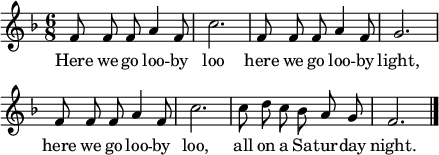
This is a modern children's version:
In popular culture
The chorus of Johnny Thunder's 1963 hit song "Loop de Loop" featuring The Bobbettes is taken almost in whole from this song. The name was used for a ragdoll character in Andy Pandy who was regularly introduced with the song.6
References
References
- Halliwell-Phillipps, James Orchard (1849). Popular Rhymes and Nursery Tales: A Sequel to the Nursery Rhymes of England. John Russell Smith. p. 129.
- Freeman, Laura (2011). Here We Go Looby Loo. Child's World. ISBN 9781609542917.
- Johnson, Charles Spurgeon; Carter, Elmer Anderson (1933). "Lyrics". Opportunity: A Journal of Negro Life. 11–12. National Urban League: 242.
- Reid, Rob (1999). Family Storytime: 24 Creative Programs for All Ages. American Library Association. p. 65. ISBN 9780838907511.
- LaRowe, Michelle (2010). A Mom's Ultimate Book of Lists 100+ Lists to Save You Time, Money, and Sanity. Baker Publishing Group. p. 124. ISBN 9781441212450.
- "Watch with Mother". televisionheaven.co.uk. Archived from the original on June 4, 2011. Retrieved April 12, 2011.