| Hepatica acutiloba | |
|---|---|
| |
Scientific classification 
| |
| Kingdom: | Plantae |
| Clade: | Embryophytes |
| Clade: | Tracheophytes |
| Clade: | Spermatophytes |
| Clade: | Angiosperms |
| Clade: | Eudicots |
| Order: | Ranunculales |
| Family: | Ranunculaceae |
| Genus: | Hepatica |
| Species: | H. acutiloba
|
| Binomial name | |
| Hepatica acutiloba DC.
| |
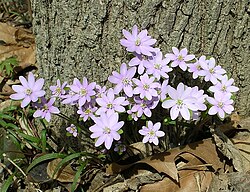
Hepatica acutiloba, the sharp-lobed hepatica, is a herbaceous flowering plant in the buttercup family Ranunculaceae. It is sometimes considered part of the genus Anemone, as Anemone acutiloba, A. hepatica, or A. nobilis.1
Each clump-forming plant grows 5 to 19 cm (2.0 to 7.5 in) tall, flowering in the early to mid spring. The flowers are greenish-white, white, purple or pinkish in color, with a rounded shape. After flowering the fruits are produced in small, rounded columned heads, on pedicels 1 to 4 mm long. When the fruits, called achenes, are ripe they are ovoid in shape, 3.5–4.7 mm long and 1.3–1.9 mm wide, slightly winged and tend to lack a beak.2
Hepatica acutiloba is native to central eastern North America where it can be found growing in deciduous open woods, most often in calcareous soils.2
Historical uses
Among the Cherokee Indians, the plant was formerly used to cure coughs, either in tea or by chewing its root.3
Gallery
-
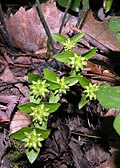 Fruiting H. acutiloba in Willsboro, New York
 -
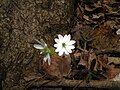 H. acutiloba in North Canaan, Connecticut
 -
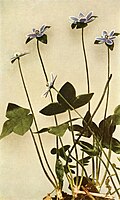 H. acutiloba plate in Wildflowers of New York (1918)
References
References
- "Hepatica acutiloba DC". Plants of the World Online. Royal Botanical Gardens Kew. Retrieved 15 December 2019.
- Dutton, Bryan E.; Keener, Carl S.; Ford, Bruce A. (1997). "Anemone acutiloba". In Flora of North America Editorial Committee (ed.). Flora of North America North of Mexico (FNA). Vol. 3. New York and Oxford: Oxford University Press. Retrieved 10 January 2021 – via eFloras.org, Missouri Botanical Garden, St. Louis, MO & Harvard University Herbaria, Cambridge, MA.
- Mooney, James (1891). "The Sacred Formulas of the Cherokees". Seventh Annual Report of the Bureau of Ethnology. Washington DC: Government Printing Office. pp. 301–398. OCLC 747738317., s.v. Selected List of Plants Used