  | |
| Observation data Epoch J2000.0 Equinox J2000.0 (ICRS) | |
|---|---|
| Constellation | Hydra1 |
| Right ascension | 08h 54m 17.9471s2 |
| Declination | −05° 26′ 04.054″2 |
| Apparent magnitude (V) | 6.003 |
| Characteristics | |
| Evolutionary stage | Main sequence2 |
| Spectral type | G2V4 |
| U−B color index | +0.225 |
| B−V color index | +0.675 |
| R−I color index | +0.215 |
| Astrometry | |
| Radial velocity (Rv) | 31.99±0.122 km/s |
| Proper motion (μ) | RA: −413.648 mas/yr2 Dec.: 30.619 mas/yr2 |
| Parallax (π) | 59.3595±0.0408 mas2 |
| Distance | 54.95 ± 0.04 ly (16.85 ± 0.01 pc) |
| Absolute magnitude (MV) | +4.811 |
| Details4 | |
| Mass | 1.053+0.056 −0.068 M☉ |
| Radius | 1.125+0.035 −0.011 R☉ |
| Surface gravity (log g) | 4.35±0.18 cgs |
| Temperature | 5,790±170 K |
| Metallicity [Fe/H] | 0.24±0.09 dex |
| Rotation | 15 days6 |
| Rotational velocity (v sin i) | 37 km/s |
| Age | 5.5+2.5 −2.1 Gyr |
| Other designations | |
| BD−04 2490, GC 12307, GJ 327, HD 76151, HIP 43726, HR 3538, SAO 136389, PPM 191823, LTT 3283, NLTT 205043 | |
| Database references | |
| SIMBAD | data |
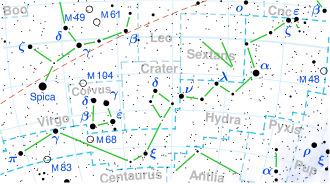
HD 76151 is a high proper motion, G-type main-sequence star and solar analog4 in the constellation of Hydra 54.95 light-years from Earth.2 It has an apparent visual magnitude of approximately 6.00, which means it is faintly visible to the naked eye under good viewing conditions.3 An infrared excess has been detected around this star, most likely indicating the presence of a circumstellar disk at a radius of 7.9 AU. The temperature of this dust is 99 K.8
HD 76151 has an age of roughly 5.5 billion years old, with estimates ranging from 3.4 to 9.6 billion years. The stellar atmosphere has an effective temperature of around 5,790 K (5,520 °C; 9,960 °F). The radius of HD 76151 is 1.125 solar radii (783,000 km) based on spectroscopic observations, though Gaia DR3 estimates a radius of 0.977 solar radii (680,000 km). It is slightly metal-rich and is a member of the thin disk population.4
References
References
- Anderson, E.; Francis, Ch. (2012). "XHIP: An extended hipparcos compilation". Astronomy Letters. 38 (5): 331. arXiv:1108.4971. Bibcode:2012AstL...38..331A. doi:10.1134/S1063773712050015. XHIP record for this object at VizieR.
- Vallenari, A.; et al. (Gaia collaboration) (2023). "Gaia Data Release 3. Summary of the content and survey properties". Astronomy and Astrophysics. 674: A1. arXiv:2208.00211. Bibcode:2023A&A...674A...1G. doi:10.1051/0004-6361/202243940. S2CID 244398875. Gaia DR3 record for this source at VizieR.
- "HD 76151". SIMBAD. Centre de données astronomiques de Strasbourg. Retrieved January 20, 2011.
- Senturk, S.; et al. (October 2024). "Near-Infrared Spectroscopy of the Sun and Solar Analog Star HD 76151: Compiling an Extensive Line List in Y-, J-, H-, and K-Bands". The Astrophysical Journal. 976 (2). id. 175. arXiv:2410.08270. Bibcode:2024ApJ...976..175S. doi:10.3847/1538-4357/ad85e4.
- HR 3538, database entry, The Bright Star Catalogue, 5th Revised Ed. (Preliminary Version), D. Hoffleit and W. H. Warren, Jr., CDS ID V/50. Accessed on line January 20, 2011.
- Maldonado, J.; et al. (October 2010), "A spectroscopy study of nearby late-type stars, possible members of stellar kinematic groups", Astronomy and Astrophysics, 521: A12, arXiv:1007.1132, Bibcode:2010A&A...521A..12M, doi:10.1051/0004-6361/201014948, S2CID 119209183
- HD 76151, database entry, The Geneva-Copenhagen Survey of Solar neighbourhood, J. Holmberg et al., 2007, CDS ID V/117A. Accessed on line January 20, 2011.
- Eiroa, C.; et al. (July 2013). "DUst around NEarby Stars. The survey observational results". Astronomy & Astrophysics. 555: A11. arXiv:1305.0155. Bibcode:2013A&A...555A..11E. doi:10.1051/0004-6361/201321050. S2CID 377244.