  | |
| Observation data Epoch J2000 Equinox ICRS | |
|---|---|
| Constellation | Phoenix1 |
| HD 142 A | |
| Right ascension | 00h 06m 19.17532s2 |
| Declination | −49° 04′ 30.6712″2 |
| Apparent magnitude (V) | 5.711±0.0033 |
| HD 142 B | |
| Right ascension | 00h 06m 19.14790s4 |
| Declination | −49° 04′ 34.9098″4 |
| Apparent magnitude (V) | +11.55 |
| Characteristics | |
| Evolutionary stage | main sequence |
| Spectral type | F7V6 + K8.5-M1.57 |
| B−V color index | 0.519±0.0118 |
| Astrometry | |
| HD 142 A | |
| Radial velocity (Rv) | +5.76±0.122 km/s |
| Proper motion (μ) | RA: +575.0992 mas/yr Dec.: −40.8742 mas/yr |
| Parallax (π) | 38.1945±0.0355 mas2 |
| Distance | 85.39 ± 0.08 ly (26.18 ± 0.02 pc) |
| HD 142 B | |
| Proper motion (μ) | RA: +566.9844 mas/yr Dec.: −17.3874 mas/yr |
| Parallax (π) | 38.2306±0.0349 mas4 |
| Distance | 85.31 ± 0.08 ly (26.16 ± 0.02 pc) |
| Details | |
| HD 142 A | |
| Mass | 1.25±0.019 M☉ |
| Radius | 1.41±0.1110 R☉ |
| Luminosity | 2.910 L☉ |
| Surface gravity (log g) | 4.45±0.079 cgs |
| Temperature | 6,349±269 K |
| Metallicity [Fe/H] | +0.133±0.0209 dex |
| Rotation | 27.15 days11 |
| Rotational velocity (v sin i) | 9.58±0.7412 km/s |
| Age | 2.50+0.32 −0.289 Gyr |
| HD 142 B | |
| Mass | 0.64313 M☉ |
| Radius | 0.42313 R☉ |
| Luminosity | 0.04613 L☉ |
| Surface gravity (log g) | 4.9913 cgs |
| Temperature | 4,11013 K |
| Other designations | |
| CD−49°14337, HD 142, HIP 522, WDS J00063-4905 | |
| HD 142A: HR 6, SAO 21496314 | |
| HD 142B: NLTT 218, 2MASS J00061919-490434815 | |
| Database references | |
| SIMBAD | A |
| B | |
| Exoplanet Archive | data |
| ARICNS | data |
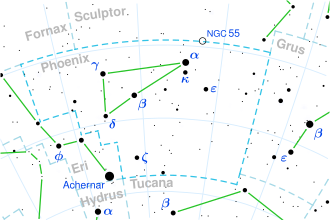
HD 142 is a wide binary star5 system in the southern constellation of Phoenix. The main component has a yellow-white hue and is dimly visible to the naked eye with an apparent visual magnitude of 5.7.3 The system is located at a distance of 85.5 light years from the Sun based on parallax measurements, and is drifting further away with a radial velocity of +6 km/s.16
The primary component is an F-type main-sequence star with a stellar classification of F7V,6 which indicates it is undergoing core hydrogen fusion. It is an estimated 2.5 billion years old9 and is spinning with a projected rotational velocity of 10 km/s.12 The star has 1.25 times the mass of the Sun9 and 1.4 times the Sun's radius. It is radiating 2.9 times the luminosity of the Sun from its photosphere10 at an effective temperature of 6,349 K.9
A magnitude 11.55 companion star was detected in 1894 making this a binary star system.17 The binary companion was confirmed to be gravitationally bound in 2007 and determined to be a red dwarf of spectral type K8.5-M1.57 with 54% of the Sun's mass.18 The pair have a projected separation of 120.6 AU.18
Planetary system
In 2001, the Anglo-Australian Planet Search team led by Chris Tinney announced the discovery of an extrasolar planet orbiting the primary star.1920 An additional linear trend in the radial velocity data was noticed in 200621 that could have been due to another planet or to the stellar companion.22 In 2012, additional measurements allowed the detection of a second planet. A third possible planet with a period of 108 days was seen in the data, but with a false alarm probability of five percent.23 Another paper by the same team updated the parameters for b and c but did not mention the possible planet d.24
An astrometric measurement of HD 142 b's inclination and true mass was published in 2022 as part of Gaia DR3.25 Another 2022 study determined the inclination and true mass of planet c, and confirmed the existence of planet d.26
| Companion (in order from star) |
Mass | Semimajor axis (AU) |
Orbital period (days) |
Eccentricity | Inclination (°) |
Radius |
|---|---|---|---|---|---|---|
| d | ≥0.260+0.032 −0.036 MJ |
0.474+0.021 −0.023 |
108.5±0.1 | 0.130+0.103 −0.085 |
— | — |
| b | 7.1±1.0 MJ | 1.039+0.046 −0.051 |
351.4±0.4 | 0.158+0.033 −0.030 |
59±7 | — |
| c | 10.901+1.278 −0.937 MJ |
9.811+0.515 −0.520 |
10,159.6+384.8 −321.9 |
0.277+0.026 −0.027 |
90.374+10.495 −12.319 |
— |
References
References
- Roman, Nancy G. (1987). "Identification of a Constellation From a Position". Publications of the Astronomical Society of the Pacific. 99 (617): 695–699. Bibcode:1987PASP...99..695R. doi:10.1086/132034. Vizier query form
- Vallenari, A.; et al. (Gaia collaboration) (2023). "Gaia Data Release 3. Summary of the content and survey properties". Astronomy and Astrophysics. 674: A1. arXiv:2208.00211. Bibcode:2023A&A...674A...1G. doi:10.1051/0004-6361/202243940. S2CID 244398875. Gaia DR3 record for this source at VizieR.
- Olsen, E. H. (1994). "Stroemgren photometry of F- and G-type stars brighter than V = 9.6. I. UVBY photometry". Astronomy and Astrophysics Supplement Series. 106: 257–266. Bibcode:1994A&AS..106..257O. Vizier catalog entry
- Vallenari, A.; et al. (Gaia collaboration) (2023). "Gaia Data Release 3. Summary of the content and survey properties". Astronomy and Astrophysics. 674: A1. arXiv:2208.00211. Bibcode:2023A&A...674A...1G. doi:10.1051/0004-6361/202243940. S2CID 244398875. Gaia DR3 record for this source at VizieR.
- Eggleton, P. P.; Tokovinin, A.A. (September 2008). "A catalogue of multiplicity among bright stellar systems". Monthly Notices of the Royal Astronomical Society. 389 (2): 869–879. arXiv:0806.2878. Bibcode:2008MNRAS.389..869E. doi:10.1111/j.1365-2966.2008.13596.x.
- Gray, R. O.; et al. (2006). "Contributions to the Nearby Stars (NStars) Project: Spectroscopy of Stars Earlier than M0 within 40 pc - The Southern Sample". The Astronomical Journal. 132 (1): 161–170. arXiv:astro-ph/0603770. Bibcode:2006AJ....132..161G. doi:10.1086/504637.
- Eggenberger, A.; et al. (2007). "The impact of stellar duplicity on planet occurrence and properties I. Observational results of a VLT/NACO search for stellar companions to 130 nearby stars with and without planets". Astronomy and Astrophysics. 474 (1): 273–291. Bibcode:2007A&A...474..273E. doi:10.1051/0004-6361:20077447.
- Anderson, E.; Francis, Ch. (2012). "XHIP: An extended hipparcos compilation". Astronomy Letters. 38 (5): 331. arXiv:1108.4971. Bibcode:2012AstL...38..331A. doi:10.1134/S1063773712050015. S2CID 119257644.
- Carvalho-Silva, Gabriela; Meléndez, Jorge; Rathsam, Anne; Shejeelammal, J.; Martos, Giulia; Lorenzo-Oliveira, Diego; Spina, Lorenzo; Ribeiro Alves, Débora (April 2025). "A New Age–Activity Relation For Solar Analogs that Accounts for Metallicity". The Astrophysical Journal Letters. 983 (2): L31. arXiv:2504.17482. Bibcode:2025ApJ...983L..31C. doi:10.3847/2041-8213/adc382. ISSN 2041-8205.
- Ghezzi, L.; et al. (September 2010). "Stellar Parameters and Metallicities of Stars Hosting Jovian and Neptunian Mass Planets: A Possible Dependence of Planetary Mass on Metallicity". The Astrophysical Journal. 720 (2): 1290–1302. arXiv:1007.2681. Bibcode:2010ApJ...720.1290G. doi:10.1088/0004-637X/720/2/1290.
- Oelkers, Ryan J.; Rodriguez, Joseph E.; Stassun, Keivan G.; Pepper, Joshua; Somers, Garrett; Kafka, Stella; Stevens, Daniel J.; Beatty, Thomas G.; Siverd, Robert J.; Lund, Michael B.; Kuhn, Rudolf B.; James, David; Gaudi, B. Scott (2018). "Variability Properties of Four Million Sources in the TESS Input Catalog Observed with the Kilodegree Extremely Little Telescope Survey". The Astronomical Journal. 155 (1): 39. arXiv:1711.03608. Bibcode:2018AJ....155...39O. doi:10.3847/1538-3881/aa9bf4.
- Soto, M. G.; Jenkins, J. S. (July 2018). "Spectroscopic Parameters and atmosphEric ChemIstriEs of Stars (SPECIES). I. Code description and dwarf stars catalogue". Astronomy & Astrophysics. 615: 28. arXiv:1801.09698. Bibcode:2018A&A...615A..76S. doi:10.1051/0004-6361/201731533. A76.
- Tuchow, Noah W.; Stark, Christopher C.; Mamajek, Eric (2024). "HPIC: The Habitable Worlds Observatory Preliminary Input Catalog". The Astronomical Journal. 167 (3): 139. Bibcode:2024AJ....167..139T. doi:10.3847/1538-3881/ad25ec.
- "HD 142". SIMBAD. Centre de données astronomiques de Strasbourg. Retrieved 2020-08-12.
- "HD 142B". SIMBAD. Centre de données astronomiques de Strasbourg. Retrieved 2020-08-12.
- Valenti, J. A.; Fischer, D. A. (2005). "Spectroscopic Properties of Cool Stars (SPOCS). I. 1040 F, G, and K Dwarfs from Keck, Lick, and AAT Planet Search Programs". The Astrophysical Journal Supplement Series. 159 (1): 141–166. Bibcode:2005ApJS..159..141V. doi:10.1086/430500.
- Raghavan, Deepak; et al. (2006). "Two Suns in The Sky: Stellar Multiplicity in Exoplanet Systems". The Astrophysical Journal. 646 (1): 523–542. arXiv:astro-ph/0603836. Bibcode:2006ApJ...646..523R. doi:10.1086/504823.
- Tokovinin, A.; Kiyaeva, O. (February 2016). "Eccentricity distribution of wide binaries". Monthly Notices of the Royal Astronomical Society. 456 (2): 2070–2079. arXiv:1512.00278. Bibcode:2016MNRAS.456.2070T. doi:10.1093/mnras/stv2825.
- "Astronomers close in on Solar System's 'siblings'" (Press release). Marsfield, New South Wales, Australia: Australian Astronomical Observatory. October 15, 2001. Archived from the original on August 22, 2016. Retrieved July 10, 2016.
- Tinney, C. G.; et al. (2002). "Two Extrasolar Planets from the Anglo-Australian Planet Search". The Astrophysical Journal. 571 (1): 528–531. arXiv:astro-ph/0111255. Bibcode:2002ApJ...571..528T. doi:10.1086/339916.
- Butler, R. P.; et al. (2006). "Catalog of Nearby Exoplanets". The Astrophysical Journal. 646 (1): 505–522. arXiv:astro-ph/0607493. Bibcode:2006ApJ...646..505B. doi:10.1086/504701.
- Wright, J. T.; et al. (2007). "Four New Exoplanets and Hints of Additional Substellar Companions to Exoplanet Host Stars". The Astrophysical Journal. 657 (1): 533–545. arXiv:astro-ph/0611658. Bibcode:2007ApJ...657..533W. doi:10.1086/510553.
- Wittenmyer, Robert A.; et al. (2012). "The Anglo-Australian Planet Search. XXII. Two New Multi-planet Systems". The Astrophysical Journal. 753 (2). 169. arXiv:1205.2765. Bibcode:2012ApJ...753..169W. doi:10.1088/0004-637X/753/2/169.
- Wittenmyer, Robert A.; et al. (2020). "Cool Jupiters greatly outnumber their toasty siblings: occurrence rates from the Anglo-Australian Planet Search". Monthly Notices of the Royal Astronomical Society. 492 (1): 377–383. arXiv:1912.01821. Bibcode:2020MNRAS.492..377W. doi:10.1093/mnras/stz3436.
- Gaia Collaboration; et al. (2023). "Gaia Data Release 3". Astronomy & Astrophysics. 674: A34. arXiv:2206.05595. Bibcode:2023A&A...674A..34G. doi:10.1051/0004-6361/202243782. S2CID 249626026.
- Feng, Fabo; Butler, R. Paul; et al. (August 2022). "3D Selection of 167 Substellar Companions to Nearby Stars". The Astrophysical Journal Supplement Series. 262 (21): 21. arXiv:2208.12720. Bibcode:2022ApJS..262...21F. doi:10.3847/1538-4365/ac7e57. S2CID 251864022.