| Observation data Epoch J2000 Equinox ICRS | |
|---|---|
| Constellation | Boötes |
| Right ascension | 14h 36m 00.56073s2 |
| Declination | +09° 44′ 47.4536″2 |
| Apparent magnitude (V) | 7.483 |
| Characteristics | |
| Spectral type | K3V4 |
| B−V color index | 0.973±0.0043 |
| Variable type | BY Dra5 |
| Astrometry | |
| Radial velocity (Rv) | −9.62±0.152 km/s |
| Proper motion (μ) | RA: 204.3602 mas/yr Dec.: −250.3902 mas/yr |
| Parallax (π) | 61.2111±0.0740 mas2 |
| Distance | 53.28 ± 0.06 ly (16.34 ± 0.02 pc) |
| Absolute magnitude (MV) | 6.393 |
| Details | |
| Mass | 0.826 M☉ |
| Radius | 0.78±0.012 R☉ |
| Luminosity | 0.308±0.0012 L☉ |
| Surface gravity (log g) | 4.586 cgs |
| Temperature | 4,863+46 −152 K |
| Metallicity [Fe/H] | 0.087 dex 0.126 dex |
| Rotational velocity (v sin i) | 5.66 km/s |
| Age | 0.5–1.0 Gyr8 6.356 Gyr |
| Other designations | |
| HN Boo, BD+10°2710, GC 19679, GJ 3860, HD 128311, HIP 71395, SAO 120554, LTT 14312, GSC 00910-001659 | |
| Database references | |
| SIMBAD | data |
| ARICNS | data |
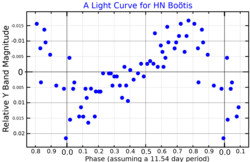
HD 128311 is a variable star in the northern constellation of Boötes. It has the variable star designation HN Boötis, while HD 128311 is the star's designation in the Henry Draper Catalogue. The star is invisible to the naked eye with an apparent visual magnitude that fluctuates around 7.48.3 It is located at a distance of 53 light years from the Sun based on parallax, but is drifting closer with a radial velocity of −9.6 km/s.2 Two confirmed extrasolar planets have been detected in orbit around this star.8
The stellar classification of HN Boo is K3V,4 which indicates this is a K-type main sequence star. Klaus G. Strassmeier et al. announced that the star's brightness varies, in the year 2000.1 It was given its variable star designation in 2006.10 It is a BY Draconis-type variable, randomly varying in brightness by 0.04 in magnitude over a period of 11.54 days5 due to star spots and high chromospheric activity. The star exhibits strong emission, which suggests an age of 0.5–1.0 billion years.8 It has 82% of the mass of the Sun and 78% of the Sun's radius. The metallicity of the star, meaning its abundance of heavier elements, appears slightly higher than in the Sun. It is radiating 31% of the luminosity of the Sun from its photosphere at an effective temperature of 4,863 K.6
Planetary system
| Companion (in order from star) |
Mass | Semimajor axis (AU) |
Orbital period (days) |
Eccentricity | Inclination (°) |
Radius |
|---|---|---|---|---|---|---|
| d (unconfirmed) | ≥0.133±0.00511 MJ | 0.092±0.00411 | 11.2210±0.000811 | 0.196±0.03011 | — | — |
| b | 1.9+0.7 −0.312 MJ |
1.09±0.0112 | 453.019±0.40411 | 0.30±0.0412 | 90+30 −4012 |
— |
| c | 3.4+0.6 −0.212 MJ |
1.75±0.0212 | 921.538±1.1511 | 0.19+0.05 −0.0712 |
70+40 −2012 |
— |
In 2002, the discovery of the exoplanet HD 128311 b was announced by Paul Butler.13 In 2005, the discovery of a second exoplanet HD 128311 c was announced by Steve Vogt.8
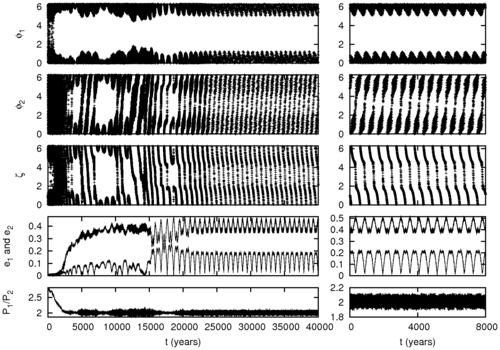
Most likely, the system has been formed in a very turbulent disc.7 The authors were able to show with both analytic and numerical models that certain libration modes are readily excited by turbulence. It was initially thought that the system could have been resulted from planet–planet scattering, but this is rather unlikely.
In 2014, the true mass of HD 128311 c was measured via astrometry. The same study also proposed a third planetary candidate, but it has not been confirmed.11 In 2026, the mass of HD 128311 b was also measured with astrometry.12
References
References
- Strassmeier, K. G.; Washuettl, A.; Granzer, Th.; Scheck, M.; Weber, M. (March 2000). "The Vienna-KPNO search for Doppler-imaging candidate stars". Astronomy & Astrophysics Supplement Series. 142 (2): 275–311. Bibcode:2000A&AS..142..275S. doi:10.1051/aas:2000328.
- Brown, A. G. A.; et al. (Gaia collaboration) (August 2018). "Gaia Data Release 2: Summary of the contents and survey properties". Astronomy & Astrophysics. 616. A1. arXiv:1804.09365. Bibcode:2018A&A...616A...1G. doi:10.1051/0004-6361/201833051. Gaia DR2 record for this source at VizieR.
- Anderson, E.; Francis, Ch. (2012). "XHIP: An extended hipparcos compilation". Astronomy Letters. 38 (5): 331. arXiv:1108.4971. Bibcode:2012AstL...38..331A. doi:10.1134/S1063773712050015. S2CID 119257644.
- Koen, C.; et al. (April 21, 2010). "UBV(RI)CJHK observations of Hipparcos-selected nearby stars". Monthly Notices of the Royal Astronomical Society. 403 (4): 1949–1968. Bibcode:2010MNRAS.403.1949K. doi:10.1111/j.1365-2966.2009.16182.x.
- Samus', N. N; Kazarovets, E. V; Durlevich, O. V; Kireeva, N. N; Pastukhova, E. N (2017). "General catalogue of variable stars: Version GCVS 5.1". Astronomy Reports. 61 (1): 80. Bibcode:2017ARep...61...80S. doi:10.1134/S1063772917010085. S2CID 125853869.
- Luck, R. Earle (January 2017). "Abundances in the Local Region II: F, G, and K Dwarfs and Subgiants". The Astronomical Journal. 153 (1): 19. arXiv:1611.02897. Bibcode:2017AJ....153...21L. doi:10.3847/1538-3881/153/1/21. S2CID 119511744. 21.
- Rein, Hanno; Papaloizou, J. C. B. (2009). "On the evolution of mean motion resonances through stochastic forcing: Fast and slow libration modes and the origin of HD128311". Astronomy and Astrophysics. 497 (2): 595–609. arXiv:0811.1813. Bibcode:2009A&A...497..595R. doi:10.1051/0004-6361/200811330. S2CID 12286814.
- Vogt, Steven S.; et al. (2005). "Five New Multicomponent Planetary Systems" (PDF). The Astrophysical Journal. 632 (1): 638–658. Bibcode:2005ApJ...632..638V. doi:10.1086/432901. S2CID 16509245.
- "HD 128311". SIMBAD. Centre de données astronomiques de Strasbourg. Retrieved 2021-04-06.
- Kazarovets, E. V.; Samus, N. N.; Durlevich, O. V.; Kireeva, N. N.; Pastukhova, E. N. (August 2006). "The 78th Name-List of Variable Stars" (PDF). Information Bulletin on Variable Stars. 5721: 1–45. Bibcode:2006IBVS.5721....1K. Retrieved 6 December 2024.
- McArthur, Barbara E.; et al. (2014). "Astrometry, Radial Velocity, and Photometry: The HD 128311 System Remixed with Data from HST, HET, and APT". The Astrophysical Journal. 795 (1): 41. Bibcode:2014ApJ...795...41M. doi:10.1088/0004-637X/795/1/41. hdl:2152/35199. S2CID 122980723.
- Van Zandt, Judah; Gilbert, Gregory J.; Petigura, Erik A.; Giacalone, Steven; Howard, Andrew W.; Handley, Luke B. (2026-04-02). "A Smooth Transition from Giant Planets to Brown Dwarfs from the Radial Occurrence Distribution". The Astronomical Journal. 171 (5): 267. doi:10.3847/1538-3881/ae5102. ISSN 0004-6256.
- Butler, R. Paul; et al. (2003). "Seven New Keck Planets Orbiting G and K Dwarfs". The Astrophysical Journal. 582 (1): 455–466. Bibcode:2003ApJ...582..455B. CiteSeerX 10.1.1.7.6988. doi:10.1086/344570. S2CID 17608922.
External links
External links
- "Notes for star HD 128311". Extrasolar Planets Encyclopaedia. Archived from the original on July 2, 2007. Retrieved 2008-08-18.
External links
- GJ 3860
- Extrasolar Planet Interactions Archived 2016-05-05 at the Wayback Machine by Rory Barnes & Richard Greenberg, Lunar and Planetary Lab, University of Arizona
- Image HD 128311